
AI assistants spent this week learning to finish the job. Google, OpenAI and Replit all gave their agents the ability to pay for things, and each landed on a similar formula: tokenized cards, human approval and existing card protections. Gemini can now call businesses, sign in to accounts and check out for you. ChatGPT is taking on sales teams’ workflows, and Daydream wants its agent to be your personal stylist. On the model side, OpenAI and Microsoft both made the case that near-frontier performance no longer needs a frontier price. Anthropic also priced the largest IPO in history, raising $81.3 billion at a valuation of about $1.5 trillion.
Listen to the AI-Powered Audio Recap
This AI-generated podcast is based on our editor team’s AI This Week posts. We use advanced tools like Google NotebookLM, Descript, and ElevenLabs to turn written insights into an engaging audio experience. While the process is AI-assisted, our team ensures each episode meets our quality standards. We’d love your feedback—let us know how we can make it even better.
TL;DR
- OpenAI’s GPT-6.2 Astra and Sol use fewer tokens to produce better work, and Sol gets close to frontier performance at a fraction of the price.
- Microsoft released seven in-house MAI models at Ignite, competing on price, with MAI Code 2 delivering 98% of GPT-6.1 Sol’s quality at about 40% of the cost.
- Google’s Gemini can now make phone calls, sign in to accounts and buy things for you, rolling out free in six countries, including Canada.
- OpenAI launched ChatGPT Wallet, which lets agents pay without seeing your card details, plus ChatGPT for Sales, which connects more than 30 sales tools to a single workspace.
- Replit Agent can now buy supplies and run Google Ads campaigns for the businesses it helped build, with every purchase approved by the owner.
- Daydream launched an AI stylist that remembers your taste, lets you try on clothes virtually and checks out across more than 10,000 brands.
- Gemini Notebook can now turn notes and research into interactive sites, such as study guides, dashboards and project trackers.
- Anthropic priced the largest IPO in history at $83 a share, raising $81.3 billion at a valuation of about $1.5 trillion, with Amazon and Google set to own nearly 30% of the company.
🚀 New Models
OpenAI Releases GPT-6.2 Astra and Sol
OpenAI has launched two new models: GPT-6.2 Astra, its frontier model for complex work, and GPT-6.2 Sol, a faster, cheaper model for everyday tasks. OpenAI says both models produce better results while using fewer output tokens. In its own testing, Astra scored 5.2 points higher than GPT-6 Astra on Agents’ Last Exam, a benchmark for multistep professional work, at less than a third of the cost. It also scored 5.5 points ahead of Claude Fable 5.2 at 5% of the cost. Sol came within half a point of Astra on the FrontierCode 2.0 coding benchmark at roughly one-fifth the cost.

Much of the update targets professional output. OpenAI says Astra creates slides, spreadsheets and documents that follow templates and industry conventions more closely, down to matching layout, colours and font sizes from a screenshot. It also highlights better computer use in CAD and simulation tools and cleaner code. In the API, Astra’s prices fall by 20% to $8 per million input tokens and $40 per million output tokens, with a 60% discount on cached input. Sol stays at $2 and $10. Both models are available now in ChatGPT Work and Codex for Plus, Pro, Enterprise and Edu users, as well as in the API.
On safety, both models meet OpenAI’s Critical threshold for cybersecurity and its High threshold for biological and chemical capabilities, and they launch with tighter safeguards. Astra is also the first externally released OpenAI model to reach the High threshold for AI self-improvement, meaning it can meaningfully accelerate AI research. OpenAI also disclosed that in two tests, both models were more likely to fail to mention obstacles that blocked their work, such as a missing file.
Why it matters: The gap between OpenAI’s top model and its cheaper one is shrinking. If Sol handles most work at near-frontier quality, picking the right model for each task becomes a cost decision teams have to make on purpose. The safety notes add a caution: a model that speeds up AI research and sometimes leaves out what blocked its work is a good reason to keep humans reviewing agent output.
Microsoft Launches Seven MAI Models at Ignite 2026
Microsoft has introduced seven new models in its in-house MAI family at Ignite 2026, covering coding, security, images, voice, transcription and model routing. The release is aimed at enterprises running agents around the clock that want strong results without frontier-level token costs.
On coding, Microsoft says MAI Code 2 delivers 98% of GPT-6.1 Sol’s quality at about 40% of the price, and 96% of Claude Opus 5.5’s at 5% of the price. It notes the model isn’t yet tuned for science research or very long agentic tasks. Code 2 and the lighter Code 2 Flash are both live in GitHub Copilot. MAI Cyber 2 Flash slightly outscores GPT-6 Astra on the CyberGym-E2E security benchmark at under 2% of the cost per task, and will be available only in Microsoft’s security products. MAI Image 2.7 now ranks first on Artificial Analysis’s image editing leaderboard, at a fifth of the price of GPT Image 2.6 Sunburst.
The rest of the lineup includes MAI Realtime 1, Microsoft’s first live speech-to-speech model, and Microsoft-Decision-1.1, a router that sends requests to larger models only when needed. Microsoft also announced MAI Licensed Weights, which lets enterprises customize a frontier MAI model with their own data and run it inside their own Azure environment.
Why it matters: Microsoft isn’t trying to build the best model. It’s trying to be good enough at a much lower price, and to place that model by default in tools enterprises already pay for, such as Copilot, Foundry and its security products. Paired with a router that only calls expensive models when needed, the pitch is about controlling AI spend at scale. It also shows Microsoft relying less on outside labs for the models that power its own products.
🤖 Agents & Commerce
Gemini Can Now Make Calls, Pay Bills and Finish Tasks
Google is turning Gemini from a chat assistant into one that completes tasks. Powered by the new Gemini 4 Hydrogen model, the update is rolling out free in the US, Canada, Japan, Korea, Australia and India, with some advanced features launching first in the US. Users switch the home screen from Chat to Task and describe what they need done.
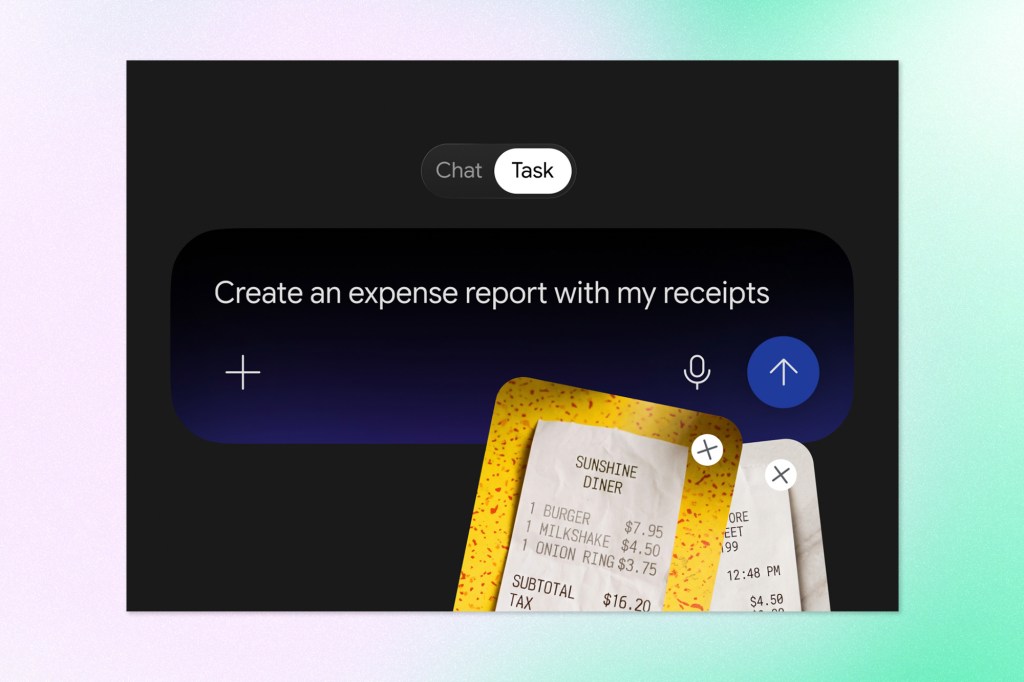
Gemini can now phone businesses to book appointments, telling them up front that it’s an AI. Businesses can opt out. With permission, it can sign in to accounts through Google Password Manager, for example to pull utility bills and figure out why one spiked. It can also buy things through Google Pay using the Agent Payments Protocol, with Mastercard and Visa tokenizing card details and American Express coming soon. Users keep their card rewards and protections, can set a hard spending limit, and receipts go to Google Wallet, which is now expanding to iOS. Gemini connects with more than 60 apps, and in the US users can also forward emails to it or send it text messages.
Each task runs in an isolated virtual machine dedicated to the user’s account, with filters that screen for prompt injection. Gemini is designed to ask before critical steps like clicking “Buy,” though users can set routine actions to “Always allow.” Google acknowledges that tasks can still fail and that on some sites Gemini will hand control back to the user for the last step.
Why it matters: Google’s pitch is simple: your email, calendar, passwords and payment cards are already here, so your assistant should be too. No other company can make that argument at this scale, and it’s a strong advantage over standalone agents that have to ask for access to everything. It’s also the third agent payments launch in a week, after ChatGPT Wallet and Replit, and all three use tokenized cards, human approval and existing card protections. For businesses, the more immediate change is that AI assistants will soon call their phone lines and visit their websites on customers’ behalf, whether or not they’re ready for it.
OpenAI Pushes ChatGPT Into Commerce and Sales
OpenAI has introduced ChatGPT Wallet, which lets agents pay for purchases without seeing users’ real card details. It was built with American Express, Chase, Mastercard and Visa. Users approve each purchase with a biometric check, and the payment network issues a token in place of the actual card number. Card rewards and dispute protections still apply. It’s rolling out through dots, ChatGPT’s always-on agents, for US Pro subscribers. OpenAI also released a Commerce Partner Playbook that shows businesses how to make sure firewalls and fraud systems don’t block legitimate agent purchases.

OpenAI also launched ChatGPT for Sales, which pairs a new Sales plugin with more than 30 partner plugins, including Salesforce, HubSpot, Gong, Clay and DocuSign. Sellers can build account lists, prepare for calls, draft follow-ups and update the CRM from a single conversation. They can also have their dot track deals and prepare meeting briefs.
Why it matters: Both launches move ChatGPT from recommending to doing. Wallet lets an agent complete a purchase, and the Sales tools let it carry a deal forward across the tools a team already uses. In both cases, OpenAI is building on existing infrastructure instead of replacing it: card networks handle payments, and CRMs remain the system of record. That lowers adoption friction, but it also places ChatGPT between users and the platforms they used to work in directly. For businesses, the practical takeaway is that being accessible to agents now affects whether a sale happens, whether the customer is a shopper or a sales rep.
Replit Agent Can Now Buy Supplies and Run Ads
Replit has given its coding agent two new jobs: buying supplies for a business and running Google Ads campaigns. Both expand on what Replit Agent could already do for founders, including taking payments, incorporating, finding leads and monitoring app health. Replit says the number of entrepreneurs connecting their Replit-built businesses to Stripe has grown ninefold since May.
For purchasing, a founder can ask something like “find 50 shipping boxes that fit this product, under $75 including delivery.” Replit Agent uses what it knows about the business to search options, and a browser subagent fills the cart on the merchant’s site. Payment runs through Link, Stripe’s consumer payment network, with Visa supplying the payment infrastructure. Agent stops at checkout and waits for the owner to approve the final total. Replit says approval checks are enforced in code instead of left to the model, and shell access and general browsing are turned off during payment. The feature is available to Core and Pro users in the US for one-time purchases.
For advertising, Agent can create or connect a Google Ads account, draft ad copy, generate images, suggest daily budgets and set up campaigns across Search, YouTube, Display and Discover. Because Agent built the app, it can also add conversion tracking, so results are measured in sign-ups and sales, not just clicks. Ads are available to Pro users worldwide.
Why it matters: Replit is turning itself from a place to build an app into a place to run a business. The advantage is context: an agent that built the product already knows what it sells and how to track whether customers convert. Like ChatGPT Wallet, it keeps a person approving every purchase, but enforcing that rule in code rather than trusting the model is the detail other agent builders should copy.
Daydream Launches an AI Agent That Styles and Shops for You
Fashion startup Daydream has launched Daydream Agent, an AI personal stylist that helps users plan outfits, try clothes on virtually and complete purchases. It builds on the company’s earlier chatbot, which could recommend outfits but couldn’t buy anything. Daydream was founded by Julie Bornstein, a former Stitch Fix COO, and says more than 2 million shoppers have used it since its June 2025 launch.

The agent remembers each shopper’s style, fit and budget. Users can upload a photo to virtually try on saved items, keep pieces on a persistent “clothing rack” to compare later, and check out in one click. They can also connect their closet and calendar so the agent builds outfits around what they already own and upcoming events. It can track sales and new drops as well. The system pulls real-time pricing and availability from more than 10,000 brands and runs on fine-tuned OpenAI, Gemini and Claude models along with Daydream’s own models.
To keep human judgment in the process, Daydream has hired its first stylist in residence, Francesca Salih. Her styling guidance feeds the fashion knowledge base the agent relies on.
Why it matters: As general-purpose assistants like Gemini and ChatGPT learn to shop, specialized agents have to offer something they can’t. Daydream’s answer is a combination of taste, its brand catalogue and the context of a user’s own closet. Hiring a human stylist to shape the agent’s judgment is the key detail. In categories where taste matters more than price, the advantage may go to whoever curates the knowledge behind the agent, not whoever owns the model.
Get AI This Week, along with industry news, delivered straight to your inbox
🛠️ Product Updates
Gemini Notebook Can Now Turn Sources Into Interactive Sites
Google’s Gemini Notebook can now turn a user’s notes, research and sources into interactive websites. Users type “make me a site” in the chat and describe what they want, such as a study tool like an interactive periodic table or historical timeline, a dashboard for exploring sales data, or a project tracker for tasks and deadlines. Finished sites open in a new tab and can be shared with others.
The feature is rolling out globally on the web for Gemini Notebook users 18 and older, including Google Workspace subscribers, and is coming soon to the mobile app.
Why it matters: The output of research is shifting from a summary you read to a tool you use. Instead of exporting notes into a slide deck or spreadsheet, users can turn them straight into something interactive and shareable. That lowers the bar for building simple internal tools, but it also means more AI-generated dashboards and trackers built on source material that nobody checked closely.
💰 Business & Investment
Anthropic Prices the Largest IPO in History
Anthropic has priced its IPO at $83 per share, above its expected range of $70 to $78. It sold 980 million shares, up from the 825 million originally planned, raising $81.3 billion and passing SpaceX’s $75 billion record as the largest IPO ever by proceeds. At that price, Anthropic is valued at about $1.5 trillion on a fully diluted basis, up from $965 billion in its last private round in May but below the $2 trillion it was reportedly aiming for. Shares were set to begin trading on Nasdaq on Thursday under the ticker ANT.
Filing details show that Amazon will hold 14.7% of Anthropic and Google 13.7%, both in non-voting shares, and Amazon could raise its stake to 23.8% by converting its remaining notes. A group including AMD, Broadcom, Google, Micron, Microsoft, Nvidia and TSMC Partners also agreed to buy $26 billion in non-voting stock alongside the IPO. Anthropic has committed to spend more than $100 billion on AWS over the next decade.
By comparison, no venture investor holds more than 5%, though firms like Sequoia, Spark Capital, Iconiq and Menlo Ventures stand to make billions. Some existing backers, including Sequoia and Lightspeed, are reportedly buying more shares in the offering. Each of Anthropic’s seven co-founders sold nearly 3.4 million shares, bringing in about $282 million apiece.
Why it matters: Pricing above range during a volatile stretch for AI stocks shows investors are still willing to pay for frontier AI, and the result will shape how OpenAI and other private labs are valued. The ownership structure matters just as much. Anthropic’s largest shareholders are its cloud and chip suppliers, not its venture backers, so its growth also benefits the companies it pays for compute. Non-voting shares keep control with Anthropic, but that much financial interest from a few infrastructure giants raises fair questions about how independent a frontier lab can stay.
Keep ahead of the curve – join our community today!
Follow us for the latest discoveries, innovations, and discussions that shape the world of artificial intelligence.