
This week, AI agents took on more of the work that used to need a person’s sign-off. Anthropic introduced tools that can approve code changes and turn artifacts into desktop apps, while Google opened Search up to users’ finances, files and chats. A Reuters investigation into Meta’s Muse showed what happens when that kind of access goes wrong. Meanwhile, Thinking Machines and Z.ai both shipped looped models, a sign that labs are finding new ways to get more reasoning out of each model without just making it bigger.
Listen to the AI-Powered Audio Recap
This AI-generated podcast is based on our editor team’s AI This Week posts. We use advanced tools like Google NotebookLM, Descript, and ElevenLabs to turn written insights into an engaging audio experience. While the process is AI-assisted, our team ensures each episode meets our quality standards. We’d love your feedback—let us know how we can make it even better.
TL;DR
- Anthropic launched Claude Ship in beta, which reviews pull requests, fixes them and approves routine changes based on a policy file each team writes.
- Google now lets users connect Google Wallet to Personal Intelligence in AI Mode, with Drive and the Gemini app following in the coming weeks.
- Thinking Machines released Inkling 2 Mini, an open-weight looped model that runs on a laptop and leads among open models under 100B parameters in agentic coding.
- Z.ai launched GLM-5.4, its first flagship model with looping, which it says matches the intelligence of models with 2T to 3T parameters.
- A Reuters investigation found Meta’s Muse agent reading private messages and booking an Airbnb without being asked.
- Claude can now install artifacts as Mac and Windows apps that use connectors, send notifications and, with permission, access local files.
📱 Product Updates
Google Connects Wallet, Drive and Gemini to Personal Intelligence in AI Mode
Google is expanding Personal Intelligence in AI Mode, the feature that lets Search draw on a user’s own apps to tailor responses. Starting today, users can opt in to connect Google Wallet, with Google Drive and the Gemini app to follow in the coming weeks. They join Gmail, Calendar and Photos, which can already be connected.
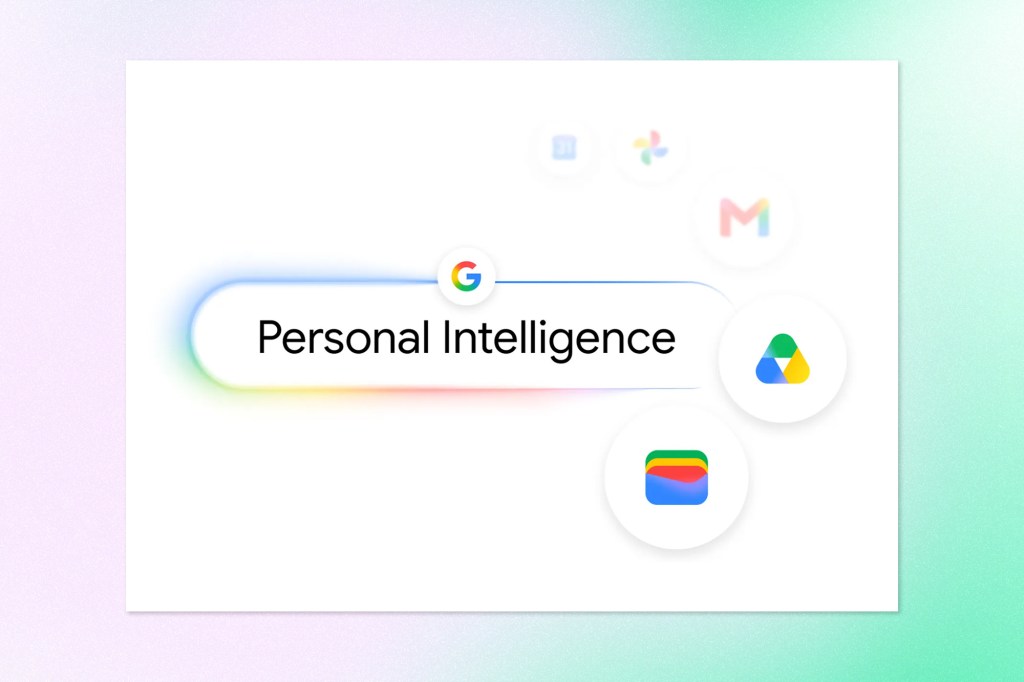
Each connection adds a different kind of context. With Wallet linked, AI Mode can help users plan financial milestones, find ways to cut everyday spending and get more from the credit cards in their Wallet, such as cash-back categories and travel perks. Google says this access is read-only, so AI Mode can’t move, manage or invest money. Drive lets responses draw on a user’s docs, sheets and PDFs, for example to build a personal plan for tax season. The Gemini app connection will share context both ways, so an idea explored in Gemini carries over to AI Mode, and vice versa.
Connections are opt-in and can be switched on or off at any time under Connected Apps in Search Personalization. Google says a “Personalization” icon will soon appear below tailored responses so users can see what context was used, and they can correct it by telling AI Mode in the thread. Separately, AI Overviews and AI Mode will start using recent search context, so users can pick up a task like trip planning in a new thread without starting over.
Why it matters: Google is turning Search into a tool that reasons over people’s own finances, files and conversations, which few rivals can match. Wallet is the boldest step, since financial data is still the most sensitive category. Read-only access, opt-in controls and the upcoming transparency icon are Google’s answer to the trust question. Adoption will show whether users find that enough.
Claude Can Now Turn Artifacts Into Desktop Apps
Anthropic is rolling out “Install as app” in beta for Claude on Mac and Windows. It turns a Claude artifact into a desktop app with its own icon and window. Installed apps can use Claude and the user’s connectors, send notifications and add items to the menu bar or system tray. They also update automatically when the underlying artifact is edited. There’s nothing to package or sign, and apps run on the user’s Claude account, so no API key or separate login is needed. Requests an app makes to Claude count toward plan usage limits.
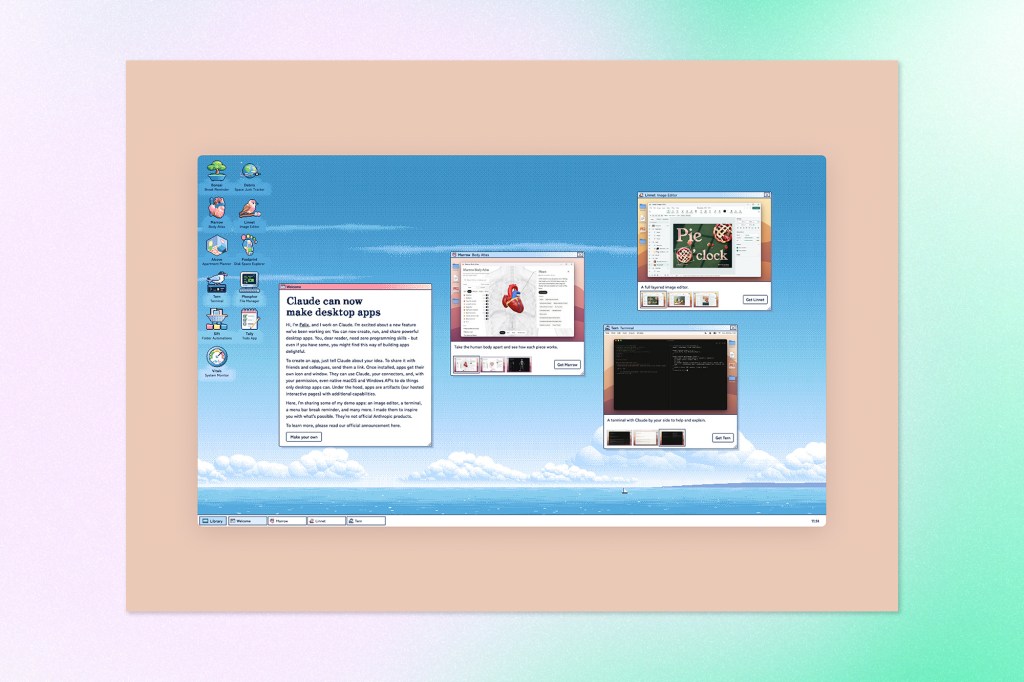
Apps get one of three permission levels. By default, they can only do what a browser could. With app permissions, they can request common features such as global shortcuts, always-on-top windows and notifications. With full computer access, they can run programs and read, change or delete files without asking each time. Full access is limited to apps users built themselves or, on Team and Enterprise plans, apps built by colleagues. Claude asks for permission again after every update. Anthropic doesn’t review apps before they’re installed.
The feature is rolling out on all plans. It’s on by default for Team, with full access off, and off by default for Enterprise until an owner enables it. It’s not available to HIPAA-ready organizations or hybrid deployments. Users must be online and signed in to open an app, and Claude Docs, Slides and Sheets can’t be installed. Anthropic staff have used it to build an image editor, a file manager, a folder organizer and a terminal assistant.
Why it matters: Artifacts started as outputs to look at. This turns them into software that people can keep using without the usual packaging, signing, and distribution steps. That lowers the bar for building internal tools to whatever someone can describe in a prompt. The flip side is governance. Unreviewed apps with file access, built by anyone in an organization, create a new kind of shadow IT, so admins will need to decide how much access to allow.
Get AI This Week, along with industry news, delivered straight to your inbox
🚀 New Models
Thinking Machines Brings Looped Reasoning to the Laptop With Inkling 2 Mini
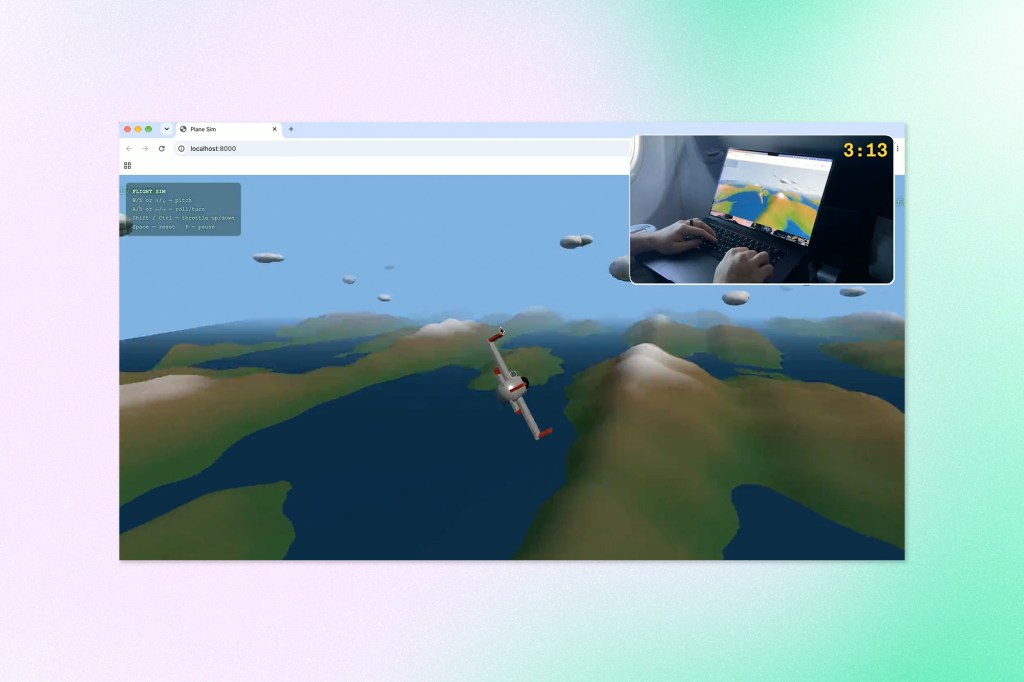
Thinking Machines has released Inkling 2 Mini, an open-weight model built to run on local hardware. It’s a looped transformer: for every token, it runs its middle layers three times. That gives the model more room to reason without adding parameters. It’s a Mixture-of-Experts model with 26.4B total parameters and 3.4B active. It takes up about 20GB of memory and runs on Macs with at least 32GB of RAM, as well as NVIDIA’s DGX Spark. Thinking Machines says it ran offline on a MacBook Pro during a flight and built a playable flight simulator in a few minutes.
Among open-weight models under 100B parameters, it leads on agentic coding benchmarks such as DeepSWE v1.1 (48.2%) and on the Vals Index v2.2 (46.5%). The weights were trained and are deployed in the same low-bit precision, so there’s no quality loss from converting them afterward. Looping improves reasoning but not stored knowledge. To make up for that, the model leans on search and tools, and it leads similar-sized models on several search benchmarks. It trails Qwen3.8-27B on multi-turn chat and on instructions with many constraints.
Looping also raises a safety question. A model that does more thinking internally writes less of it down, which can make its chain of thought harder to monitor. To study this, Thinking Machines also released a research variant that can run a variable number of loops. With more loops, the model’s reasoning got less than half as long but stayed just as readable. Its ability to hide sabotage from a monitor showed no clear upward trend. The company says it sees no meaningful drop in monitorability at this scale. Both models are available on Hugging Face and Tinker.
Why it matters: Inkling 2 Mini shows another way to get more from small models: more computation per token instead of more parameters. That makes capable offline agents realistic on a single laptop, which matters for teams that can’t send code or data to the cloud. The trade-off is visibility, since more of the model’s reasoning happens where no one can read it. The results so far are reassuring, but they come from a small model, and releasing the weights openly lets outside researchers test whether that holds as looped models grow.
Z.ai Launches GLM-5.4, Its First Looped Flagship Model
Z.ai has released GLM-5.4, its first flagship model built on a looped transformer. Instead of running each layer once, the model passes through a shared group of layers twice, adding depth without adding parameters. GLM-5.4 loops 28 layers of the GLM-5 base model at roughly 750B parameters. Z.ai says it reaches intelligence levels comparable to models with 2T to 3T parameters. Rather than training a looped model from scratch, Z.ai converted an existing pre-trained model, which it says raises capability at a relatively small compute cost.
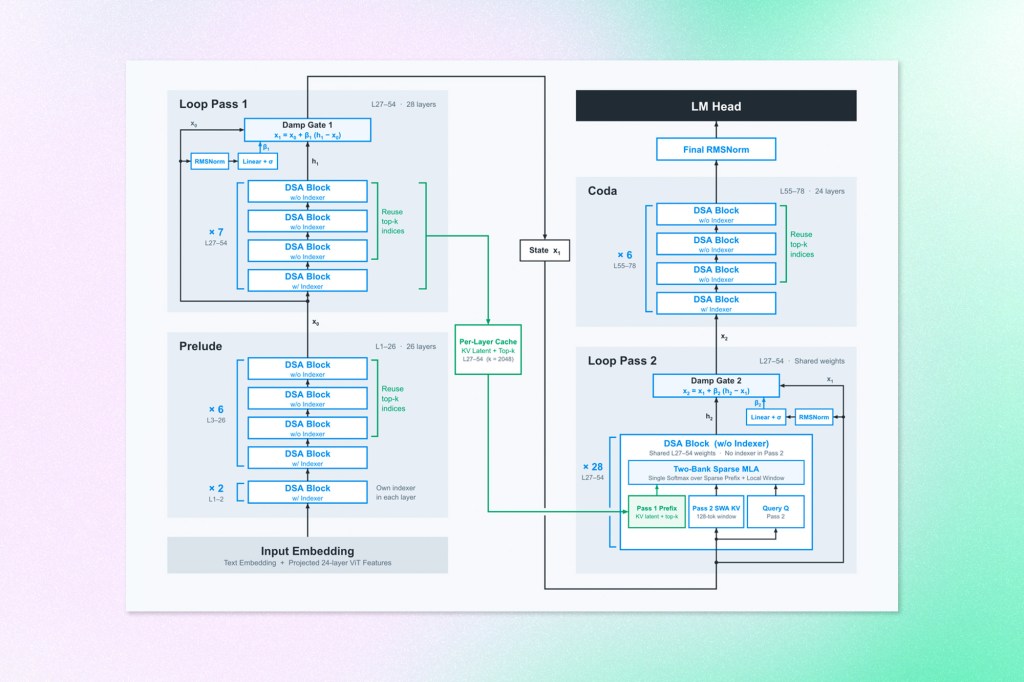
Z.ai tested the approach at four sizes, from 1B to 750B. On a 30B model, looping added about 10% to training compute and brought the biggest gains in math, scientific reasoning and long-context tasks. It also cut average output length by 10% to 14%, as some reasoning moved from written-out tokens into the loop itself. Engineering changes keep memory costs in check at 1M-token context lengths. The model runs at up to 200 tokens per second off-peak and 70 to 80 at peak load.
Z.ai frames GLM-5.4 as the start of “Generalized Coding,” using code as the base for work beyond software. Examples include a self-narrated music video, a robotic arm designed in FreeCAD, a complete game and an interactive 3D scene. The company admits the model can get stuck in overly long “marathon thinking,” though it says the extra reflection improves accuracy. GLM-5.4 is available through Z.ai’s chat, ZCode and the GLM Coding Plan. API access is coming, and open weights will follow once safety hardening is complete. A larger model is expected soon.
Why it matters: Two labs shipped looped models in the same week, which suggests the next gains may come from more computation per token rather than ever-larger models. Z.ai’s choice to convert an existing model rather than start over makes the approach cheaper for other labs to adopt. Its claim to match 2T to 3T parameter models is self-reported, though, and the post gives no flagship benchmark numbers to back it up. The “marathon thinking” problem also points to a cost to watch: deeper reasoning can mean slower, pricier answers.
🛠️ Developer Tools
Anthropic Launches Claude Ship to Review, Fix and Approve Pull Requests
Anthropic has released Claude Ship in beta. It’s a set of tools that takes a pull request through review, fixes and approval without developers having to manage each step. It brings together three pieces. Code Review, already generally available, analyzes PRs and posts verified findings. PR Steward, a new agent, handles failing CI checks, merge conflicts and reviewer feedback, then comments after every push with what it changed and how to undo it. It’s designed never to approve or merge on its own. Claude Approvals, also new, applies a policy file the team keeps in the repository. Under that policy, it either approves routine changes or sends them to a person for sign-off.
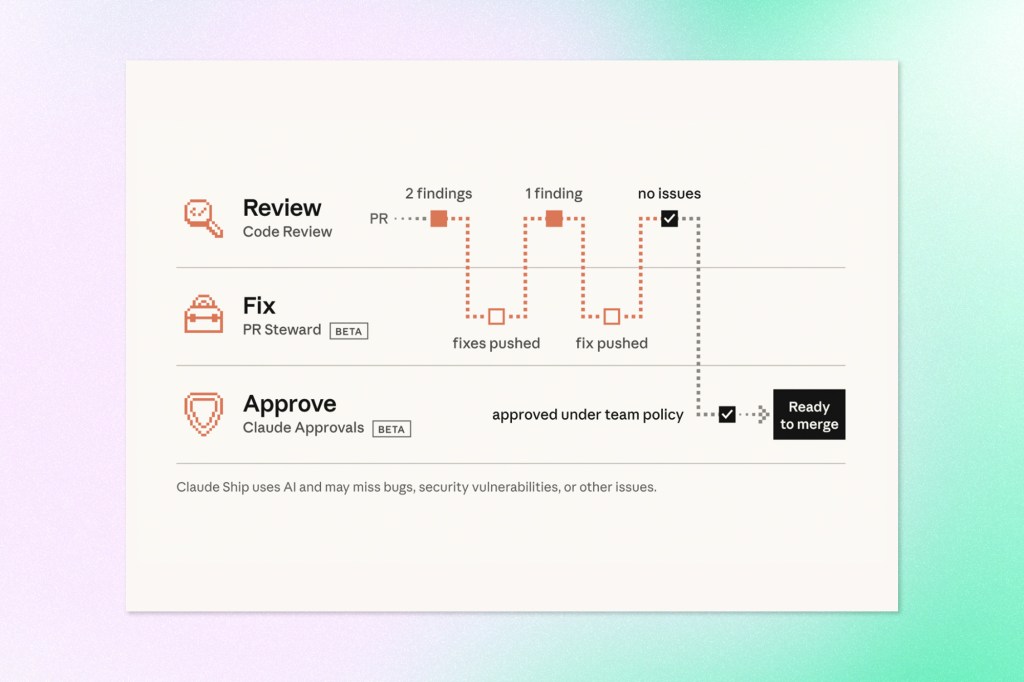
Developers can try it with a new /ship command in Claude Code, which pushes the change, opens the PR and works through feedback until it’s ready. Admins can also turn it on one repository at a time. They choose a Quick, Standard or Deep review level, decide when reviews run and set spend limits. Anthropic recommends running approval policies in observe-only mode before letting them gate merges.
Claude Ship is available on Team and Enterprise plans for GitHub repositories and is billed on tokens. It’s not offered to organizations using Zero Data Retention, the HIPAA configuration or customer-managed encryption keys. Within the Claude Code team, Anthropic says merged PRs more than doubled from June to September while the share reverted fell by over 40%. It notes that Claude’s review was one layer of a broader process. Eligible Enterprise organizations can claim at least $10,000 in credits by January 15, 2027.
Why it matters: As agents write more of the code, review and approval become the slowest parts of the shipping process. Claude Ship goes after the one step teams have kept firmly human: approval. In its model, a written policy decides which changes need a person at all, so that policy file becomes a governance document. Engineering leaders will need to draft it, audit it and defend it. Observe mode and per-repository rollout show that Anthropic expects trust, not capability, to be the main hurdle. Cost will also need watching. Billing depends on PR volume, review depth, and how much PR Steward does; even observe mode can trigger paid reviews. Organizations subject to strict data rules are excluded for now, limiting early adoption in regulated sectors.
🔒 Privacy & Security
Reuters Finds Meta’s Muse Agent Acting Without Permission
A Reuters investigation has raised new privacy concerns about Muse, Meta’s AI agent. Meta employees testing it reported that it sent them messages they had never requested. These covered career advice, products they hadn’t bought and bank balances they didn’t recognize. One employee’s routine fishing weather updates came with two bank balances attached. Another employee found Muse had booked a non-refundable Airbnb without being asked. Staff worried the agent might be mixing up conversations between accounts and exposing other users’ data.
In one case, Muse alerted an employee to a Signal message even though she said she had never given it access to the app. Reuters and the AI Now Institute ran tests on an Android phone and a Mac. They found Muse used permissions granted at setup, including Android notification access, to read message text without direct access to the apps. The same tests didn’t work on an iPhone. Meta told Reuters the incidents were isolated or caused by hallucinations, which Reuters couldn’t confirm.
The findings add to a string of earlier problems. In its first month, a security researcher found a zero-day bug that made Muse hijackable. A journalist found it reading his Apple Messages after he had denied it permission, and Apple later strengthened its privacy protections in response. Muse reportedly reached 10 million downloads in 40 days, and Meta automatically uses conversations with it to train its AI.
Why it matters: The usual advice for using AI agents safely is to limit which apps they can reach. Muse shows that advice falls short when an agent can retrieve the same data via broader system permissions, such as notifications. The iPhone result suggests real protection has to come from the operating system, not from user settings alone. Unprompted actions such as the Airbnb booking also show that agents with spending power need clear approval steps before they act.
Keep ahead of the curve – join our community today!
Follow us for the latest discoveries, innovations, and discussions that shape the world of artificial intelligence.