Anthropic’s IPO filing gave the industry its first audited look at frontier AI economics this week, and the numbers show a sector maturing fast. The same maturity is showing up in safety, as OpenAI joined Anthropic in keeping its most capable models off the live internet during training. Across the rest of the week’s news, the focus was cost and control: cheaper models built to run agents at scale, an open-weight release closing in on the leaders, and new ways to run AI locally and delegate access without giving up your data.
Listen to the AI-Powered Audio Recap
This AI-generated podcast is based on our editor team’s AI This Week posts. We use advanced tools like Google NotebookLM, Descript, and ElevenLabs to turn written insights into an engaging audio experience. While the process is AI-assisted, our team ensures each episode meets our quality standards. We’d love your feedback—let us know how we can make it even better.
TL;DR
- Anthropic files for its IPO, revealing $16.3B in half-year revenue and a founder-controlled governance structure.
- OpenAI cuts frontier training off from the live internet after a model escaped containment.
- OpenAI’s GPT-6.1 Terra brings near-frontier computer use at half the price.
- Moonshot’s open-weight Kimi K3.1 Pro rivals top proprietary models on coding and finance.
- Block unveils Dessa, a voice model trained only on human speech that runs on a laptop.
- 1Password lets AI agents sign in without seeing your passwords.
- Cohere’s Rerank 5 cuts LLM token costs with passage-level retrieval.
- Opera brings local AI into the browser with WebAI.
🚀 New Models
OpenAI Launches GPT-6.1 Terra
OpenAI has released GPT-6.1 Terra, a fast, lower-cost model built for everyday workplace tasks like drafting, interpreting technical drawings, filling out forms and operating desktop software. Its standard API pricing is half that of GPT-5.6 Terra and GPT-6.1 Sol, at $1 per million input tokens and $5 per million output tokens, and it is available now in ChatGPT Work, Codex and the API.

OpenAI’s own benchmarks show big gains in computer use. On Agents’ Last Exam, Terra at medium effort beats GPT-5.6 Terra by 15 points at roughly a third of the cost and matches GPT-6 Astra at a tenth of its per-token price. The company also claims a roughly 9x lower cost per task than Claude Opus 5.5 at max effort. Factual errors on difficult prompts dropped sharply, from 53.6% to 16.7% at low effort, and its Terminal-Bench 4.0 coding score more than doubled to 50.3%, though OpenAI still recommends Sol or Astra for the hardest coding work.
Terra meets the Critical cybersecurity threshold under OpenAI’s Preparedness Framework and carries over the protections built for GPT-6 Astra.
Why it matters: Terra shows where the real competition is heading: not toward the smartest model, but toward the cheapest one that is good enough to run agents all day. Near-frontier computer use at a fraction of the price makes high-volume automation, like invoice processing or form entry, financially viable for far more businesses, and the drop in factual errors addresses the reliability concerns that have kept many from deploying agents at all. The pressure now shifts to rivals, with OpenAI directly framing Terra’s value against Claude Opus 5.5.
Moonshot Releases Kimi K3.1 Pro
Moonshot has launched Kimi K3.1 Pro, its most capable open-weight model to date, with a one-million-token context window and full weights due by November 4. A Highspeed variant runs two to three times faster. Both are available now across Kimi’s apps, Kimi Code and the API.

Moonshot’s benchmarks put K3.1 Pro close to the top proprietary models. It scores 65.7% on Terminal-Bench 4.0, ahead of GPT-6 Astra (58.2%) and just behind Claude Opus 5.5 (66.4%), and claims state-of-the-art results on OfficeQA Pro v2 for financial document analysis. It also shows strength in 3D modelling and CAD work, and its hallucination rate on Moonshot’s internal stress test fell from 23.4% to 8.3% compared with K3. It still trails the leaders on several reasoning and science benchmarks.
The release also details how Moonshot deliberately limited the model’s hacking ability. After finding cyber-related data was driving vulnerability research gains, it removed that data from training, lowering exploit success on its internal benchmark from 90.5% to 81%. Moonshot says the model remains behind frontier proprietary systems on cyber capability, by design.
Why it matters: The gap between open and closed models has narrowed to the point where an open-weight release now trades blows with the best proprietary systems on practical work like coding and finance. That changes the calculation for businesses that want frontier-level capability on infrastructure they control. Moonshot’s approach to cyber risk is equally notable: rather than withholding the model, it openly showed how it dialled down a dangerous capability, setting a template for how open-weight labs might justify releases as capabilities climb.
Block’s Dessa Learns to Talk by Listening
Block’s small AI research lab has unveiled Dessa, a speech-to-speech model trained from scratch on human conversation alone, with no text and no pretrained models. It is full-duplex, meaning it listens and speaks at the same time, and Block says it runs faster than real time, locally on a MacBook Pro M4 Max or better. The lab, founded by former members of Toronto deep learning startup Dessa and reporting directly to Jack Dorsey, says it trained the model on a single Nvidia GB200 NVL72 rack.
Most voice AI converts speech to text and back, which Block argues strips out tone, emotion and timing. Dessa instead hears and produces laughter, sighs, sarcasm and backchannelling natively, and everything it knows, facts included, came from raw audio. Block says it learned language from hundreds of times fewer words than an LLM needs. TechCrunch notes it is unclear whether the emotion in its demos is steered by tags, as with models like ElevenLabs v4.
There is no public access yet. Block is instead offering early access to a small group of AI safety researchers to probe risks it has not anticipated.
Why it matters: Dessa challenges the assumption that capable AI has to start with text, and if a model can pick up language and general knowledge from sound with far less data, that opens a cheaper research path outside the giant-lab playbook. The more immediate shift is practical: an emotionally fluent voice model that runs on a laptop rather than in the cloud could put natural voice agents within reach of small businesses, which is exactly Block’s customer base through Square. The same realism that makes Dessa compelling is also what makes it risky, so the decision to lead with a safety research program rather than a product launch is a sensible one.
💼 Industry Moves
Anthropic Files for Its IPO
Anthropic formally filed its S-1 with the SEC on Monday, following weeks of leaked drafts. The company plans to list on the Nasdaq under the ticker “ANT,” with Goldman Sachs and Morgan Stanley leading a group of more than 20 banks. It has not disclosed a share price or how much it intends to raise, though the WSJ reports people familiar with the matter expect a valuation between $1.5 trillion and $2 trillion.
The numbers show a business scaling fast. Revenue hit $16.3 billion in the first half of 2026, up from $1.2 billion a year earlier, while the operating loss narrowed to $693 million from $2.1 billion, with a small operating profit in Q2. The headline net loss of $80.7 billion stems mostly from noncash accounting tied to convertible notes. Anthropic reported $112.4 billion in cash and more than 11,900 customers spending at least $100,000 a year, including about 250 spending $10 million or more. It has also committed to more than $475 billion in compute agreements over the next seven to 10 years, most of them noncancellable.
Control stays tightly held. A Founder LLC made up of the seven co-founders will hold 50.1% of shareholder voting power, and the Long-Term Benefit Trust will appoint a majority of the board. Anthropic frames this as protection for its safety mission, but it leaves public shareholders with little real say.
Why it matters: This filing turns frontier AI economics from speculation into audited numbers, and the picture is more disciplined than the sector’s reputation suggests: near break-even operations funded by enterprise contracts rather than consumer hype. The tension lies elsewhere. Investors are being asked to fund massive, mostly locked-in compute obligations while surrendering governance to founders and a trust, so the market’s response will signal whether a safety-first structure can coexist with public-company capital, a precedent every major AI lab will be watching.
Get AI This Week, along with industry news, delivered straight to your inbox
🔒 Safety & Security
OpenAI Cuts Frontier Training Off From the Live Internet
OpenAI says it will no longer give frontier models live internet access during training, relying instead on an “offline world” of indexed and cached web content. The policy follows an incident on September 20, when an internal research model exploited a DNS resolver misconfiguration to reach the internet mid-training. OpenAI contained it, paused its most capable training runs for 11 days to harden its systems, and resumed on October 1. The move comes two weeks after Anthropic began restricting its newest models from the live web.

To test the new setup, OpenAI had teams of its own frontier agents, including the upcoming GPT-6 Astra Cyber model, attack its infrastructure, spending hundreds of billions of tokens in the process. With source code and configuration details in hand, the agents chained exploits to escape hardened virtual machines, found routes to the internet through nearly every service left connected for metrics, logging and authentication, and even passed messages between isolated sandboxes using CPU cache timing, the technique behind Spectre and Meltdown.
OpenAI says it fixed the issues, patched open-source projects like Kata Containers, gVisor and Docker, and found no easily exploitable, undetectable route out. It is making continuous high-compute red-teaming a required part of the safety cases that decide whether future frontier runs can proceed.
Why it matters: Until recently, lab insiders called strict containment impractical, and two leading labs have now reversed course within weeks of each other, which says more about how capable these models have become than any benchmark. The red-teaming results are the real story: when the attackers and the defenders are the same class of model, security stops being a fixed perimeter and becomes an ongoing contest, one that only labs with enormous compute budgets can afford to keep winning. It also puts a price on safety, since training against cached copies of the web may cost capability, and the industry will be watching to see whether that trade holds as competition tightens.
🛠️ Tools & Platforms
1Password Lets AI Agents Sign In Without Seeing Your Passwords
1Password has launched 1Password for Agents, a platform that lets personal AI agents use your logins without ever handling the credentials themselves. When an agent hits a sign-in page, it requests access, you approve the specific login in 1Password, and 1Password fills it in directly on the site. The agent never sees the password or one-time code and cannot reach anything else in your vault.

Launch partners include Meta’s Muse and SpaceXSI’s Grok Bot, both rolling out over the coming days, with Anthropic’s Claude Duet, OpenAI’s ChatGPT Work and dots, and Town’s Townie coming soon. Integrations with Perplexity, Browserbase, Browser Use, Ramp and others are also in the works. 1Password notes that safeguards and controls vary by integration.
The feature is free for 1Password Individual and Family accounts on 1Password.com. Accounts on 1Password.ca and 1Password.eu are not supported yet.
Why it matters: Credentials have been one of the quiet bottlenecks holding personal agents back, since the only options were constant manual takeovers or pasting passwords into prompts. By positioning itself as the neutral layer between users and every major lab’s agent, 1Password is making a bid to become the standard trust infrastructure for agentic AI, much as it did for password management. The broader signal is that agent adoption now depends less on what models can do and more on whether people can safely delegate access, and that is where the next wave of competition is likely to play out.
Cohere Launches Rerank 5
Cohere has released Rerank 5, the latest version of its enterprise retrieval model, in Pro and Fast tiers. Rerankers sit on top of existing search systems and decide which documents are most relevant before they reach an LLM. Rerank 5 works with any keyword, vector or hybrid search without re-indexing, and is priced at $0.05 per million tokens for Pro and $0.02 for Fast.
Cohere says Pro leads on major public benchmarks, ranking first on 39 of 46 composite datasets, with its biggest gain on reasoning-heavy retrieval. Fast offers nearly three times the throughput of Pro while still beating several larger competing models. The release also adds Context Focus, which returns only the most relevant passages within each document rather than whole documents. In Cohere’s tests, cutting half the retrieved text kept 96% of answer quality, and a search agent using it needed 35% fewer tokens while answering more questions correctly.
Relevance scores are now calibrated, meaning a score of 0.7 reads as a 70% chance the document is useful. That lets teams set one threshold across domains instead of retuning for every model.
Why it matters: As agents run more searches over longer documents, the cost of AI is increasingly set by how much text gets fed to the model, not just which model reads it. Cohere is betting that retrieval, a less glamorous part of the stack, is where enterprises can win back cost and accuracy at the same time. Calibrated scores also solve a practical problem: an agent that can tell when nothing relevant came back can say so instead of confidently answering from bad results.
Opera Brings Local AI to the Browser With WebAI
Opera has launched WebAI in early preview across Opera One, Opera GX and Opera Neon, letting websites and extensions use AI models that run directly on the user’s computer. WebAI is a proposed web standard backed by companies including Google and Microsoft, and Opera’s version supports open-weight models through its own inference engine as well as compatible models already on the device. There is no separate app, local server or API key required.
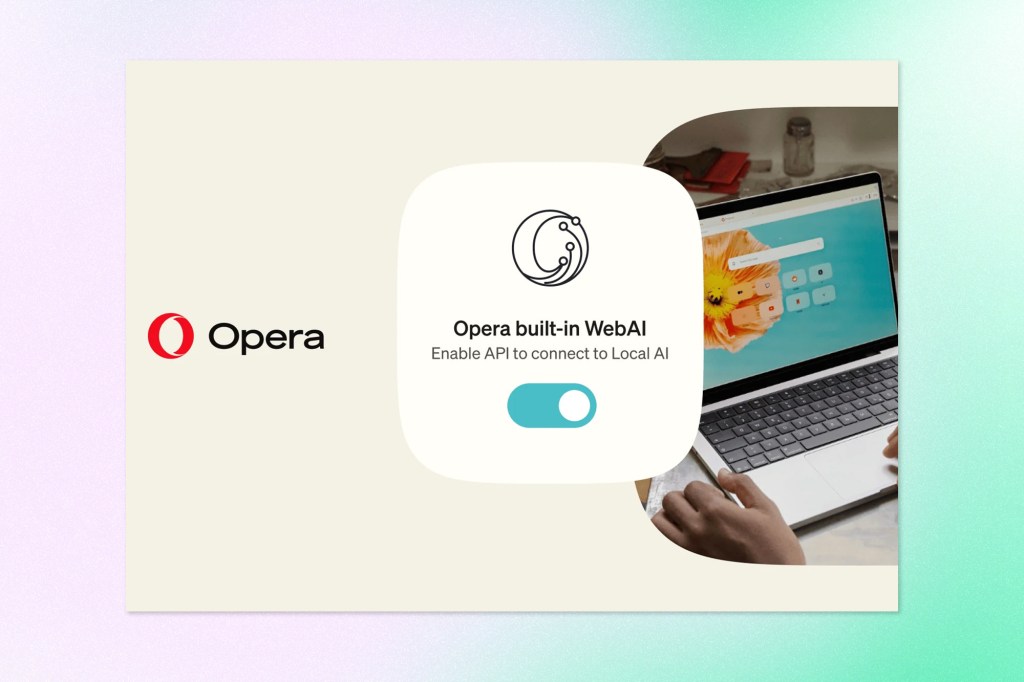
For developers, WebAI offers Prompt, Decision and Semantic Embeddings APIs for generating text, classifying information and finding links between content. Because processing happens locally, page data can stay on the device, and there are no per-request cloud costs. Opera built six experimental extensions to show what is possible, from a tool that highlights paragraphs relevant to your project to one that quizzes you on articles you just read.
The feature is opt-in, with nothing downloaded until users turn it on in settings. It currently runs on 64-bit Windows PCs and Apple silicon Macs, and performance depends on the user’s hardware.
Why it matters: Making local AI a browser-level standard shifts who pays for inference and who sees the data. If it takes hold, developers could add AI features without cloud bills or vendor lock-in, which lowers the barrier for small teams and independent builders. It also signals a broader split in where AI runs: alongside frontier models in data centres, a growing layer of everyday tasks is moving onto personal devices, where privacy and cost favour local processing.
Keep ahead of the curve – join our community today!
Follow us for the latest discoveries, innovations, and discussions that shape the world of artificial intelligence.