
Three of the biggest AI labs shipped frontier models within days of each other, and each one is betting on something different. Meta wants an agent that remembers your life, Google wants a model that does your hardest work, and OpenAI wants ChatGPT to build the interface around your question. Meanwhile, Google gave enterprise agents their own email addresses and calendars, and American Express published a framework for proving what you actually asked an agent to buy. Agents already act on our behalf, and this week the focus shifted to the rules around them: whose authority they carry, what they are allowed to touch and who answers for their mistakes. Closer to home, Google.org is funding a national network of cyber clinics to help Canadian non-profits keep up with AI-powered threats.
Listen to the AI-Powered Audio Recap
This AI-generated podcast is based on our editor team’s AI This Week posts. We use advanced tools like Google NotebookLM, Descript, and ElevenLabs to turn written insights into an engaging audio experience. While the process is AI-assisted, our team ensures each episode meets our quality standards. We’d love your feedback—let us know how we can make it even better.
TL;DR
- Meta launched Muse Wonder and Muse Wonder Full, models built for personal agents with persistent memory and sustained focus on complex tasks.
- Google released Gemini 4 Argon globally, with first place on the Vals Index, a 1M-token limit, and introductory pricing of $2 per million input tokens.
- OpenAI rolled out GPT-6 to all ChatGPT users, introducing Intelligent UI for interactive answers and faster responses that start while the model is still reasoning.
- Google Cloud introduced the Gemini agent, including coworker agents with their own Workspace accounts, identities and audit trails, plus support for Claude models.
- Google.org committed $3.5 million to launch Cyber Clinics Canada, training students to provide free cybersecurity help to community organizations.
- American Express published its Intent Intelligence framework to verify customer purchase intent before an AI agent completes a transaction.
🏁 The Model Race
Meta Launches Muse Wonder, Its Bid for Personal Superintelligence
Meta has introduced the Muse Wonder series, made up of Muse Wonder and the larger Muse Wonder Full, which it calls its most capable models to date. Meta says both deliver state-of-the-art results on agentic tasks for personal and professional use, along with memory and coding benchmarks. Muse Wonder is available now through the Meta Model API and Muse Code, while Muse Wonder Full is limited to Muse Code subscribers. The model will later power experiences in the Muse app, starting with subscribers, and Meta plans to use it to build specialized models for its wider user base.

The release centres on two capabilities. Active Memory is designed to carry context about a person across conversations and pull up relevant details when needed. Active Focus describes how the model keeps working toward a difficult goal, trying new approaches, asking for clarification and checking in before taking important actions. Both models were trained at Meta’s gigawatt-scale Prometheus data center, about 14 months after the company began rebuilding its AI efforts from the ground up.
Meta also argues that Muse Wonder Full handles unfamiliar tasks better than its benchmark scores alone would predict, crediting a larger, stronger base model. On safety, the company highlights resistance to adversarial instructions, careful handling of private information and its strongest safeguards yet against CBRN and cyber misuse. A full safety report is still to come.
Why it matters: Meta is not trying to win the general chatbot race on its own terms. It is betting on personal agents, where its real advantage is reach across billions of users and the everyday context that comes with them. That same advantage is the risk. An agent with persistent memory that can act across messages, calendars and private documents only works if people trust the company holding that context, and Meta has historically struggled on that front. Until the full safety report is published and independent testing backs up its self-reported benchmarks, Muse Wonder is a strong statement of intent more than a proven product.
Google Releases Gemini 4 Argon for Deep, Complex Work
Google has launched Gemini 4 Argon, the first model in its Gemini 4 family, built for long, multi-step work in areas like coding, finance, law, cybersecurity and science. It is available globally to developers and enterprises through the Gemini API, AI Studio and Google Antigravity, and to Google AI Ultra and Pro subscribers in the Gemini app and AI Mode in Search. Google says Argon ranks first on the Vals Index, which measures performance across economically important sectors, and it supports a 1M unified input-output token limit. Introductory pricing is $2 per million input tokens and $10 per million output tokens, with cached input 95% cheaper.
Google leaned heavily on its own results. Internally, Argon in Antigravity raised agentic code submissions by more than 35% while cutting rollbacks by nearly a third. It helped the Chrome team refactor a roughly 6 million-line legacy folder in weeks instead of months, and sped up inference on an open Gemma model by 2.85x in a few days. In research, Argon helped design five novel enzymes that showed strong activity in lab testing, contributed to new counterexamples to a decades-old fusion physics conjecture and scored 87% on the ERQA embodied reasoning benchmark.
On safety, Google reports that coding shortcut attempts fell to 2% and prompt injection attack success dropped to 0.7% on the Gray Swan benchmark. It is also expanding its Fairwind Program for cyber defenders to hundreds more partners and offering 10,000 scientists free access to Antigravity’s top usage tier for six months.
Why it matters: Google is competing on proof rather than promises. Instead of leaning only on benchmarks, it is pointing to shipped code in Chrome, merged pull requests and lab-validated enzymes, which is a harder claim for rivals to match. The pricing matters just as much. Frontier-level performance at $2 per million input tokens puts pressure on every competitor selling premium models to enterprises, though “introductory” signals that rate may not last. Taken alongside this week’s other launches, the major labs are clearly splitting their bets: OpenAI on everyday interfaces, Meta on personal agents and Google on high-stakes professional and scientific work.
OpenAI Brings GPT-6 and Intelligent UI to All ChatGPT Users
OpenAI is rolling out a new GPT-6 model in ChatGPT, extending the next-generation models it first released to paid customers last month to the more than 1.2 billion people who use the service each week. The headline feature is Intelligent UI, which lets ChatGPT answer with interactive interfaces instead of plain text. Depending on the question, a response can include charts, forms, tappable buttons, maps or small working tools like a bill splitter or savings calculator. When text is the better answer, the model can still default to it.

Under the hood, OpenAI built a library of native components and a compiler that renders the interface as the model generates it, so responses appear progressively rather than all at once. The model was also trained to judge layout, interactivity and when a simpler answer is enough. Separately, GPT-6 can begin answering while it is still reasoning. OpenAI says GPT-6 Instant starts responding 44% sooner on average than GPT-5.6 Instant for questions that require web search, and that it makes better decisions about when to search.
Plus, Pro, Business and Enterprise users get GPT-6 Sol starting now, with Free and Go users moving to GPT-6 Luna a day later. Enterprise access depends on admin settings, and the models behind Work and Codex are unchanged. OpenAI also reports stronger resistance to multi-turn jailbreak attempts and better honesty about the model’s own limits.
Why it matters: This changes what an “answer” is. When a chatbot can generate a calculator, a comparison view or a planning checklist on demand, it starts doing the job that many websites, apps and content pages were built for, and the user never has to leave the conversation. For organizations that rely on search traffic or simple utility tools to bring people in, the competition is no longer just a better summary but a better interface built in seconds. OpenAI’s own framing, software adapting to people instead of the reverse, signals that the next battleground for AI assistants is design judgment, not only raw model intelligence.
Get AI This Week, along with industry news, delivered straight to your inbox
💼 AI at Work
Google Turns Gemini Into a Single Agent for Work
At its Gemini at Work 2026 event, Google Cloud introduced the Gemini agent, a single, universal agent that handles questions, knowledge work, media creation and coding from one prompt box and one API. Users assign it outcomes rather than step-by-step instructions, and it plans the work, connects to company systems, and returns finished output. It runs in the cloud with persistent memory, so long tasks continue after a laptop closes, and it is accessible across web, mobile, desktop, the command line, Workspace, Microsoft 365 and Slack.
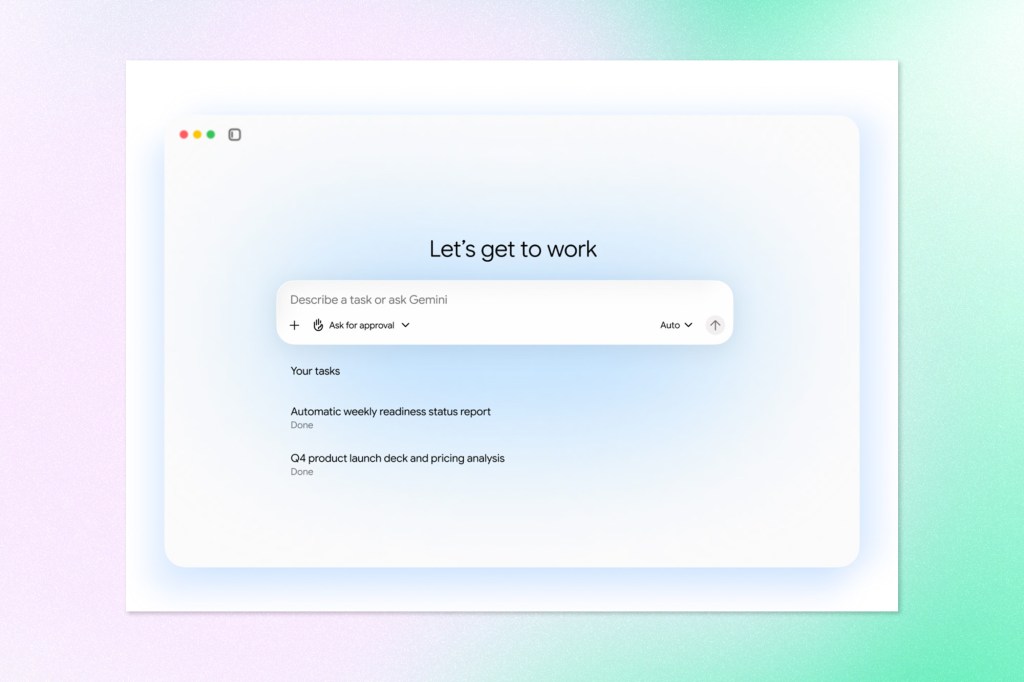
The more striking feature is the coworker agent. Teams describe a role, and Gemini creates an agent with its own Workspace account, email address, calendar, Drive and directory listing. Colleagues can @mention it in Chat or tag it in a Doc comment, and its edits appear under its own name in version history. Gemini also spins up temporary sub-agents for complex tasks and routes each job to the best-fit model, including Anthropic’s Claude models alongside Google’s own.
Governance is built around treating agents like employees. Each one gets its own identity, role-based permissions and an audit trail, with all traffic passing through an AI firewall called Agent Gateway that enforces company policy. Project-level spend caps pause agents automatically when limits are reached. Google also launched industry versions for financial services and legal in preview, with government, healthcare and retail to follow.
Why it matters: Google is reframing enterprise AI from a tool people use to a colleague people manage. Giving agents email addresses, directory entries and version history credits means organizations will need to rethink accountability, access and even team structure, not just software procurement. The decision to support Claude inside Gemini is just as telling. Google is conceding that no single model will lead for long and betting that the real lock-in sits in the agent layer: the memory, skills, permissions and company context that stay put when the underlying model changes.
🔐 Trust and Security
American Express Builds Guardrails for AI Agent Purchases
American Express has published its Intent Intelligence framework, a public approach for confirming what a customer wants before an AI agent completes a purchase on their behalf. Because language models can act unpredictably, Amex wants a customer’s approved instructions to act as a control across the entire transaction, from checkout through to fraud checks and disputes. The framework is part of the ACE Developer Kit Amex launched in April, and the company is releasing it openly to push toward a shared industry standard.
It works in a few steps. An agent captures the customer’s request, including constraints like merchant, budget and preferences, and the customer verifies their identity to approve it. That creates an Intent ID and a Proof of Intent Token, which is used to issue a payment credential limited to what the customer approved, so the agent never touches the real card number. If an agent tries to buy Adidas shoes when the customer asked for white Nikes in a size 9, the purchase can be blocked before it happens.
Amex says the key difference from other approaches is that the card issuer sees the approved intent before the agent buys anything, not after. It has not yet seen a rise in disputes from agentic purchases but wants protections in place as volume grows. The company is also working with EMVCo on secure card-based agent transactions and supporting the x402 Foundation’s work on internet-native payment standards.
Why it matters: The biggest obstacle to agentic shopping is not capability but accountability. When an agent buys the wrong thing, there is currently no clean record of what the customer actually authorized, which makes disputes messy for everyone involved. Amex’s advantage is that it operates as both card issuer and payment network, so it can enforce intent at points in the transaction that AI companies cannot reach. Publishing the framework openly and aligning with EMVCo and x402 suggests Amex knows a proprietary standard would stall, and that the card networks want to define the rules of agentic commerce before AI platforms do it for them.
Google.org Funds a National Network of Cyber Clinics in Canada
Google.org has committed $3.5 million to the Rogers Cybersecure Catalyst to launch Cyber Clinics Canada, a national network that trains post-secondary students and early-career professionals by having them deliver free cybersecurity consulting to public and community organizations. The program expands the Catalyst Cyber Clinic, which launched last year to support Canadian non-profits and community groups.
The Catalyst’s founding executive director, Charles Finlay, compared the model to a teaching hospital: learners get supervised, hands-on experience, and smaller organizations get help they likely could not afford otherwise. Students will not respond to active attacks. Instead, they will handle vulnerability and risk assessments, phishing and digital hygiene training, incident response planning, and privacy and regulatory compliance. The Catalyst will also give universities the tools to launch clinics of their own.
The funding arrives as threats grow. An IBM report earlier this year found a 44% year-over-year increase in attacks targeting public-facing applications, a trend tied in part to more capable AI tools.
Why it matters: AI is making attacks cheaper and faster to run, and the organizations least equipped to absorb that shift are the non-profits, community groups and small public bodies that hold sensitive data but rarely have security staff. Frontier cyber defence tools are mostly flowing to large enterprises and vetted partners, which leaves a widening gap at the bottom. This program addresses both sides of Canada’s problem at once: it gives under-resourced organizations a baseline of protection and builds a pipeline of practitioners with real experience, which is often the missing piece between a cybersecurity credential and a first job.
Keep ahead of the curve – join our community today!
Follow us for the latest discoveries, innovations, and discussions that shape the world of artificial intelligence.