This week was about what happens after the model works. Meta shipped a release for developers already juggling multiple agents. OpenClaw spent seven weeks rebuilding its foundation and came back with half its total code in one release. Parse.ly gave assistants direct access to analytics through MCP. Cohere shipped a parser that loses to frontier models and may still win the deal because enterprises processing millions of pages are buying on economics, not leaderboard position. Anthropic pushed further into scientific work with Fable 5.1 and Mythos 5.1, while restricting its most capable version to vetted organizations. OpenAI released Astra with enterprise access off by default, safety checks that can halt a task mid-run, and its strongest cyber capabilities held back for vetted defenders. Then Runway introduced something genuinely different: an interface generated as you use it, early enough that even Runway is explicit about what it still cannot do.
Listen to the AI-Powered Audio Recap
This AI-generated podcast is based on our editor team’s AI This Week posts. We use advanced tools like Google NotebookLM, Descript, and ElevenLabs to turn written insights into an engaging audio experience. While the process is AI-assisted, our team ensures each episode meets our quality standards. We’d love your feedback—let us know how we can make it even better.
TL;DR
- OpenAI’s GPT-6 Astra tops the agentic benchmarks and hits the Critical cyber threshold, so it ships with access off by default and safety checks that can halt a task mid-run.
- Anthropic shipped Fable 5.1 and Mythos 5.1, cutting agentic costs, more than doubling Terminal-Bench-Science performance, and restricting its most capable scientific model to vetted organizations.
- Runway introduced Solaris, a model that generates an interface frame by frame as you use it, with no code underneath.
- Meta took Muse Code out of beta with inter-session messaging, parallel subagent workflows, session rewind, a TypeScript SDK, and subscription pricing.
- OpenClaw shipped its biggest release ever: 16,000 pull requests, 933 contributors, and shared sessions that make it multiplayer.
- Cohere launched Parse at $1.50 per 1,000 pages, beating specialized parsers and hyperscalers while conceding the top of the benchmark to frontier models.
- Parse.ly shipped an MCP server and a Claude connector, putting content analytics inside the assistant instead of the dashboard.
- OpenAI is cutting Cursor off from its models on November 12 after SpaceX bought the company.
- Fambot launched an AI chief of staff for family logistics, backed by $3.5 million pre-seed.
🧠 New Models and Research
GPT-6 Astra Arrives With Critical Cyber Rating
OpenAI released GPT-6 Astra, positioning it as its most capable and most aligned model to date. Rollout begins with a limited set of organizations before opening to ChatGPT Plus, Pro, Business, and Enterprise, along with the API, Azure, and Bedrock. API pricing is $10 per million input tokens and $50 per million output tokens.
The claims concentrate on agentic work. OpenAI reports 57.9% on Terminal-Bench 4.0 against 55.8% for Claude Fable 5.1, 59.3% on Agents’ Last Exam against 55.5% for Claude Opus 5, and 96.0% on GPQA Diamond. It also reports significant efficiency gains, including roughly 65% fewer output tokens than Opus 5 on the professional-task benchmark. Codex picks up a note-keeping mechanism that carries detail across context windows instead of compacting a long session into a single summary.

Two things stand out beyond the scores. Astra meets the Critical threshold for cybersecurity under OpenAI’s Preparedness Framework, and it surfaced two previously unknown vulnerabilities during evaluation, both disclosed to maintainers. The shipped version declines to build proof-of-concept exploits, with looser safeguards planned for vetted defenders through a separate program. OpenAI also reports that Astra’s written reasoning is harder to monitor than its predecessor’s, a regression the company flags in the announcement itself.
Why it matters: Benchmark leads change hands constantly and this one will too, so the more durable signal is the shape of the release. Enterprise access is off by default at launch, safety checks can pause a task mid-run, and the cyber capabilities ship with staged access. Capability and containment are being announced as a single product decision. For teams putting agents near production systems, the useful questions are about scope limits, review gates, and audit trails, not leaderboard position.
Anthropic ships Fable 5.1 and Mythos 5.1
Anthropic released Claude Fable 5.1 and Claude Mythos 5.1, the same model with different safeguard levels. Fable 5.1 is generally available. Mythos 5.1 goes only to vetted organizations working in cybersecurity and life sciences.
Cache reads dropped 75 percent to $0.25 per million tokens, cutting typical costs about 25 percent against Fable 5 and up to 45 percent on agentic work. Terminal-Bench-Science more than doubled to 52.6 percent, and Millennium reported the model traced a one-in-a-million crash its engineers had not explained in four to five years.
Anthropic put most of its emphasis on scientific work. Mythos 5.1 designed protein binders with affinities ten times higher than the best competition entries on three targets, hitting a roughly 50 percent success rate where 10 to 15 percent is normal. Fable 5.1 built a new elevation map of a third of Venus from 30-year-old Magellan radar data, released under Creative Commons ahead of the VERITAS and EnVision missions.
Safeguards moved both ways. Cyber interventions fire about 60 percent less often and Fable 5.1 can now find software vulnerabilities, though exploit generation still routes to Opus. New API accounts lose a context-editing feature that had been used to extract Claude’s reasoning.
Why it matters: A model designing working protein binders at five times the field’s normal hit rate is doing something categorically different from writing code faster, and shipping it behind a government-partnered access program says Anthropic now sees the constraint as who gets to use it.
Runway Introduces Solaris
Runway announced Solaris, the first of what it calls Interface World Models. Normally, software is built ahead of time: a designer makes a mockup, a developer turns it into code, and the finished app only does what someone anticipated. Solaris skips that. The model generates the screen itself, frame by frame, and generates the response to whatever you click or drag as you go. There is no code underneath, just an image that keeps redrawing itself in reaction to you.
Runway’s examples show what that buys you. A virtual clothing store where you drag a shirt from the rack onto a photo of yourself. A furniture scene where you say “change the colour of the couch” and it changes. A cooking interface where you build a salad by dragging ingredients into a bowl. None of these interactions were programmed. The model infers what should happen because it has learned how objects behave.

The other use is training AI agents. Computer-use models today learn one site’s layout and fail on the next one, because they are trained against fixed coded interfaces. An environment that generates a different interface every time gives them something harder to memorize.
Under the hood, a language model decides what the interface should do next, and the world model, adapted from Runway’s Gen-4.5 video model, renders it. In a user study against Claude Opus 5, with 250 participants and roughly 7,500 judgments, Solaris was preferred for instruction following 61 percent to 24 percent, and for natural behaviour in the scene 71 percent to 21 percent.
Runway names the gaps: legible text, trustworthy output, coherence over long sessions, and accessibility. Solaris is not publicly available, and early access is by request.
Why it matters: Generated interfaces will not replace apps until text, trust and accessibility are solved, so the nearer-term value is giving agents an environment that changes every time instead of one they can memorize.
🛠️ Agent Tooling
Muse Code Exits Beta
Meta moved Muse Code out of beta on August 31, adding inter-session messaging, a workflow orchestration mode, conversation rewind, a developer preview of the SDK, and subscription pricing. Installation stays a single curl command on macOS and Linux, signed in through a Meta Model API account.
The messaging feature lets concurrent sessions talk to each other. If one session makes a change that breaks what another is working on, it can trigger a warning instead of the developer manually relaying it between terminals. Traffic runs over a Unix socket between local processes, so nothing leaves the machine, and the agent handles discovery and sending through two built-in tools.
Workflow splits a large task across a team of subagents working in parallel, viewable and controllable from /workflows with live progress, stop and restart, and the option to save a run for reuse. Setting effort to ultra triggers workflows more often. Rewind, bound to a double Esc, rolls a session back to an earlier point, with Muse Code offering only rewind points its event log considers safe.
The SDK exposes the CLI engine as a TypeScript library covering sessions, tools, and permission control. Programs spawn a local Muse host and communicate over the Muse Session Protocol, an open protocol running over standard I/O with no server component. Types are generated from the protocol schema, and the schema is machine-readable so that clients can be generated in other languages.
Three subscription tiers are now available, positioned as cheaper than pay-as-you-go API usage.
Why it matters: The centre of gravity here is coordination. Every feature in this release assumes the developer is already running several agents at once and struggling to keep them coherent. Messaging, workflows, and rewind are all answers to the same failure mode: parallel agents drifting apart, and no cheap way to undo the mess. That is a maturity signal. Vendors ship orchestration primitives once single-session performance stops being the bottleneck.
OpenClaw 2.0 Goes Multiplayer
OpenClaw shipped its largest release ever, built by 933 contributors, 569 of them first-timers, across more than 16,000 pull requests. That is roughly half of every pull request ever merged into the project. The team had been shipping 106 releases in 230 days, usually a day or two apart, so nearly seven weeks of silence was unusual. They say the pace of work outgrew both the codebase and the release process, so they rebuilt both at once and took the extra time to make sure existing installs would not break.
The work started narrow and spread. Simplifying installation meant pulling from what is already on a person’s machine, including existing ChatGPT or Claude subscriptions, API keys, and local models, then moving the rest of the configuration out of setup so people can finish by talking to their Claw. Rebuilding the browser app as a first-class surface followed, and the cleanup carried through messaging, memory, skills, models, automations, native apps, plugins, and security.
The examples are deliberately small. A Claw that watches your inbox for school emails and pings you on Telegram when homework is due. Being asked over iMessage which iPad you bought your dad, and having the Claw dig the receipt out of your email and reply for you. The new piece is shared cloud sessions, which let someone else join live work or take it over without losing what the Claw already knows. The team built this release using it.
OpenClaw is open source, and the post is explicit that it is not selling anything or asking anyone to depend on a single model or provider.
Why it matters: A seven-week pause that produced half the project’s total code is a sign of a project rebuilding its foundation under pressure, and shared sessions are the tell: OpenClaw is aiming at team workflows, not just hobbyist installs.
🏢 Enterprise AI
Cohere Bets Enterprises Will Trade Benchmark Points for Cost
Cohere released Parse, a vision language model built for turning large volumes of enterprise documents into structured, machine-readable output. It returns clean Markdown and handles tables, forms, diagrams and embedded images across nine major languages, with bounding boxes for tables and images so document structure survives into retrieval and automation. Pricing through the Cohere API is $1.50 per 1,000 pages.
On ParseBench, Parse averages 79.2 across three dimensions, ahead of LlamaParse Cost Effective at 78.3, Mistral OCR 4 at 74.5 and Databricks AI Parse at 72.4. The gap against hyperscaler services is much wider: more than 20 points over both AWS Textract and Google Document AI. The only models that beat it are the frontier general purpose ones, GPT-5.5 at 84.4, Opus 4.8 at 84.3 and Gemini 3.5 Flash at 81.8, all considerably larger. Throughput is 4.5 pages per second, or 36 per second on an 8 H100 node, around 1.4 times dots.mocr and 2.2 times Chandra OCR 2 on the same hardware.
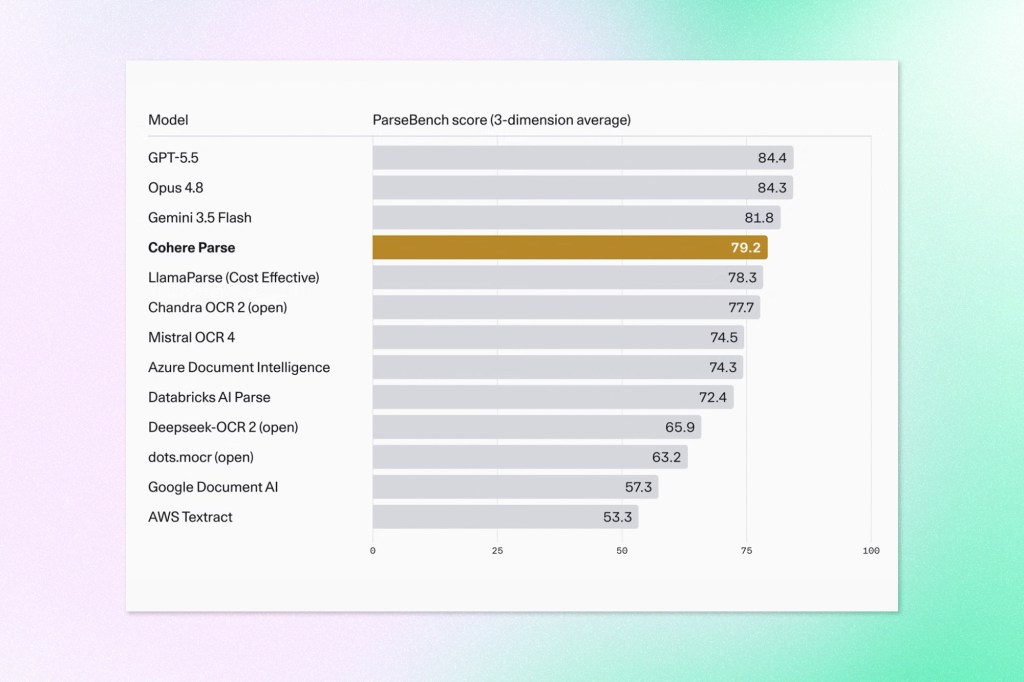
Cohere is direct about scoping. It excluded the Layout and Chart dimensions from its comparison because the model deliberately does not emit per-element bounding boxes for text and treats charts as visual elements instead of data to extract. Chart extraction is planned for the next version.
Deployment covers the Cohere API, Model Vault for single-tenant inference, Microsoft Foundry and AWS SageMaker, plus private cloud and on-premises for regulated industries. Cohere’s own example puts an accounts payable workflow at 13 million pages a month, where Model Vault saves roughly $144,000 a year against the API, and about $1.47 million against a hyperscaler charging $10 per 1,000 pages.
Why it matters: Parse is losing to the frontier models on the benchmark and winning on everything else that decides a purchase, which is what a company does when it has read the room: most enterprises parsing millions of pages a month care more about the invoice than the leaderboard.
Parse.ly Ships an MCP Server
WordPress VIP released Parse.ly MCP, a hosted endpoint at dash.parsely.com/mcp that exposes Parse.ly analytics as tools any MCP-compatible client can call. Instead of opening the dashboard, you ask your assistant what the top posts were last week and where the traffic came from, and get an answer grounded in your own data.
More than 20 tools are live. Discovery covers authors, tags, sections, sites and saved groups. Query covers top content, traffic trends, referrers, real-time, post detail, conversions, goals, campaigns, headline tests and network rankings across multi-brand setups. Utility covers docs search and user info. Authentication runs on OAuth 2.1 with PKCE, so there are no API keys to copy or store, and access is scoped to exactly the sites and permissions the account already has in the dashboard.
An official Claude connector is installable from the connector directory, and the endpoint works with ChatGPT, Codex CLI and Claude Code. Both are available now to all Parse.ly customers.
Why it matters: The pitch is not that the assistant can read your analytics, it is that it can chase a traffic spike the way an analyst would, pulling the trend, checking referrers, finding the post, all while holding context on everything else you are working on.
Ready to explore what AI can do for your organization?
⚔️ Industry Moves
OpenAI Cuts Off Cursor
OpenAI is ending Cursor’s access to its models, with a proposed shutoff date of November 12, 2026 and no new models supplied during the wind-down. The trigger was SpaceX completing its $60 billion acquisition of Cursor parent Anysphere on August 14. OpenAI’s stated reason is that it cannot be confident SpaceX will honour its terms of service, citing its experience with Musk’s companies violating contracts.
Cursor CEO Michael Truell said OpenAI models account for roughly 5 percent of Cursor traffic and that the two companies are talking. He noted Cursor was one of OpenAI’s earliest customers and had treated the platform as neutral infrastructure. Musk responded on X with an expletive and a repeat of his claim that Altman and Brockman stole an open source nonprofit.
The backdrop is years of litigation. Musk co-founded and helped fund OpenAI in 2015, left the board in 2018, and sued in 2024 over the for-profit conversion. He lost earlier this year and has said he will appeal. SpaceX, which went public in June, had already absorbed X and xAI in February.
This is not the first cutoff of its kind. Anthropic blocked Windsurf’s access to Claude last June. Anthropic co-founder Tom Brown posted that Cursor has been a trusted partner since Sonnet 3.5 and that Anthropic will add compute to support Claude in Cursor under SpaceX ownership. Replit CEO Amjad Masad pointed out the Windsurf history, and Docker’s Mat Velloso suggested Brown should have stayed quiet.
Why it matters: Cursor did nothing except change owners, and 5 percent of its traffic evaporated on someone else’s grudge, which is the argument for multi-model architecture made better than any vendor could make it.
🏠 Consumer AI
Fambot Pitches an AI Chief of Staff for Families
Fambot launched what it calls an AI chief of staff for parents, aimed at the mental load of school events, kids’ activities, newsletters and general family logistics. CEO David Reich, previously president at UnitedMasters and head of Uber’s 250-person transit team, built it out of his own frustration: three kids, and evenings spent working through 40 emails instead of being with them. CTO Greg Karlin came from Instagram, and third co-founder Jason Morrow from Google and LinkedIn.
Families connect email, calendar and the WhatsApp groups they care about, and Fambot returns a daily checklist plus a look ahead at what is coming. It runs on a mix of models, with a stated condition that none of them train on user data.
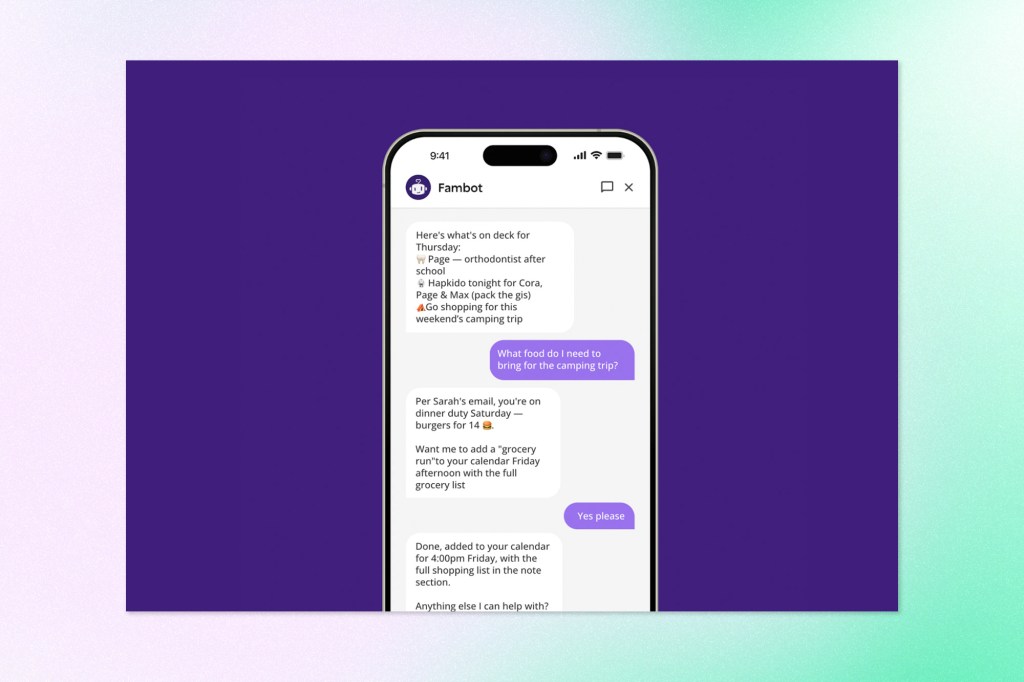
The differentiator Fambot claims is surface. Competitors like Poke and Instinct work over text messages. Fambot also runs on the web and a mobile app, which the team argues lets it build features text alone cannot support. Texting still works. The longer plan is integrating with the school, sports and club apps where family communication actually lives, making Fambot the hub for all of it.
Reich cites 43 million US families with kids under 16 as the market. Over 1,000 families tested it before launch, and the useful finding was that demand was not limited to busy dual-income households. Single-parent families, only-child families and families where parents do not work all showed up. The company raised $3.5 million pre-seed, co-led by NextView Ventures and Baukunst, with Correlation Ventures, Karman Ventures and Founders Network participating. It is free in beta on iOS, Android and web, with eventual pricing around what Netflix costs.
Why it matters: Everything Fambot needs access to, email, calendar, WhatsApp groups about other people’s children, is roughly the most sensitive data a household has, so the no-training promise is not a footnote here, it is the entire product.
Keep ahead of the curve – join our community today!
Follow us for the latest discoveries, innovations, and discussions that shape the world of artificial intelligence.