
The biggest labs spent this week closing the distance between themselves and their customers. OpenAI stood up a deployment company. Anthropic landed inside AWS. Both are now fighting over the same prize: not who builds the best model, but who owns the work of putting it into production. Elsewhere, the edges of the technology are getting noisier. A new lab published research built around the idea that AI should stay in the room with you, not run ahead, and the open office learned the hard way that voice-first workflows come with social costs nobody budgeted for. The EU quietly traded regulatory ambition for competitive anxiety, Microsoft dropped the clearest adoption numbers the industry has seen, and the gap between those numbers carried more weight than the headline figure.
Listen to the AI-Powered Audio Recap
This AI-generated podcast is based on our editor team’s AI This Week posts. We use advanced tools like Google NotebookLM, Descript, and Elevenlabs to turn written insights into an engaging audio experience. While the process is AI-assisted, our team ensures each episode meets our quality standards. We’d love your feedback—let us know how we can make it even better.
TL;DR
- OpenAI launched the OpenAI Deployment Company with $4 billion in backing and ~150 engineers from its Tomoro acquisition, plus three new real-time audio models, and a Trusted Contact safety feature for ChatGPT.
- Anthropic’s Claude Platform is now generally available on AWS, giving customers full native API feature parity through existing AWS infrastructure, billing, and authentication.
- Thinking Machines published a research preview of an interaction model built on 200-millisecond micro-turns, designed for continuous real-time collaboration across audio, video, and text rather than turn-based exchange.
- Voice dictation is moving from an accessibility tool to an everyday workflow, and the open office hasn’t figured out what to do about it.
- The EU agreed to delay enforcement of the AI Act’s high-risk provisions until December 2027 and carved out industrial AI applications entirely, in the first significant rollback of EU digital regulation.
- Microsoft’s Q1 2026 Global AI Diffusion Report puts global generative AI usage at 17.8% of the working-age population, with git pushes up 78% year over year and U.S. software developer employment at a record high.
🏢 Platform Wars
OpenAI Goes Full Stack
OpenAI had a busy week, and the throughline across all three announcements is the same: the company is moving aggressively from model provider to something much harder to dislodge.
The biggest structural news is the launch of the OpenAI Deployment Company, a standalone business unit built to embed engineers directly inside enterprises to redesign workflows around AI. It arrives with teeth: a $4 billion commitment, backing from TPG, Bain Capital, Brookfield, Goldman Sachs, SoftBank, McKinsey, Capgemini, and others, plus the acquisition of Tomoro, an applied AI consulting firm that brings roughly 150 engineers to the operation on day one. The model mirrors what Palantir has long done with its Forward Deployed Engineers: get inside the organization, own the implementation, and make yourself structural. The difference is that OpenAI is wiring those engineers directly to its own model roadmap, so clients are always building toward what’s coming next, not just what exists today.
On the product side, OpenAI launched three new real-time audio models through its API. GPT-Realtime-2 brings GPT-5-class reasoning to live voice, with a 128K context window, adjustable reasoning effort, parallel tool calling, and better recovery behaviour when conversations go sideways. GPT-Realtime-Translate handles live speech translation across 70-plus input languages into 13 output languages, and Deutsche Telekom is already testing it for multilingual customer support. GPT-Realtime-Whisper is a streaming transcription model built for low-latency speech-to-text as conversations happen. Zillow, Priceline, Glean, and Intercom were among the early testers, and the use cases span everything from real estate search to in-flight rebooking by voice.
The third announcement is different in character. OpenAI is rolling out Trusted Contact in ChatGPT, an opt-in feature that lets adult users designate someone who can be notified if trained reviewers determine a conversation may indicate a serious self-harm risk. The notification is intentionally narrow (no transcripts, no chat details), and every alert goes through human review before it’s sent. The feature was developed with guidance from clinicians, the American Psychological Association, and OpenAI’s own Expert Council on Well-Being and AI. It extends a similar system already in place for linked teen accounts.
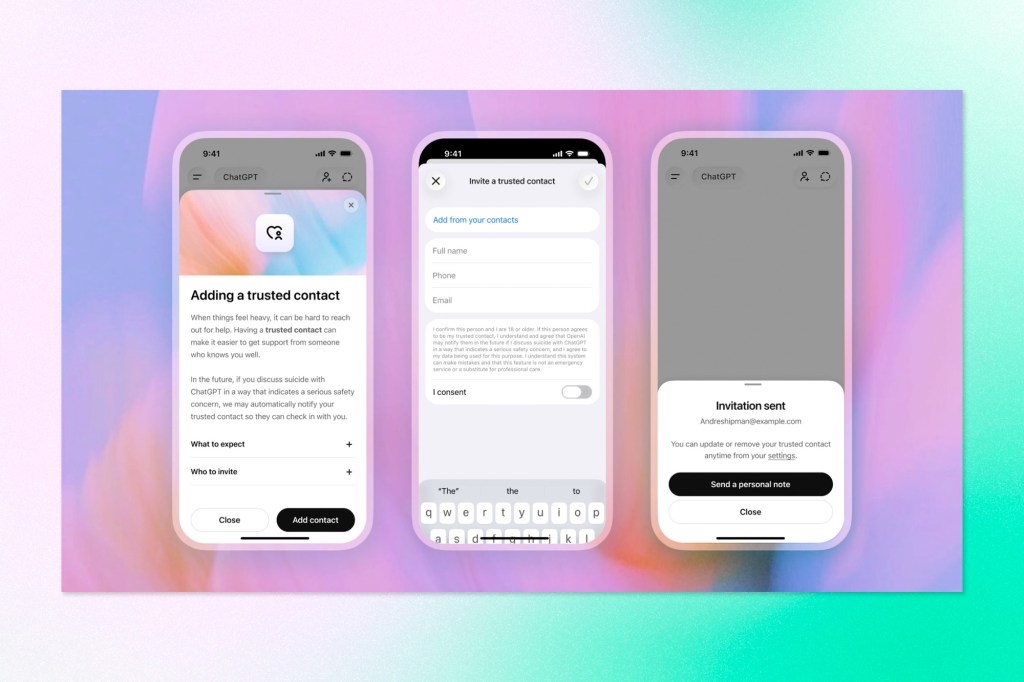
Why it matters: The Deployment Company is the most consequential of the three. By owning deployment through embedded engineers, proprietary playbooks, and a direct line to its own research pipeline, OpenAI is trying to make switching costly in a way that API access alone never could. The voice models matter because they push real-time audio from novelty toward infrastructure — the kind of thing that goes into apps and stays there. And Trusted Contact is worth watching not for its immediate scale but for what it signals: that AI companies are increasingly being asked to make decisions that used to belong to healthcare providers, school counsellors, and crisis services. How those judgment calls get made, and by whom, is a question the industry hasn’t fully answered.
Get AI This Week, along with industry news, delivered straight to your inbox
Anthropic Brings the Full Claude Platform to AWS
Anthropic’s Claude Platform is now generally available on AWS, giving AWS customers access to the complete native Claude API through the infrastructure they already use. Authentication runs through AWS IAM, audit logging through CloudTrail, and billing consolidates into a single AWS invoice that counts against existing cloud commitments. The arrangement means teams don’t need separate credentials or a new vendor relationship to access Claude’s full feature set.
The distinction from Claude on Amazon Bedrock is worth understanding. Bedrock keeps AWS as the data processor and operates within the AWS boundary, which suits organizations with strict data residency requirements. The Claude Platform on AWS is operated by Anthropic, with data processed outside the AWS boundary, but it delivers full feature parity with the native Claude API from day one, including same-day access to new releases and betas. Available features include Claude Managed Agents, web search, code execution, the Files API, Skills, MCP connector, prompt caching, citations, and batch processing, along with access to the Claude Console for building and testing. Claude Opus 4.7, Sonnet 4.6, and Haiku 4.5 are all available at launch.
Why it matters: This is a meaningful distribution move for Anthropic. A large share of enterprise AI development happens inside existing cloud contracts, and the friction of adding a net-new vendor relationship, separate billing, and unfamiliar authentication is a real barrier to adoption, even when the underlying product is compelling. By meeting AWS customers inside their existing infrastructure and commitment structures, Anthropic removes that friction without forcing a choice between convenience and capability. The Bedrock path still exists for organizations where data residency is non-negotiable. But for everyone else, the message is clear: you no longer have to trade features for familiarity.
🎤 AI Finds Its Voice
Thinking Machines Rethinks How AI Listens
The research lab Thinking Machines has published a research preview of what it calls an interaction model, built around a premise that most AI development has been getting something wrong. Current models, the argument goes, are optimized for autonomous, long-running tasks where the human steps away and checks back later. That works in some situations, but most real work involves staying in the loop, redirecting, correcting, and collaborating as things develop. Turn-based interfaces structurally exclude that kind of participation.
The model Thinking Machines built, TML-Interaction-Small, is designed from the ground up for continuous, real-time exchange rather than bolting interactivity onto an existing architecture. Rather than processing complete turns, it works in 200-millisecond micro-turns, taking in audio, video, and text simultaneously and producing output in the same continuous loop. This means the model can interrupt, backchannel, speak while the user is still talking, react to visual cues without being explicitly prompted, and maintain a sense of elapsed time. A background model handles heavier reasoning tasks asynchronously while the interaction model stays present in the conversation, integrating results as they arrive.
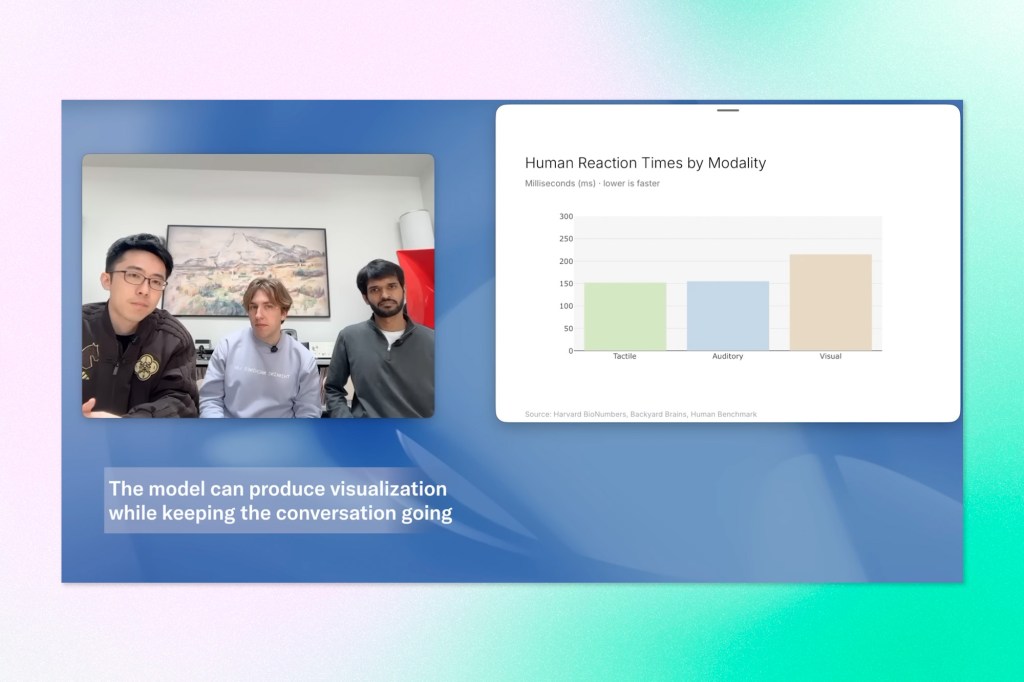
The benchmark results are notable in their specificity. On FD-bench, which measures interactivity rather than raw intelligence, TML-Interaction-Small scores 77.8 on the v1.5 average, well ahead of GPT-Realtime-2 at 46.8 and Gemini at 54.3 under comparable conditions. For tasks that require the model to react to visual cues or speak at precise moments, the paper reports that no existing commercial model performs meaningfully on those evaluations at all. The model is a 276 billion parameter mixture-of-experts architecture with 12 billion active parameters. A limited research preview is planned, with a broader release later this year.
Why it matters: Most of the current discourse around agentic AI treats human oversight as a feature to be designed around rather than a capability to be supported. Thinking Machines is making a different bet: that the most valuable AI systems won’t be the ones that run farthest on their own, but the ones that stay closest to the human throughout the work. The micro-turn architecture is a meaningful technical departure, not just a product positioning choice. If it scales, it suggests a different trajectory for AI interfaces than the one most labs are currently pursuing, one where the interface itself is treated as a first-class research problem rather than a wrapper around the model.
The Office Is Getting Weird
Voice dictation is moving from an accessibility tool to an everyday workflow, and the social friction is arriving faster than the etiquette to handle it. A recent Wall Street Journal feature on the rising use of dictation apps like Wispr, which can now connect directly to vibe-coding tools, prompted a round of candid observations from people already living this shift. One venture capitalist noted that startup offices are starting to feel like high-end call centers. Gusto co-founder Edward Kim told his team to expect offices that sound more like sales floors, while acknowledging that constant dictation at work is, in his words, “just a little awkward.” AI entrepreneur Mollie Amkraut Mueller said her husband grew frustrated enough with her late-night whispering sessions that they now work in separate rooms. Wispr founder Tanay Kothari’s response: This will all seem normal eventually, the same way hours of phone-staring now do.
Why it matters: The awkwardness people are describing isn’t a quirk of early adoption. It’s a signal that voice-first AI interaction is running into a genuine design problem that no app update will solve. Open offices were already contested spaces before everyone started narrating their work aloud. The deeper issue is that voice input externalizes cognition in a way that typing doesn’t. When someone types, their thought process is invisible. When they dictate, it isn’t. That changes the social dynamics of shared workspaces in ways that go well beyond etiquette. Expect this to become a live debate in workplace design, hybrid work policy, and even commercial real estate as the behaviour scales.
🇪🇺 Policy and Regulation
Europe Blinks on AI Regulation
The EU has agreed to delay enforcement of the high-risk provisions of its AI Act until December 2027, more than a year past the August deadline that was already baked into the law. The deal, reached after overnight negotiations between the European Parliament and the Cypriot Council presidency, also carves out industrial AI applications entirely from the Act’s scope, a direct concession to Germany, whose government lobbied hard to shield companies like Siemens and Bosch from a double regulatory burden. Those firms will now only need to comply with AI requirements under existing machinery rules. Medical devices and other sectors were not granted the same exemption and remain under the Act’s jurisdiction.
The agreement includes a grace period for AI-generated content watermarking requirements, though negotiators trimmed it to three months rather than the six originally on the table. The deal also adds explicit bans on AI systems capable of generating sexualized deepfakes of identifiable people, a provision that came into focus following the controversy over Elon Musk’s Grok tool, and maintains existing prohibitions on AI-generated child sexual abuse material.
The EU’s AI Act became law in August 2024 after years of drafting and debate. Its phased implementation was designed to give industry time to adapt, but the high-risk provisions landing this summer proved to be the sticking point. With few other jurisdictions moving to adopt comparable frameworks, European industry and several member state governments argued the rules were positioning the bloc to regulate itself out of the race.
Why it matters: This is the first meaningful rollback of EU digital regulation, and the circumstances matter as much as the outcome. The concessions weren’t extracted through the normal legislative process. They came from sustained pressure by industry, member state capitals, and an increasingly unfavourable comparison to the United States, where no equivalent federal framework exists. The industrial AI carve-out for Germany is particularly telling: when economic competitiveness is directly on the line for major manufacturers, the political will to hold the regulatory line softens quickly. What the EU is learning, and what other jurisdictions are watching, is that being first to regulate doesn’t automatically mean setting the standard. It can also mean going alone.
📊 By the Numbers
AI Adoption: The Numbers Behind the Narrative
Microsoft’s latest Global AI Diffusion Report puts some hard data behind what has largely been a vibes-driven conversation about how broadly AI is actually spreading. As of Q1 2026, 17.8% of the world’s working-age population used generative AI during the quarter, up 1.5 percentage points from the previous period. Twenty-six economies now have usage rates above 30%. The UAE leads the world at 70.1%. The United States, despite being home to most of the major AI labs, sits at 21st globally with a 31.3% usage rate, up from 24th last quarter.
Asia saw notable movement in the quarter, with South Korea, Thailand, and Japan posting the largest gains. Microsoft attributes part of the acceleration to improving AI capabilities in Asian languages, with Japan serving as a case study in the full report on how multilingual improvements translate into adoption. The geographic divide, however, continues to widen. Usage in the Global North now stands at 27.5% versus 15.4% in the Global South.
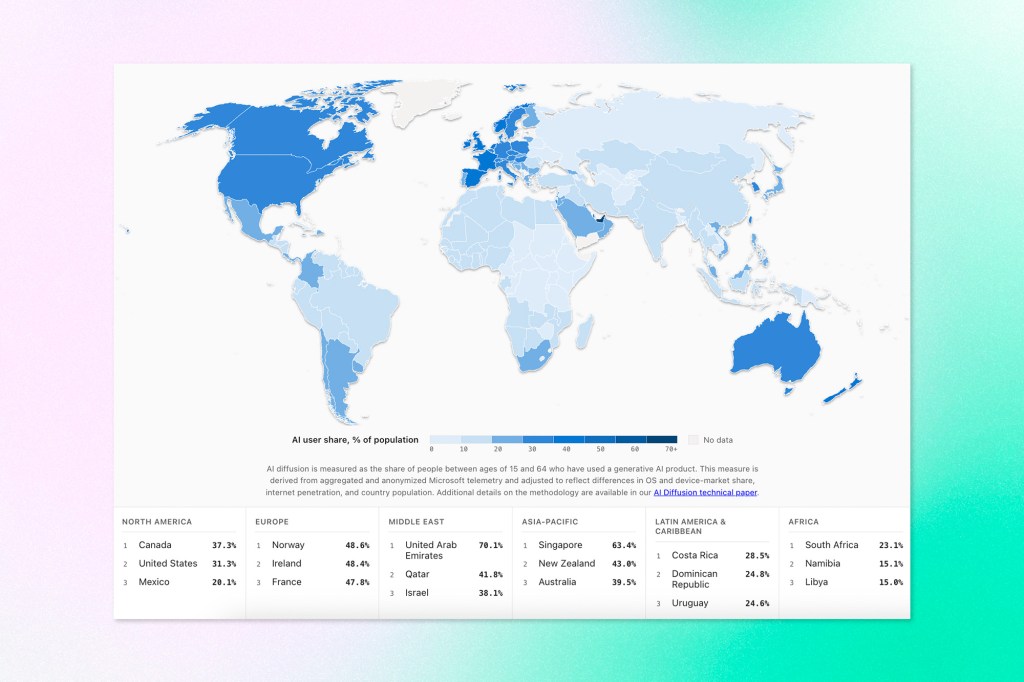
On the software side, the report documents a sharp rise in AI-assisted coding output. Git pushes increased 78% year over year globally, reflecting the combined effect of tools like Claude Code, OpenAI Codex, and GitHub Copilot. Notably, the productivity gains do not appear to be displacing developers, at least not yet. U.S. software developer employment hit approximately 2.2 million in 2025, up 8.5% year over year and a record high for the profession. Early Q1 2026 data shows that figure running about 4% higher than the same point last year.
Why it matters: The developer employment data is the most immediately counterintuitive finding here, and it deserves more attention than it usually gets in the coding-AI-will-kill-jobs discourse. The dynamic Microsoft is describing is a classic demand elasticity story: when software gets cheaper to build, organizations build more of it, which sustains or grows demand for the people who build it. That pattern may not hold as capabilities continue to advance, but for now, the data doesn’t support the displacement narrative. More broadly, the North-South diffusion gap is a slow-moving story that rarely gets the urgency it warrants. If AI is as economically significant as its proponents claim, a structural gap in access between the Global North at 27.5% and the Global South at 15.4% isn’t a rounding error. It’s a compounding disadvantage that will be much harder to close the longer it persists.
Keep ahead of the curve – join our community today!
Follow us for the latest discoveries, innovations, and discussions that shape the world of artificial intelligence.