
Every story this week is about AI getting closer. Google built Gemini into a laptop’s operating system, and Snap mounted an assistant behind glasses, moving it from an app you open to a presence that is simply on. The agents closed the same distance to your accounts, with Meta letting a customer’s agent reach a business directly through Muse and Google handing CC its own login to run a household of six. At the model layer, Anthropic and OpenAI both cut prices to match last year’s best for a fraction of the cost, and Anthropic put numbers to the loop everyone worries about, its own AI now leading a quarter of the work that builds the next model.
Listen to the AI-Powered Audio Recap
This AI-generated podcast is based on our editor team’s AI This Week posts. We use advanced tools like Google NotebookLM, Descript, and ElevenLabs to turn written insights into an engaging audio experience. While the process is AI-assisted, our team ensures each episode meets our quality standards. We’d love your feedback—let us know how we can make it even better.
TL;DR
- Meta opened Muse to third-party connectors, letting a customer’s agent reach a business’s service directly, while publishing no fee, revenue share, or developer terms.
- Google Labs turned CC into a shared household agent with its own verified Google account, letting up to six members hand it what they choose.
- Anthropic and OpenAI shipped cheaper models the same day, minutes apart, both matching last generation’s top tier at 40 to 50 percent lower cost.
- Google opened pre-orders for the Googlebook, a laptop line with Gemini built into the OS, on-device NPUs above 45 TOPS, and a Linux terminal that runs rival agents like Claude Code.
- Snap unveiled SPECS, standalone AR glasses at $2,195, betting the next AI interface is a view the assistant shares rather than a screen you address.
- Anthropic published internal metrics on AI building AI, reporting Claude now “leads” 26 percent of its R&D work, up from under one percent in February.
🤖 Agentic AI
Meta Opens Muse to Third-Party Connectors
On September 18, Mark Zuckerberg posted that developers can now build connectors for Muse, Meta’s personal AI agent. A connector gives the agent a new ability, such as reading a calendar or sending an email, by linking Muse to an outside app or service. The pitch reverses the usual app-store arrangement: the business keeps its own service and API, and the customer’s agent comes to it rather than the customer downloading anything. The three-step path runs through Meta’s review of functional, security, and legal requirements to a directory where editors decide featured placement, with payments routed through Stripe Link.
What the page does not publish is almost everything a business would ask about: no fee, no revenue share, no review timeline, no SDK, no developer terms, and no named launch partners. The submission form asks for a description of the product, not code, and the page does not say who actually writes the connector. The connector push arrived alongside Muse for Mac, which lets the agent act directly on a user’s computer with explicit permission, doing things like organizing a downloads folder, tracking down a lost file, or summarizing messages and notes.
That deeper access is also where the friction shows. Some Mac users have reported Muse reading their direct messages and suggesting actions based on private conversations, and while Meta says this only happens when a user grants permission, the reach can feel intrusive. Meta is betting that broader connections make Muse more useful, but many of the tasks it automates, like hunting for products or planning activities, are ones people do not necessarily want handed off, which leaves the company selling both trust and purpose at once.
Why it matters: The connector model is Meta’s bid to own the moment of choice. When a customer reaches a service by asking their agent for it, the agent’s owner decides which service gets suggested, and an editorial layer over the directory turns that into placement Meta controls. That is a different kind of leverage than an app store, because the business no longer owns the interface where its customer decides. But the adoption problem cuts against the platform ambition: the connectors only matter if users grant Muse deep access to messages, calendars, and payments, and the early unease about the agent reading DMs shows how thin the trust margin is. Meta is racing to lock in developer supply while the terms are still its to set, on a bet that consumers will hand a Meta agent the keys to their private accounts.
Google Turns CC Into an Agent for Families
Google Labs updated CC, its personal agent, to run a household rather than a single person. The agent now gets its own verified Google account, which gives it a distinct identity and permissions model and lets up to six members share it. CC only sees what each member chooses to hand over, such as emails from a child’s school, a swim centre, or the vet, and it sorts through them to build a shared daily brief while connecting to Calendar and Tasks.
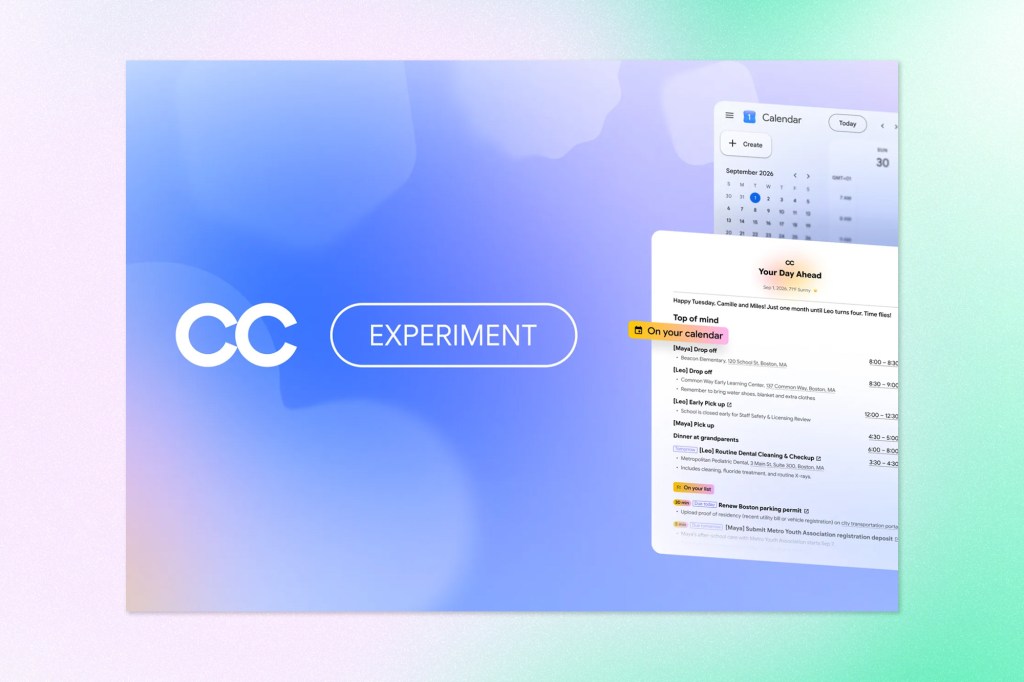
The pitch is aimed at the coordination overhead of a busy home. Each morning CC delivers a shared “Your Day Ahead” brief, so schedules stop living in one person’s inbox, and it tracks dates and to-dos by pulling shared information into a family calendar or task list. It also takes on the tedious logistics, filling out permission slips and registration PDFs, drafting school supply lists, or building weekly meal plans, and it asks for missing details and updates a group memory as it goes.
Control is the part Google is careful to spell out. Members choose what to share and can change it anytime; an “auto cc” option flags email senders to always forward, and one-off items can be pushed to CC by email or chat. Under the hood, each instance runs on its own isolated cloud computer powered by Google’s Antigravity harness and recent Gemini models. It is an early experiment, live on web and mobile for U.S. users 18 and older with a personal Google account.
Why it matters: Giving an agent its own account and a shared memory across six people shifts what an assistant is: not a tool one person queries, but a standing member of a group with its own view of everyone’s data. The bet worth watching is whether households treat an AI as shared infrastructure the way they treat a calendar, since the chores CC targets, the registration forms and meal plans nobody wants to do, are where an agent earns a permanent seat rather than a novelty visit.
🧠 New Models
Anthropic and OpenAI Both Push Models Down the Cost Curve
Two frontier labs shipped releases the same day, minutes apart, built around the same idea: match last generation’s top-tier performance for far less money. Anthropic introduced Claude Opus 5.5, the first model in its 5.5 family, which it says performs at the level of its Fable 5.1 model on most work while costing 40 percent less to run than Opus 5. Input and output tokens drop to $4 and $20 per million, cache reads fall 60 percent to $0.20, and output generates more than 30 percent faster. Anthropic frames it as its first release since calling to pace the frontier, tested before launch by outside evaluators including METR and Frontier Design, and its strongest model yet on the internal alignment audit.
OpenAI expanded its GPT-6 line with Sol and Luna, cheaper siblings to the Astra model it released earlier in the month. Both are trained with Astra’s methods but tuned for cost, priced 50 percent below their GPT-5.6 predecessors: Sol at $2 input and $10 output per million, Luna at $0.10 and $0.50. OpenAI keeps Astra as its top model and positions Sol and Luna as the way to spread that intelligence across everyday work, leaning on caching improvements that discount reused context by 90 percent.
Both companies make the same competitive claim against each other’s flagship, and both lean on efficiency rather than a new capability ceiling. Anthropic reports Opus 5.5 beating GPT-6 Astra on some agentic coding and knowledge-work benchmarks at a fraction of the cost per task, while OpenAI reports Sol exceeding Claude Fable 5.1 on business-workflow and coding tests at far lower cost. The benchmarks point in convenient directions for whoever published them.
Why it matters: The story is that the frontier is bifurcating into a thin top tier and a fast-growing efficiency tier, and the real fight has moved to the second one. Both labs are betting that most work does not need the absolute best model, so the model that clears the bar cheapest wins the volume, and volume is where the token revenue lives. For anyone building on these tools, the takeaway is that “good enough at a third of the cost” is now a deliberate product, not a compromise, which makes the choice less about the leaderboard and more about matching a model’s price to what a workload actually demands.
Ready to explore what AI can do for your organization?
🖥️ AI in the Device
Google Builds Gemini Into a Laptop OS
Google opened pre-orders for the Googlebook, and the piece worth noting is not the hardware but where the assistant sits. Gemini is built into the operating system rather than bolted on as an app. Wiggling the cursor pulls it onto whatever is on screen through a feature called Magic Pointer, another called Rambler turns spoken thoughts into structured writing, and users can generate desktop widgets by describing them in plain language.
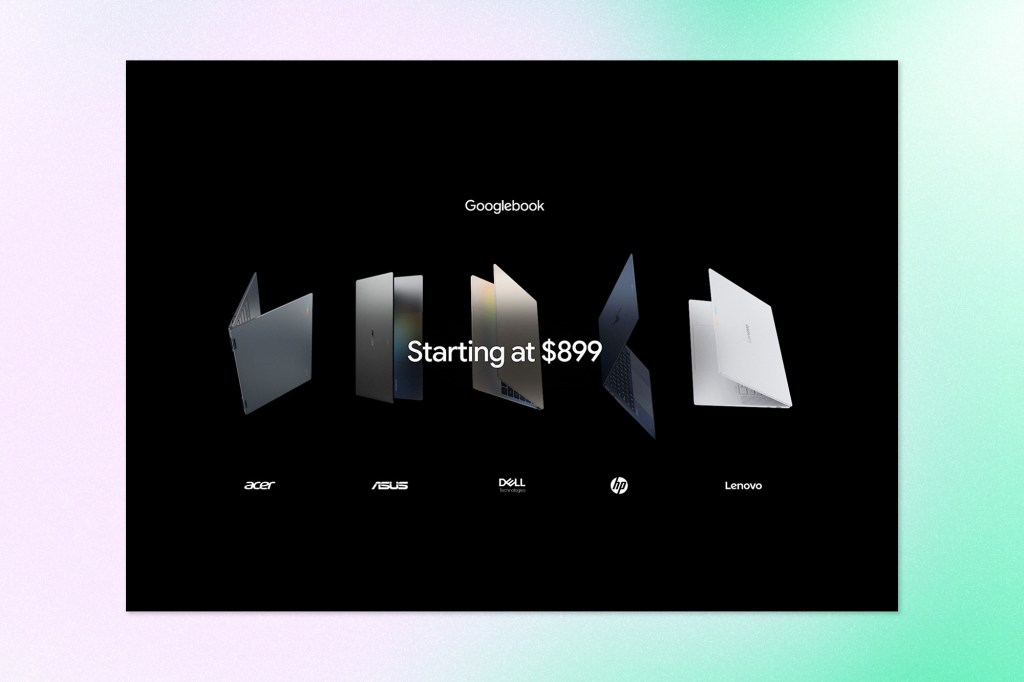
The hardware backs the pitch. The first wave comes from Acer, ASUS, Dell, HP, and Lenovo, starting at $899, with OLED touchscreens up to 2.8K, Intel or Qualcomm chips, on-device NPUs rated above 45 TOPS, and up to 14 hours of battery. Every unit bundles a year of Google AI Pro and a decade of OS updates, and devices ship October 4 in the U.S. and October 5 in Canada and several other markets.
The machines also ship with a full Linux terminal on a certified hypervisor, which Google positions for running agentic coding tools, naming Claude Code among them. So the same device pitches Gemini as the ambient assistant and stays open to rival agents doing the heavier automation.
Why it matters: The interesting move is Google making the assistant a property of the OS instead of a destination you navigate to, which changes the default from “open the AI tool” to “the AI is already here.” The dedicated NPUs matter here too: pushing over 45 TOPS on-device is what lets an ambient assistant run without a round trip to the cloud every time. For anyone building AI products, whoever owns the operating layer sets the assistant users reach for first, and everyone else competes for the tasks that assistant hands off. Google keeping the terminal open to agents like Claude Code is a quiet acknowledgment that owning the default does not mean owning the work.
Snap Unveils SPECS AR Glasses
Snap introduced SPECS, standalone augmented reality glasses now open for pre-order at $2,195, positioning AI that can see the wearer’s surroundings as the core of the pitch. The argument is that an assistant becomes more useful when it shares your view: instead of living in a text box, it can register what you are looking at, understand what you are trying to do, and surface guidance anchored to the objects and places in front of you. Snap pairs that with its long-running case that AR is the natural home for computing because it matches how people already take in the world, visually and in three dimensions.
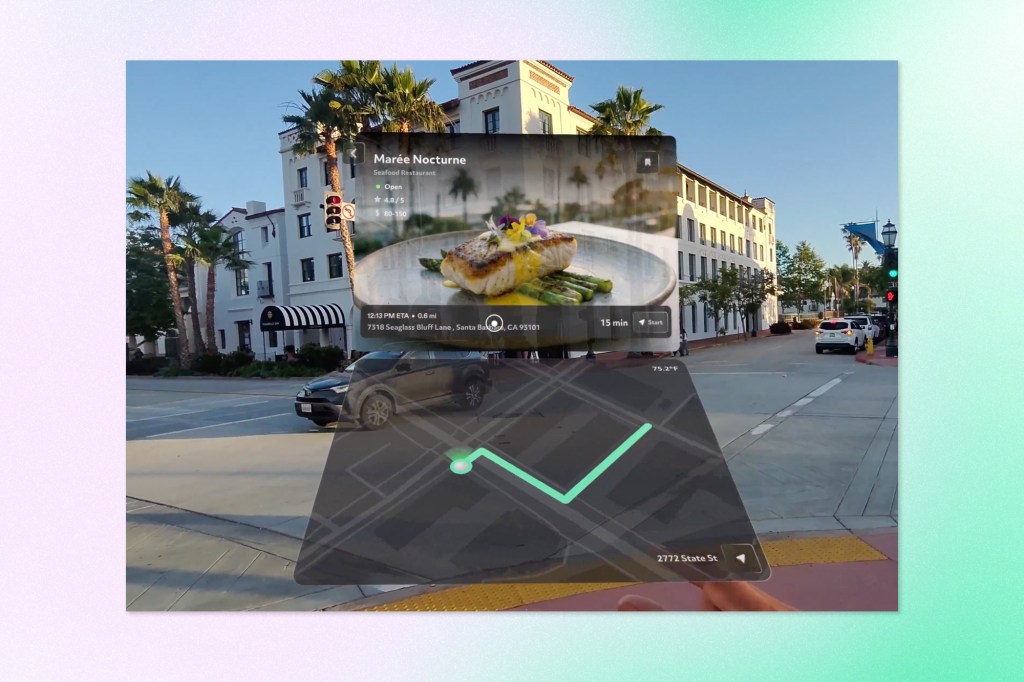
The hardware is built to make that wearable for hours rather than minutes. The glasses run on Swiss TR90 polymer, weigh about 132 to 136 grams depending on size, and use Snap’s own liquid-crystal-on-silicon display for a 51-degree field of view that reads like a 24-inch monitor up close or a home cinema screen at a distance. Two Snapdragon chips split computer vision and Lens processing, delivering 7-millisecond motion-to-photon latency and up to four hours of mixed-use battery, with roughly 20 hours via the charging case. Snap says it has filed more than 7,000 patents across the effort.
The developer story leans on AI too. Snap is rolling out a developer preview of agentic Lens building inside Lens Studio through Claude Code, Codex, and Cursor, alongside new benchmarking and migration tools. On privacy, the company stresses on-device processing, a recording indicator light, and clear prompts before sensitive data is accessed. SPECS are expected to ship this fall in the U.S., U.K., and France.
Why it matters: SPECS bets the next AI interface is not a screen you address but a view it shares, which makes the privacy design load-bearing: an AI that sees what you see is only adoptable if people trust what happens to that visual stream. The harder question is whether $2,195 glasses find an audience at all, since AR’s history is a graveyard of capable hardware that never crossed from demo to habit, and a novel AI layer does not fix the price and use-case problems that sank the category before.
🔬 Inside the Labs
Anthropic Publishes Metrics on How Fast AI Builds AI
Anthropic released a set of measurement tools meant to show, from inside a frontier lab, how much AI is now involved in building the next generation of AI. The centrepiece is an internal index of how automated the company’s own research and development has become. As of August 2026, Claude “leads” 26 percent of Anthropic’s AI R&D work, meaning it completes most of a task end-to-end from a high-level prompt while a human supervises, up from under one percent in February. More than 90 percent of the work sits at or above the level where AI at least collaborates, though no measured area is fully autonomous.
The company also detailed how it oversees the roughly 30,000 agents running research and engineering work on its main internal platform at any given time. Every action passes through a real-time monitor before executing, and over a billion decisions in August, about one in 47,000 was blocked. A second layer reads agent activity after the fact, flagging around 100,000 transcripts a week, of which roughly 50 reach human review. A third measurement tracks compute: in one sampled week, about six percent of AI R&D compute went to safety work.
Anthropic frames all of this as something any lab could report using a public methodology, and says it plans to embed independent third-party evaluators with access comparable to its internal risk teams. The stated purpose is to narrow the gap between what frontier labs know about their own pace and what the public can see, tied to CEO Dario Amodei’s call for coordination on slowing frontier development.
Why it matters: The number that lands is 26 percent going to leading in six months from a standing start, because it puts a figure on the recursive dynamic everyone talks about abstractly: the tools are now building meaningful chunks of their own successors. What makes the disclosure notable is less any single metric than the move to make the pace measurable at all, since a lab arguing for external oversight of its own speed is trying to set the terms of that oversight before regulators do.
Keep ahead of the curve – join our community today!
Follow us for the latest discoveries, innovations, and discussions that shape the world of artificial intelligence.