
A heavy week, with the business of AI front and center. OpenAI filed confidentially to go public, days behind Anthropic’s filing we covered last week, turning the rivalry into a race to the markets. Anthropic released its most capable model ever made publicly available and published a striking report on AI accelerating its own development. Apple finally rebuilt Siri, quietly leaning on Google to do it, while Airbnb’s CEO bet that the chatbot era is already giving way to something more visual. Google, for its part, told marketers the scramble to “optimize for AI” was mostly noise. Here’s what mattered.
Listen to the AI-Powered Audio Recap
This AI-generated podcast is based on our editor team’s AI This Week posts. We use advanced tools like Google NotebookLM, Descript, and Elevenlabs to turn written insights into an engaging audio experience. While the process is AI-assisted, our team ensures each episode meets our quality standards. We’d love your feedback—let us know how we can make it even better.
TL;DR
- Anthropic released Claude Fable 5, its most capable model ever made publicly available, using a safeguard that quietly routes risky cybersecurity and biology queries to Opus 4.8 rather than refusing them, and imposing mandatory 30-day data retention on all Mythos-class traffic.
- Apple rebuilt Siri around Apple Intelligence, with reporting confirming a Google Gemini partnership its own release won’t name, and a slow rollout that skips the EU and China for now.
- Google told everyone the “optimize for AI” cottage industry is mostly noise: for its Search, AEO and GEO are still just SEO.
- Airbnb’s CEO is funding a new AI lab betting that design and interface, not chatbots, are where AI’s value settles.
- OpenAI shipped Lockdown Mode, a security setting that disables browsing, agents, and research to limit what prompt injection attacks can steal.
- Anthropic published a report arguing AI is already accelerating its own development, with Claude now writing more than 80% of the company’s code, and made the case for building ways to verifiably pause frontier development.
- OpenAI filed confidentially to go public days after Anthropic did the same, setting up a race to the markets where Anthropic’s near-term profit and filing order put pressure on how OpenAI can price itself.
⚙️ New Models
Anthropic Releases Fable 5, its Most Capable Public Model Yet
Anthropic launched Claude Fable 5, a Mythos-class model and the most capable it has ever made generally available. The company says it is state of the art on nearly every capability benchmark tested, with the strongest leads on long, complex tasks across software engineering, knowledge work, vision, and scientific research. Stripe reported in early testing that Fable 5 compressed months of engineering into days, completing a codebase-wide migration of a 50-million-line Ruby codebase in a day, work a team would have taken over two months to do by hand. On vision, it beat Pokémon FireRed using only raw screenshots, where earlier Claude models needed elaborate helper tools to play at all. Pricing is $10 per million input tokens and $50 per million output, less than half what Mythos Preview cost.

The release is built around a routing safeguard rather than refusals. When Fable 5’s classifiers detect a request touching cybersecurity, biology and chemistry, or attempts to distill the model into a competitor, the response is handled instead by Claude Opus 4.8, and the user is told when it happens. Anthropic tuned these conservatively, so they sometimes catch harmless requests, but says they trigger in fewer than 5% of sessions, and that for the rest Fable performs effectively the same as the unrestricted model. The company stress-tested the classifiers with an external bug bounty that found no universal jailbreaks in over 1,000 hours, though it notes the UK AI Safety Institute made early progress toward one. Alongside Fable, Anthropic is releasing Mythos 5 to a small set of cyberdefenders and infrastructure providers through Project Glasswing in collaboration with the US government, the same underlying model with cyber safeguards lifted, and plans a trusted access program for biology researchers later.
The launch carries some notable strings. Anthropic is imposing mandatory 30-day data retention on all Mythos-class traffic, including for business customers who previously had zero-retention agreements, to help detect novel attacks and reduce false positives, and says the data will not be used for training. The rollout to subscription plans is also staged: Fable 5 is included on Pro, Max, Team, and Enterprise plans through June 22, after which continued use will require usage credits until capacity expands.
Why it matters: This lands days after Anthropic’s own report warning that AI is accelerating AI, and the timing is not accidental. The same company arguing the world should build a brake pedal for frontier development just shipped its most powerful public model, which is either a contradiction or a demonstration of its actual thesis: that capable models can be released safely if the safeguards are built first. The routing design is the genuinely interesting move. Instead of refusing risky queries or opening everything up, Anthropic quietly downgrades you to a weaker model on sensitive topics, which is a more graceful failure than a flat refusal and a template other labs will likely copy.
🚀 Products and Strategy
Apple Rebuilds Siri and Apple Intelligence on Gemini
Apple introduced the next generation of Apple Intelligence and an entirely new Siri AI, with the underlying Apple Foundation Models custom-built in collaboration with Google and its Gemini models. The models run on device and on servers using Private Cloud Compute. Siri AI is positioned as more conversational and personal, with a dedicated app, integrated Writing Tools, and Visual Intelligence across platforms, able to search a user’s messages, emails, and photos, answer open questions, and take action inside apps.
The system-wide features are where the rebuild shows up day to day. Photos gains Spatial Reframing, which shifts a shot’s perspective as if the camera had moved, an Extend tool that fills in around a crop, and a stronger Clean Up, with every AI-edited photo carrying a hidden SynthID watermark. Safari can group tabs into topics, watch a page for changes like restocks or price drops, build a custom extension from a description, and let Passwords agentically log into sites to upgrade weak credentials. Image Playground now generates photorealistic images through a Private Cloud Compute model, also SynthID-watermarked. Messages and Mail get context-aware one-tap suggestions and a personalized Smart Reply, Call Context surfaces a confirmation number when you phone a business using on-device processing, and Shortcuts can assemble an automation from a plain-language description.

Apple put privacy at the center of the architecture, saying that when Private Cloud Compute handles a request, personal data is neither stored nor accessible to Apple or anyone else, with outside experts able to verify that at any time. The rollout is staged: developer testing starts now, a public beta arrives next month, and the features reach users this fall with iOS 27 and the rest of the lineup, though Siri AI specifically will not launch initially in the EU on iPhone and iPad or in China while Apple works through regulatory requirements.
Why it matters: The Gemini partnership is the real story. After years of criticism for lagging, Apple effectively conceded it could not build a competitive foundation model on its own timeline and built its next generation with Google instead, then wrapped the result in its own privacy architecture. The differentiation Apple is betting on is no longer the model. It is the integration, the on-device and Private Cloud Compute privacy promises, and the reach into apps people already use every day.
Google’s Verdict on AEO and GEO: It’s Still SEO
Google Search Central published an official guide on optimizing for its generative AI features, and the central message is that the playbook has not changed. Because generative AI features in Google Search are rooted in its core ranking and quality systems, standard SEO best practices remain relevant. Those features pull from the same Search index using techniques like retrieval-augmented generation, which grounds AI answers in retrieved pages and links back to them, and query fan-out, where the model spins off related searches to gather fuller results. Google’s position on the newer acronyms is blunt: from its perspective, optimizing for generative AI search is optimizing for the search experience, and therefore still SEO, regardless of whether people call it AEO or GEO.
The guide spends real time debunking tactics it considers wasted effort. You do not need to create LLMs.txt files or other special machine-readable markup to appear in generative AI search. It also waves off chunking content into tiny pieces, rewriting pages specifically for AI systems, chasing inauthentic mentions across the web, and overfocusing on structured data. What it does emphasize is non-commodity content with a genuine point of view: a first-hand review or lived-experience piece over a generic listicle that restates what is already everywhere. It also nods to where things are heading, pointing to agentic experiences and emerging standards like the Universal Commerce Protocol that let search agents act on a site’s behalf.
Why it matters: This is the dominant search player telling everyone to ignore the cottage industry that has sprung up around “optimizing for AI,” and that is worth weighing carefully given the source. Google has an interest in keeping the optimization conversation centred on its existing systems, but the underlying claim is technically credible: AI Overviews retrieve from the same index, so the inputs that earn ranking are the inputs that earn citations. For content teams, the practical takeaway cuts against a lot of current vendor noise. The advice to favour first-hand, non-commodity content is also a direct signal about what survives in an AI-mediated search world, where summarizing what already exists is exactly the work a model does for free. The part not to skip is the agentic section. Google is quietly flagging that browser agents and commerce protocols will start interacting with sites directly, which is a different optimization problem than ranking for human readers and one most teams have not begun to think about.
Airbnb’s CEO Bets AI’s Future Is Design, Not Chat
Airbnb CEO Brian Chesky is in the early stages of funding a new AI lab, first reported by Bloomberg, that will develop its own models with a focus on user interaction and design rather than text-based chatbots. The venture is separate from Airbnb, and Chesky will stay on as CEO without leading the new lab day-to-day. The thinking traces back to a position he has held for years: AI for travel and e-commerce needs a rich user interface, not the kind of text-based chatbots popularized by OpenAI and Anthropic. That conviction is also why Airbnb, unlike rivals Expedia and Booking, has never struck an LLM partnership, with Chesky arguing existing products weren’t ready for high-stakes travel use.
There is a personal subplot. Chesky met Sam Altman through Y Combinator in 2006, advised him on public relations, and rallied Silicon Valley support during OpenAI’s turmoil; now he appears to be entering competition with him. Chesky studied design before co-founding Airbnb, and the new lab leans directly into that background. It also places him among a wider group of founders who are dissatisfied with what the frontier labs are shipping and want to build alternatives.
Why it matters: Chesky is making a contrarian bet at the exact moment the rest of the industry is consolidating around the chatbot as the universal interface. His wager is that the model is becoming a commodity and the durable advantage lives in how AI feels to use, which is a designer’s view of where value settles once the underlying capability is everywhere. It echoes the Apple story from earlier this issue: when the model is something you can rent or assume, differentiation moves up to the experience layer. The skeptical read is that building competitive models is brutally expensive, and plenty of founders have concluded that interface is the answer mostly because models are the part they cannot easily build. For anyone designing AI products, including teams thinking about how AI surfaces inside their own platforms, the useful question Chesky is raising is whether a chat box is actually the right container for complex, visual, high-stakes tasks, or just the one that shipped first. That question matters well beyond travel.
Ready to explore what AI can do for your organization?
🛡️ Safety & Security
OpenAI Ships Lockdown Mode for ChatGPT
OpenAI introduced Lockdown Mode, an optional security setting that trims back the features ChatGPT can reach out to the web with, on the logic that fewer outbound connections mean fewer ways for stolen data to escape. It is built for organizations handling sensitive data, designed to reduce exposure to prompt injection attacks where malicious instructions in web content can hijack AI responses. Turning it on disables live web browsing beyond cached pages, blocks ChatGPT from retrieving or showing images pulled from the web, and switches off deep research and agent mode. File downloads for data analysis are cut too, though manually uploaded files still work, and image generation stays available. It is rolling out to all personal accounts, including Free, Go, Plus, and Pro, plus self-serve ChatGPT Business accounts.
The framing OpenAI uses matters. Lockdown Mode does not stop prompt injections from appearing in content ChatGPT processes, including uploaded files and cached pages; the protection targets the exfiltration step so malicious instructions cannot use ChatGPT as a pipeline to send data out. The attack can still land and skew what the model says. What it cannot easily do is ship your data somewhere. OpenAI also notes the feature does not touch memory, training settings, or conversation sharing, which are configured separately.
Why it matters: This is OpenAI admitting, in a product feature, that prompt injection is an unsolved problem rather than a bug it can patch. The honest part is also the uncomfortable part: the best defence it can offer is to amputate the very capabilities that made agentic ChatGPT compelling in the first place. Browsing, research, agents, all the things that let the model act on your behalf are exactly the things that let an attacker act through it, so the safe configuration is the one that does less. For Canadian organizations in regulated sectors like healthcare and financial services, this reframes the procurement conversation. A named security mode gives compliance teams something concrete to point at, but it also signals that the default product was never built for their threat model. The deeper lesson for anyone deploying AI agents is that capability and exposure are the same surface, and you cannot expand one without expanding the other.
🧐 Frontier & Research
Anthropic Publishes Its Case that AI Is Now Accelerating AI
The Anthropic Institute released a report arguing that AI development is already being sped up by AI itself, and that the trend points toward recursive self-improvement: a system capable of designing and building its own successor. The report is careful to say that moment has not arrived and is not inevitable, but warns it could come sooner than most institutions are ready for.
The headline figure is that as of May 2026, more than 80% of the code merged into Anthropic’s codebase was written by Claude, up from low single digits before Claude Code launched in early 2025. The typical engineer now merges roughly eight times as much code per day as in 2024, though the report flags that lines of code is a crude measure that almost certainly overstates the real productivity gain. It backs the internal data with public benchmarks: the length of tasks models can reliably complete has been doubling about every four months, and tests like SWE-bench and CORE-Bench have gone from near-zero to saturated within two years.
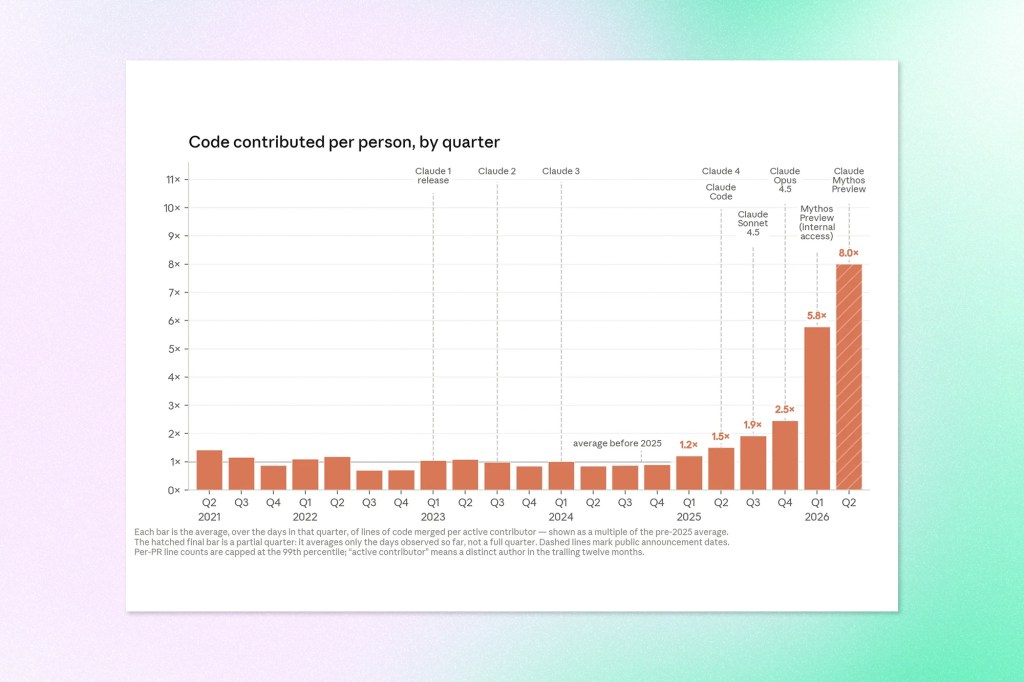
The more interesting claims are about where the human role is shrinking. Anthropic says Claude can now take an underspecified engineering problem and work out the method itself, with humans only supplying the goal. On the hardest open-ended tasks, Claude’s success rate hit 76% in May, up 50 points in six months. The company says Claude-written code was worse than human work in late 2025, sits at rough parity now, and is expected to surpass it within the year. It also put an automated Claude reviewer into its pipeline and found, in retrospect, it would have caught about a third of the bugs behind past claude.ai incidents. In one April case, Claude shipped over 800 fixes that cut a class of API errors a thousandfold, work a human was estimated to need four years for. On research, Claude went from a roughly 3x to a 52x speedup on a fixed code-optimization test in under a year, and in one demonstration, agents recovered 97% of a target performance gap on an open safety problem, against 23% for two human researchers, albeit with humans still choosing the problem and the scoring.
What stays human, for now, is taste: deciding which problems matter, which results to trust, and when a path is dead. The report is unusually frank about the cost of all this, including engineers describing collaboration eroding as Claude absorbs the small favours that built trust, and one saying that on smooth days it feels like nothing they do matters. It closes by sketching three futures and arguing that the world should build the ability to verifiably slow or pause frontier development, while conceding a unilateral pause mostly just hands the lead to someone else.
Why it matters: The 80% figure will get quoted everywhere as a productivity flex, but the report’s real value is the reasoning around it, especially the Amdahl’s law point: speeding up any single stage just relocates the bottleneck rather than removing it. Anthropic’s own constraint moved straight to human review, which is exactly where most organizations adopting this will land next, so knowing it in advance is useful. The pause-and-verification section is the most constructive part: a frontier lab trying to build coordination machinery that does not yet exist and inviting policymakers and researchers into the conversation while there is still room to shape it.
📊 The Business of AI
OpenAI Files to Go Public, Days Behind Anthropic
OpenAI confirmed it has submitted a confidential draft registration to the SEC for an IPO, announcing the move itself because it expected the news to leak. The company was clear that timing is undecided, saying some of what it wants to do is easier as a private company but that the filing keeps the option open to go public sooner. The step comes about a week after Anthropic filed its own confidential paperwork, turning the rivalry between the two into a race toward the public markets. OpenAI was last valued at $852 billion in a March round that raised $122 billion, and it reports roughly 900 million weekly active users.
The financial picture is the tension running through the whole story. OpenAI has reportedly missed its own user and revenue targets, and CFO Sarah Friar has raised concerns about whether the company can sustain its data center spending. By its own projections cited in the Journal, it expects to keep burning cash for years, spending on compute at a scale that outruns revenue. Anthropic, by contrast, has told investors it is close to its first quarterly profit, and recently surged past OpenAI to a $1 trillion valuation on the secondary platform Forge Global. The order of filing matters beyond bragging rights: Anthropic’s disclosures will set a valuation comp that constrains how OpenAI can price its own offering, and a PitchBook report characterized OpenAI as overvalued relative to its fundamentals. SpaceX is expected to debut first among the three, and experts say whoever lists earliest captures more of an increasingly scarce pool of AI capital.
The filing also surfaces governance and legal baggage that public investors will examine: the 2022 board ouster and reinstatement of Sam Altman, a recently dismissed lawsuit from Elon Musk, and a Florida suit alleging the company harmed children.
Why it matters: Two of the most important AI companies in the world are about to do something they have never had to do, which is open their books. Private valuations are set by a small circle of investors who can price on narrative; public markets price on disclosure, and the gap between the two is the real event here. OpenAI is asking investors to back a business that, by its own forecast, will spend more than it makes for years, which is a defensible bet on a company defining a category but a very different proposition once it sits next to audited financials. The sequencing with Anthropic is the sharp part. By filing first and pointing to a near-term profit, Anthropic gets to set the benchmark the market reads OpenAI against, and a conservatively priced Anthropic makes OpenAI’s target harder to reach.
Keep ahead of the curve – join our community today!
Follow us for the latest discoveries, innovations, and discussions that shape the world of artificial intelligence.