
The “agentic web” is where AI tools do more than generate text or answer questions. They can discover what a website can do, understand the rules around those actions, and complete tasks with the right permissions and approvals. In the WordPress ecosystem, that could mean drafting a post, updating product data, auditing media metadata, creating a new content model, or helping maintain a portfolio of websites.
That may sound futuristic, but the foundation is already being built. WordPress has introduced the Abilities API in WordPress 6.9, an official MCP Adapter, and a provider-agnostic AI Client in WordPress 7.0. Those pieces point to a larger transformation. WordPress is becoming agent-addressable.
For agencies, enterprise teams, publishers, and commerce brands, this is not just another AI trend. It is a structural change in how WordPress sites may be built, managed, optimized, and governed.
A Different Kind of Web Is Taking Shape
For years, websites were built for two main audiences. People read the pages, clicked the buttons, filled out the forms, and bought the products. Search engines crawled the pages, interpreted the metadata, and ranked the content.
Now a third audience has arrived: AI agents. These systems do not browse a website the way a person does. They need clean content, structured signals, clear permissions, and reliable ways to interact with services. That idea changes the role of WordPress. A traditional WordPress site might publish content for readers and use SEO plugins to help Google understand the page. An AI-ready WordPress site has to go further. It needs content that can be interpreted by agents, actions that can be safely called by agents, and governance that keeps those agents from doing anything risky without oversight.
This is where the agentic web becomes more concrete. It is not simply a chatbot sitting in the corner of a website. It is a new operating model where AI can interact with the website itself. That interaction might be read-only, like summarizing analytics or finding missing alt text. It might be draft-only, like preparing content for review. Or it might be action-oriented, like creating a product, updating a category, or moving a comment to trash.
The crucial word is “controlled.” Agentic does not have to mean autonomous in the reckless sense. The WordPress examples emerging in 2026 are mostly built around permissions, explicit confirmation, and role-based access. That makes sense. A website is not a toy. It holds brand reputation, customer data, product information, editorial history, and sometimes payment workflows.
The most useful way to think about the WordPress agentic web is this: the dashboard is no longer the only interface. AI agents are becoming another way to work with the platform.
WordPress Is Becoming Agent-Addressable
AI image generation and text generation are useful, but the bigger change is happening in the infrastructure. WordPress is being prepared so AI agents can understand what the system can do and act through standardized, permissioned pathways.
That starts with three core ideas: the Abilities API, the MCP Adapter, and the AI Client.
The Abilities API Gives WordPress a Shared Language for Action
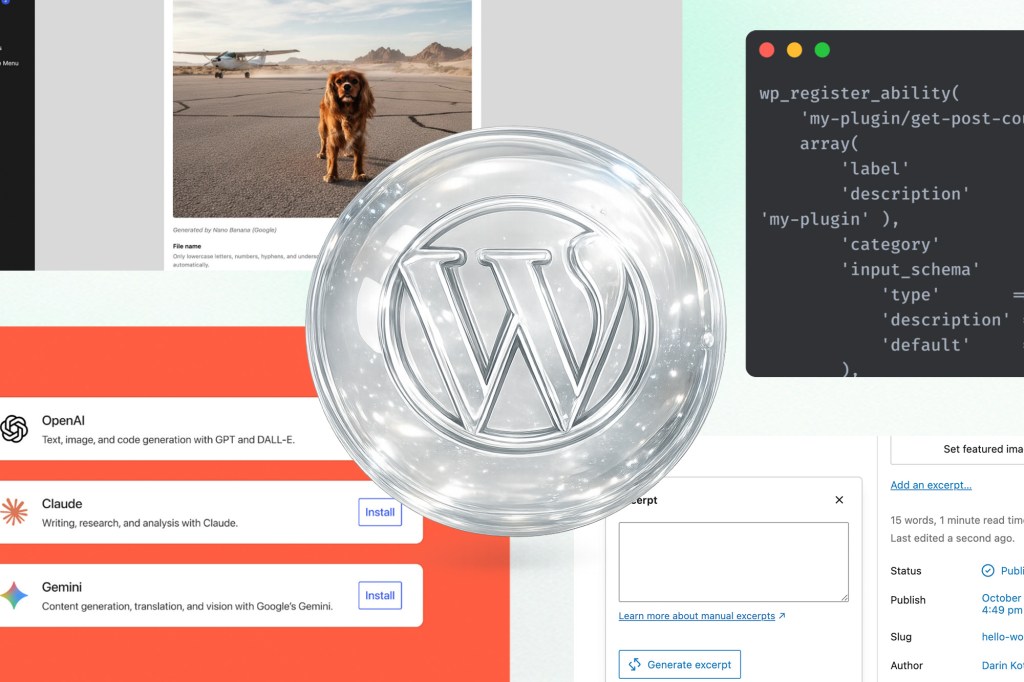
The Abilities API, introduced in WordPress 6.9, lets WordPress core, plugins, and themes register their capabilities in a standardized, machine-readable way. In plain terms, it gives WordPress a shared language for describing what the site can do.
An “ability” is a self-contained unit of functionality. It has a name, inputs, outputs, permission rules, and execution logic. That matters because AI agents need more than a vague sense that a website has posts, users, products, forms, or fields. They need a structured contract. What action is available? What information is required? What will be returned? Who is allowed to run it?
Before this kind of structure, automation often relied on custom REST integrations, plugin-specific APIs, or brittle workarounds. The Abilities API creates a more consistent path. A plugin can expose a capability, and an authorized tool can discover and use that capability without guessing how the plugin works.
Plugins have traditionally competed through admin screens, blocks, shortcodes, templates, and integrations. In an agentic environment, they may also compete through the quality of their abilities. A plugin that exposes safe, well-documented, useful abilities becomes easier for agents to work with.
MCP Turns Those Abilities Into Tools Agents Can Use
The Model Context Protocol, usually shortened to MCP, is an open protocol that helps AI assistants connect with external tools and systems. The official WordPress MCP Adapter translates WordPress abilities into MCP tools, resources, and prompts.
That translation is important. AI clients such as Claude Desktop, Claude Code, Cursor, and VS Code can use MCP to discover what a WordPress site exposes and then call approved functionality through a structured interface. The agent does not need to click through wp-admin like a person. It can interact with available tools directly.
The MCP Adapter documentation describes a three-part model: agents can discover abilities, retrieve information about a specific ability, and execute an ability. That turns WordPress into something closer to an AI-operable system, not just a human-operated website.
There is also a safety lesson in the MCP documentation. The recommendation is to start with read-only, non-destructive abilities, then expand gradually as confidence grows. That is the right mindset. Agentic WordPress should grow from controlled experiments, not broad access handed to an AI client on day one.
The AI Client Standardizes How Plugins Call Models
The AI Client introduced in WordPress 7.0 adds another piece. It gives plugins a provider-agnostic PHP API for sending prompts to AI models and receiving results through a consistent interface.
The key idea is simple. Plugin developers should not have to build separate integrations for every model provider. Site owners should not have API keys scattered across a dozen plugins. The AI Client and Connectors API are designed so model providers can be configured centrally, while plugins can request the AI capability they need through WordPress.
This could reshape the plugin market. Basic AI integration may become less distinctive over time. The more valuable layer will be the workflow around the AI. That includes domain knowledge, content governance, approval logic, structured outputs, logging, and safe use of site context.
In other words, the question will not be, “Does this plugin use AI?” The better question will be, “Does this plugin use AI responsibly inside the WordPress architecture?”

WP Engine Is Making WordPress Content Agent-Ready
WP Engine adds another enterprise layer to the WordPress agentic web conversation: retrieval. While some agentic workflows focus on actions like editing content or managing products, WP Engine’s approach is about helping AI agents access accurate, current site content through a structured interface.
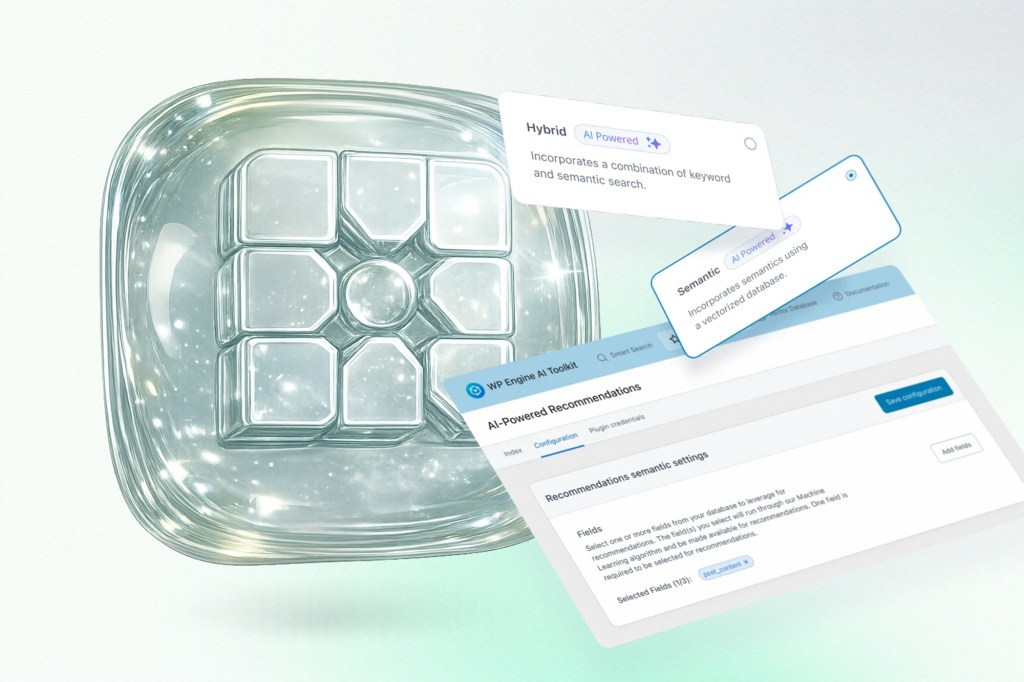
Its AI Toolkit includes Smart Search AI, AI-Powered Recommendations, and a Managed Vector Database designed to make WordPress content searchable and usable by AI applications. The Managed Vector Database extracts, cleans, vectorizes, and updates WordPress content so developers can build AI-powered search, recommendations, chatbots, and other experiences without maintaining a separate indexing pipeline.
The strongest agentic piece is WP Engine’s Smart Search AI MCP Server. WP Engine describes it as a feature that turns a WordPress site into a real-time knowledge base for external LLMs through the Model Context Protocol. When enabled, it exposes “fetch” and “search” tools so connected AI systems can retrieve public, published content from the live site through MCP instead of relying on stale scraped data.
That makes this a clear read-side agentic pattern. The AI agent is not editing the WordPress site or changing settings, but it is using the site as a live, structured knowledge source. For large enterprise sites with documentation libraries, product catalogues, newsroom archives, research hubs, or support content, that distinction matters. A static sitemap can show what pages exist. An MCP-enabled search layer can help an agent retrieve the most relevant and current information when it needs it.
This also broadens the definition of agentic WordPress in a useful way. Agentic does not always mean “an AI changes the website.” Sometimes it means the website becomes a trusted tool that an AI agent can call. In WP Engine’s case, WordPress becomes part of the agent’s knowledge workflow, supplying fresh content through a controlled retrieval layer.
For enterprise teams, that is a practical and lower-risk entry point into the agentic web. Before giving AI agents permission to create, edit, or delete content, organizations can start by making approved public content easier for agents to retrieve accurately. That creates value without immediately expanding the risk surface into write access, publishing, or administration.
WooCommerce Is Preparing for Agentic Commerce
Commerce is one of the most important areas to watch because AI agents are not only changing how people find information. They are beginning to change how products are discovered, compared, and purchased.
WooCommerce has already started moving in this direction. In October 2025, WooCommerce described its work on AI and agentic commerce, including the first version of WooCommerce MCP and its relationship to the WordPress Abilities API.
Store Management Is the First Layer
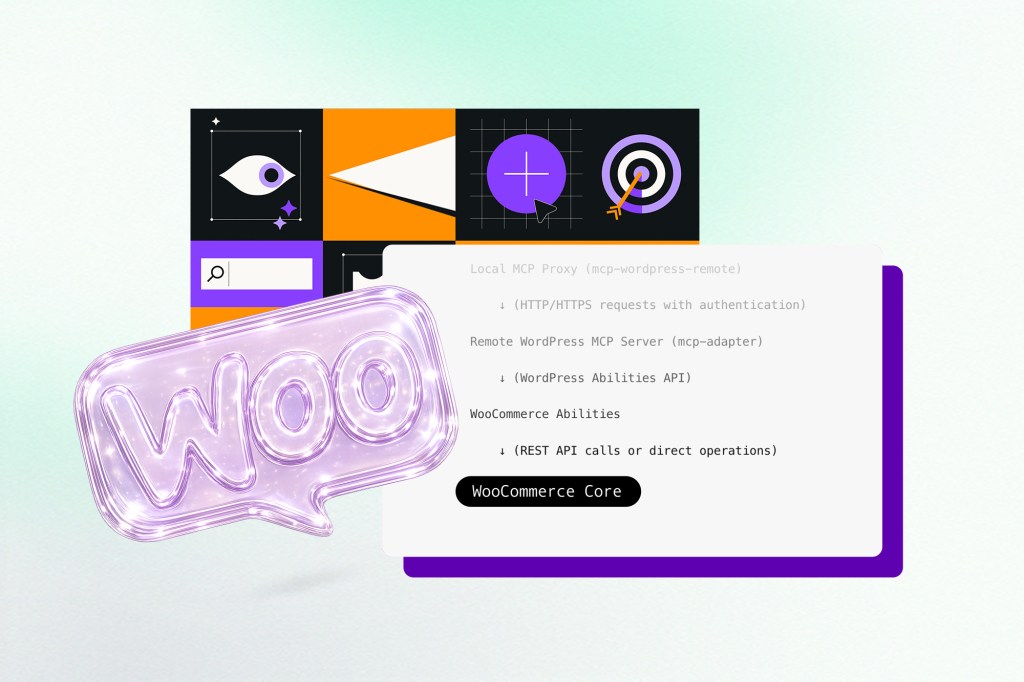
The first practical layer is store administration. WooCommerce MCP lets AI assistants interact with WooCommerce stores through a standardized approach. Its initial scope includes product and order management, such as searching for products, adding products, updating catalogue items, creating orders, and managing orders.
By April 2026, WooCommerce described the feature as a developer preview, with built-in abilities for products and orders and examples such as listing low-stock products, creating a product, updating a price, and creating an order. The workflow uses the WordPress Abilities API and the MCP Adapter to let AI clients communicate with WooCommerce through approved tools.
This has clear operational value. Store teams often spend time on repetitive catalogue work, order checks, inventory reviews, and product updates. An agent that can safely help with those tasks could reduce dashboard time and make store operations more conversational.
Still, commerce requires extra caution. A blog draft can be reviewed before publication. A product price change, order update, or inventory adjustment can affect revenue, customer experience, and fulfilment. That is why permissions, staging, confirmations, and logs matter even more in WooCommerce than in ordinary content workflows.
Agentic Checkout Is the Larger Shift
The bigger commerce shift is not just managing a store with an agent. It is selling through agents.
WooCommerce has described agentic commerce as a move from destination-based shopping toward more ambient shopping experiences, where AI agents can help users discover products and potentially complete purchases on their behalf. In that world, the storefront may not always be the first stop. Product discovery could begin inside an AI assistant.
Agentic commerce is not simply a new sales channel. It is a new layer of distribution and trust.
The Agency Opportunity Is Not “Add AI”
The easiest mistake is to treat this as a feature race. Add a chatbot. Add a content generator. Add an AI button somewhere in the editor. That may create a demo, but it does not create a strategy.
The better opportunity is agent readiness.
WP Engine’s April 2026 AI Agency Trends Report found that 63% of agencies are investing in AI tools and platforms, 72% have adjusted development and design practices for AI-friendly websites, and 85% strongly agree that AI web optimization is as pivotal to client success as mobile-responsive design was in the 2010s (WP Engine AI Agency Trends Report). Those results point to growing operational integration across organizations.
The Real Opportunity Is Readiness, Governance, and Strategy
Agent readiness is broader than plugin installation. It includes content structure, permissions, hosting, integrations, analytics, deployment workflows, security posture, and internal governance.
A WordPress estate with outdated plugins, unclear roles, messy content models, weak staging practices, and no audit logging is not ready for broad agentic access. An agent could make work faster, but it could also make mistakes faster.
A better foundation looks different. Content is structured. Roles are clear. Staging is used properly. High-risk actions require approval. Logs capture what happened. AI tools are approved. Sensitive data is not pasted into public models. Editorial and legal reviews are built into the workflow where needed.
That is where agencies can create real value. The work is not only implementation. It is assessment, architecture, governance, workflow design, and change management.
Ready to explore what AI can do for your organization?
Enterprise Adoption Depends on Trust
Enterprise teams will not adopt agentic WordPress because it sounds impressive. They will adopt it when the risk model is credible.
WordPress VIP’s guidance on AI content risk is clear about the categories that matter: legal and IP risk, regulatory and compliance risk, brand and reputational risk, and operational risk (WPVIP). The same guidance highlights issues such as shadow AI, data leakage, hallucinated facts, lack of standards, and auditability failures.
Those concerns become sharper when AI agents can act inside WordPress. A hallucinated paragraph is one kind of risk. An agent updating live product data, changing user roles, deleting content, or modifying a plugin setting is another.
This is why human-in-the-loop models are not a temporary training wheel. They are part of the enterprise architecture. Agentic systems need to be observable, constrained, reversible where possible, and aligned with business policy.
Trust is not created by saying the AI is safe. Trust is created by designing the workflow so that safety can be verified.
What This Means for Enterprise Teams
The agentic WordPress conversation should stay practical. The opportunity is real, but it needs to be tied to business priorities: better content operations, stronger accessibility workflows, cleaner structured data, safer site maintenance, more efficient ecommerce operations, and improved readiness for AI-mediated discovery.
The question is not whether AI belongs in WordPress. It already does. The better question is where it belongs, what it should be allowed to touch, and how its work should be reviewed.
A media organization may care most about editorial workflows, metadata, content reuse, and AI visibility. A public sector or regulated organization may care most about governance, accessibility, audit trails, and approved tools. A WooCommerce merchant may care most about product data, inventory accuracy, checkout trust, and future agentic commerce channels. A large enterprise may care about all of the above, spread across many sites and stakeholders.
That is why a generic AI rollout will not be enough. WordPress agentic readiness needs to reflect the organization’s actual digital estate. The same tool can be low-risk in one environment and high-risk in another.
The deeper story is not that WordPress is adding AI. The deeper story is that WordPress is being prepared for a web where AI agents become readers, operators, assistants, and intermediaries. That creates opportunity, but it also raises the bar for structure, governance, trust, and technical strategy. The most sensible path is phased. Start with read-only analysis and draft-only support. Move into structured content and workflow improvements. Add controlled actions with approvals. Use staging and sandbox environments for development. Keep governance close to the work instead of treating it as paperwork after the fact.
Trew Knowledge helps organizations plan, build, and evolve enterprise WordPress experiences with the right balance of innovation and control. For teams exploring AI-ready WordPress, agentic workflows, structured content, governance, or enterprise platform strategy, Trew Knowledge can help turn the conversation into a practical roadmap grounded in business value. Start a conversation with our experts.