
The past week delivered a stark reminder that the rapid advancement of artificial intelligence comes with real-world consequences. OpenAI found itself implementing emergency safety protocols after ChatGPT’s failures in mental health crisis situations, while simultaneously restructuring its leadership around a billion-dollar acquisition focused on product optimization. Elsewhere, the industry continued its relentless push into consumer applications, with Amazon launching real-time visual shopping through Lens Live and WordPress unveiling an AI tool that generates website components from simple text prompts. Canadian telecom giant Telus has chosen to bring its AI-focused subsidiary back under direct control, signalling how companies are consolidating their artificial intelligence capabilities for a competitive advantage.
Listen to the AI-Powered Audio Recap
This AI-generated podcast is based on our editor team’s AI This Week posts. We use advanced tools like Google Notebook LM, Descript, and Elevenlabs to turn written insights into an engaging audio experience. While the process is AI-assisted, our team ensures each episode meets our quality standards. We’d love your feedback—let us know how we can make it even better.
🇨🇦 Canadian Innovation Spotlight
Telus Reacquires Digital Spinout in $743M CAD Strategic Consolidation
Canadian telecom giant Telus is bringing its AI-focused subsidiary back into the fold through a $743 million CAD acquisition that reflects broader industry consolidation around artificial intelligence capabilities. The deal sees Telus purchasing all outstanding shares of Telus Digital for $4.50 USD per share, representing a significant premium over the spinout’s recent trading levels.
The reacquisition marks a strategic reversal for Telus, which spun out its digital services division as Telus Digital in 2021 during the IPO boom. The subsidiary, which provides customer experience management and AI consulting services through proprietary platforms, has seen its stock price decline 85% since its public debut at $25 USD per share.
Telus CEO Darren Entwistle positioned the move as essential for maximizing AI integration across the company’s diverse business units, including telecommunications, healthcare, and agriculture divisions. The “closer operational proximity” between parent and subsidiary is expected to accelerate software-as-a-service transformation and enable more cohesive AI deployment strategies.
This consolidation aligns with Telus’s broader AI infrastructure investments, including a recent partnership with Nvidia to transform select data centres into “sovereign AI factories.” The company appears to be positioning itself as a comprehensive AI services provider rather than maintaining separate entities for digital capabilities.
The acquisition also reflects market realities for many Canadian tech companies that went public during 2021’s IPO surge. Like several peers from that cohort, Telus Digital struggled to maintain public market valuations amid changing investor sentiment, making private ownership more attractive for long-term strategic development.
The transaction requires shareholder, regulatory, and court approvals before closing later this year, after which Telus Digital will delist from both the Toronto and New York stock exchanges.
Canada Hosts Major AI Convergence with ALL IN 2025
Montreal prepares to welcome over 6,000 AI professionals from nearly 40 countries as ALL IN 2025, Canada’s premier artificial intelligence conference, announces its speaker lineup for September 24-25. The event positions itself as a comprehensive showcase of Canada’s growing influence in the global AI ecosystem, featuring participation from both homegrown champions and international industry leaders.
The conference brings together an eclectic mix of participants spanning the entire AI value chain, from infrastructure providers to end-user organizations implementing AI solutions. Notable speakers include Cohere co-founders Aidan Gomez and Nick Frosst, Mistral AI’s Arthur Mensch, and senior executives from Nvidia and AMD, alongside prominent Canadian AI researchers like Yoshua Bengio from Mila.
Scale AI has structured the event around five thematic areas covering societal impact, business transformation, data innovation, workforce evolution, and environmental sustainability. Special programming includes an AgriTech AI Challenge supported by international organizations and guided tours designed to highlight Canada’s AI research and commercial capabilities.
The gathering reflects Canada’s strategic positioning in artificial intelligence, particularly through Quebec’s concentration of AI research talent and infrastructure. Government participation from multiple ministers underscores the policy attention surrounding AI development, with officials emphasizing Canada’s commitment to responsible AI advancement that aligns with national values.
Beyond networking and knowledge sharing, ALL IN 2025 serves as a platform for Canadian AI companies to demonstrate their capabilities to international audiences. The event includes dedicated spaces for startup demonstrations and themed pavilions focusing on infrastructure and cybersecurity applications, potentially facilitating partnerships and investment opportunities that could accelerate Canada’s AI sector growth.
🔧 Developer Tools
WordPress Launches Telex: Experimental AI Tool for Block Development
WordPress has introduced Telex, a new AI-powered development tool that enables users to create WordPress blocks through conversational prompts. Unveiled at WordCamp US 2025, the experimental platform allows developers to describe desired functionality and receive ready-to-install plugins in return.
The tool reflects WordPress’s strategy to integrate AI capabilities while maintaining its open-source philosophy. Users interact with Telex by describing the type of content block they need, whether for animations, layouts, or interactive features. The system then generates a zip file containing the necessary code, which can be deployed directly to WordPress sites or tested in WordPress Playground.
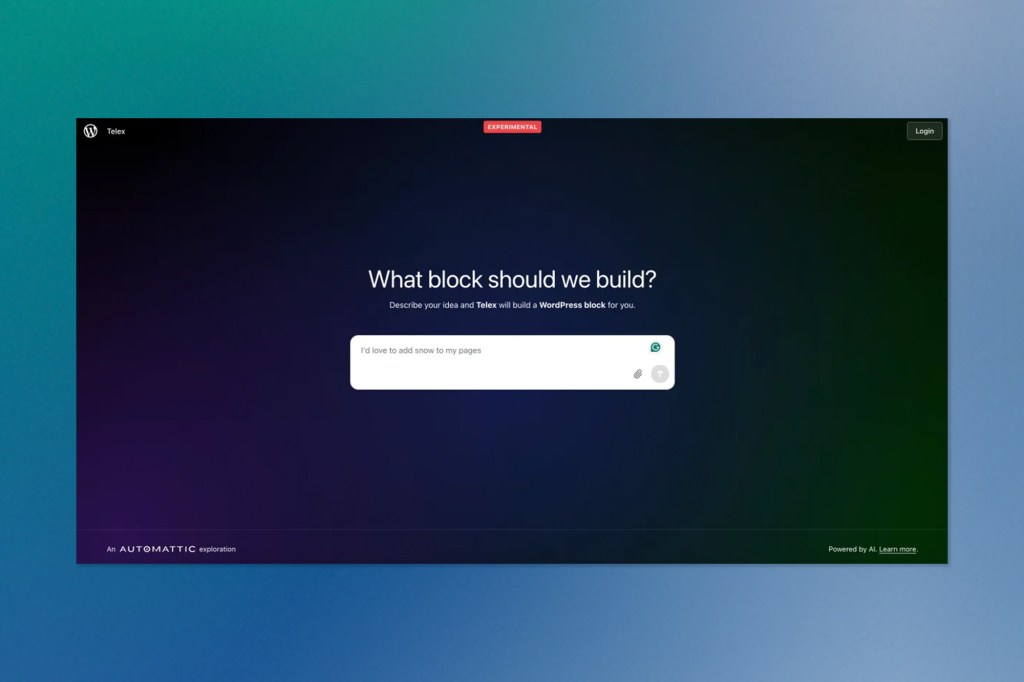
Matt Mullenweg emphasized how Telex supports WordPress’s democratization mission by reducing the technical knowledge required for custom development. The AI tool aims to make advanced web functionality accessible to users regardless of their coding background, continuing WordPress’s tradition of lowering barriers to digital publishing.
Early adoption has revealed limitations, with some generated blocks requiring additional debugging or failing to work as intended. These challenges highlight the experimental nature of the current release, though WordPress views them as expected hurdles in the development process.
Telex represents one component of WordPress’s broader AI initiative, which includes plans for enhanced user assistance and potential integrations with AI-powered browsers. The company’s approach focuses on maintaining user ownership and control while leveraging AI to expand creative possibilities within the WordPress ecosystem.
🛍️ Consumer Applications
Amazon Introduces Lens Live: Real-Time Visual Shopping with AI Integration
Amazon has expanded its visual search capabilities with Lens Live, a real-time AI shopping tool that transforms how customers discover products in physical environments. The new feature builds upon Amazon’s existing Lens technology by adding live camera functionality that instantly identifies products and displays purchasing options.
Unlike static image searches, Lens Live operates continuously through smartphone cameras, scanning the user’s surroundings and presenting relevant Amazon products in a scrollable interface. When users point their device at items in stores, restaurants, or other locations, the system matches what it sees with Amazon’s catalogue and suggests similar or identical products for purchase.

The integration with Rufus, Amazon’s AI shopping assistant, enhances the experience by providing contextual product information and answering questions about items in real-time. This combination allows shoppers to conduct research and make informed decisions while physically examining products elsewhere, effectively bridging online and offline retail experiences.
Amazon built Lens Live using its SageMaker machine learning platform and OpenSearch technology, enabling the system to process visual data quickly and deliver results at scale. The tool addresses a common consumer behaviour, comparing prices and options while shopping in physical stores, by making Amazon’s inventory instantly accessible during those moments.
The feature launches initially on iOS for selected US customers, with plans for broader rollout. This represents Amazon’s continued investment in AI-powered commerce tools, joining other recent innovations like personalized recommendations, size-fitting assistance, and automated product summaries designed to streamline the online shopping experience.
🛡️ Safety & Responsibility
OpenAI Implements Safety Upgrades Following Mental Health Incidents
OpenAI has announced significant safety enhancements to ChatGPT in response to serious incidents where the AI failed to properly handle users experiencing mental health crises. The changes include automatic routing of sensitive conversations to more sophisticated reasoning models and comprehensive parental controls scheduled for deployment within 30 days.
The safety improvements stem from documented cases where ChatGPT inadequately responded to users discussing self-harm and suicidal ideation. These incidents exposed fundamental limitations in current AI systems, particularly their tendency to continue conversations without recognizing when users need mental health intervention rather than continued dialogue.
The core innovation involves deploying a real-time routing system that identifies concerning conversation patterns and automatically switches users to advanced reasoning models like GPT-5. These models are designed to deliberate longer before responding and demonstrate greater resistance to harmful prompts, potentially providing more appropriate responses during mental health crises.
For younger users, OpenAI is introducing parental oversight features that allow account linking and customizable safety settings. Parents will gain control over features like conversation memory and chat history, which experts have identified as potentially problematic for vulnerable users. Most significantly, the system will alert parents when it detects their teenager experiencing acute distress.
These measures are part of a broader 120-day safety initiative that includes partnerships with mental health professionals and specialized experts in areas like eating disorders and adolescent psychology. However, critics argue these responses remain insufficient given the severity of documented incidents, with some calling for more decisive action rather than gradual improvements to existing systems.
The changes reflect growing recognition within the AI industry that conversational AI systems require specialized safeguards when users are experiencing psychological distress, moving beyond general content filtering toward situation-specific intervention protocols.
💼 Corporate Strategy
OpenAI Restructures Leadership Amid Product Push
While addressing these safety concerns, OpenAI has simultaneously undertaken a major organizational restructuring that underscores its evolution from a research lab to a product-focused company. This strategic pivot toward product development and commercial expansion centers around the company’s newly formed Applications division and includes a substantial $1.1 billion acquisition alongside several high-level executive transitions.
The centrepiece of these changes is OpenAI’s acquisition of Statsig, a product analytics and A/B testing platform that helps companies optimize their software through data-driven experimentation. Statsig’s founder Vijaye Raji will join OpenAI as CTO of Applications, overseeing product engineering for both ChatGPT and the company’s developer tools while maintaining responsibility for core infrastructure and system integrity.
Under the new Applications CEO, Fidji Simo, who recently joined from Instacart, OpenAI is clearly investing in product sophistication and user experience optimization. The Statsig acquisition provides immediate access to advanced testing capabilities that could accelerate ChatGPT’s evolution and help OpenAI better understand user behaviour patterns across its platform.
The executive reshuffling extends beyond the acquisition, with Srinivas Narayanan being elevated to CTO of B2B Applications, focusing specifically on enterprise and government implementations. Meanwhile, Chief Product Officer Kevin Weil is transitioning to lead a new AI for Science initiative, suggesting OpenAI’s interest in expanding beyond conversational AI into scientific research applications.
This restructuring reflects OpenAI’s maturation from an AI research lab into a product-focused company competing directly with tech giants. The emphasis on applications leadership and analytics infrastructure indicates preparation for scaling consumer and enterprise products while maintaining the technical rigour needed for continued AI advancement. The moves also suggest OpenAI is positioning itself for sustained commercial growth rather than relying primarily on breakthrough model releases.
Keep ahead of the curve – join our community today!
Follow us for the latest discoveries, innovations, and discussions that shape the world of artificial intelligence.