
Two new models landed within days of each other, and both carried the same price tag as their headline. Anthropic’s Claude Opus 5 approaches frontier intelligence at half the cost of the model above it, while Microsoft’s first cybersecurity model undercuts its rivals by handling most of the work itself and calling in a pricier model only when it has to. That shared instinct, to stop paying frontier rates for every task, turned out to be the week’s real story. It showed up again in Cohere’s new orchestration layer and Runway’s media router, both built to match each job to the cheapest model that can do it well. Google widened access to its agentic Workspace assistant, testing how much people will trust software to act on their inbox, and OpenAI published research suggesting the workplace is already reorganizing, with employees quietly absorbing tasks that used to belong to someone else.
Listen to the AI-Powered Audio Recap
This AI-generated podcast is based on our editor team’s AI This Week posts. We use advanced tools like Google NotebookLM, Descript, and ElevenLabs to turn written insights into an engaging audio experience. While the process is AI-assisted, our team ensures each episode meets our quality standards. We’d love your feedback—let us know how we can make it even better.
TL;DR
- Anthropic released Claude Opus 5, priced the same as Opus 4.8 but approaching Fable 5’s intelligence at half the cost, making frontier-adjacent capability the everyday default.
- Microsoft launched MAI-Cyber-1-Flash, its first cybersecurity model, which runs inside the MDASH harness and cuts costs in half by handling most tasks itself and escalating only the hardest ones to GPT-5.4. It arrives alongside Perception, a new agentic security platform.
- Google widened access to Gemini Spark, its agentic Workspace assistant, opening it to $20 Pro subscribers in the US and Ultra users globally, minus several carved-out regions.
- Cohere launched North Automations, an orchestration layer that coordinates multiple agents into end-to-end workflows with per-step model selection, approval checkpoints, and audit trails.
- OpenAI research found AI is redrawing job boundaries, with 43.5% of occupation-specific ChatGPT use involving tasks tied to a different job, a pattern the team calls task crossover that runs highest in smaller companies.
- Runway brought model routing to generative media with Media Router, which picks the best video, image, or audio model per request based on cost, quality, and latency preferences, extending an LLM pattern into a domain where quality is far harder to score.
🚀 New Models
Claude Opus 5 Arrives at Half the Price of the Frontier
Anthropic released Claude Opus 5 on July 24, positioning it as a model that approaches the intelligence of Claude Fable 5 while costing half as much to run. It lands as the new default on Claude Max and the top option on Claude Pro, and it holds pricing steady with its predecessor at $5 per million input tokens and $25 per million output tokens.
The headline is performance per dollar. On Frontier-Bench v0.1, a software engineering benchmark, Opus 5 tops every other model and more than doubles Opus 4.8’s score at a lower cost per task. On CursorBench 3.2 at maximum effort, it lands within half a percentage point of Fable 5’s best result while costing half as much. The model also carries an adjustable effort setting, letting users dial up intelligence or dial down token spend depending on the job.

Gains show up outside of coding too. Opus 5 scored roughly three times the next-best model on ARC-AGI 3, a test built around novel problems the model has not seen before. It cleared business automation tasks on Zapier AutomationBench at about 1.5 times the pass rate of its closest competitor for the same cost, and it beat Fable 5’s top OSWorld 2.0 result at roughly a third of the price. On the science side, it improved over Opus 4.8 across every life sciences evaluation Anthropic ran, with the biggest jumps in organic chemistry and protein function prediction.
Anthropic also frames this as its most aligned release to date. Its automated behavioural audit gave Opus 5 the lowest overall misalignment score of any recent model, along with the lowest rates of deceptive behaviour. On safety, the company says Opus 5 does not push the dangerous dual-use frontier: it trails Mythos 5 on both biology research and offensive cybersecurity. Notably, Anthropic did not train the model on cyber tasks, yet it became nearly as good as Mythos 5 at finding software vulnerabilities. It remains far behind at actually building exploits from them, which is the step that turns a flaw into a threat. Cyber safeguards are about 85% less restrictive than those on Fable 5, with flagged requests falling back to Opus 4.8.
Why it matters: The pricing decision is the real signal here. By holding the line at Opus 4.8 rates while closing most of the gap to Fable 5, Anthropic is making frontier-adjacent capability the everyday baseline rather than a premium tier, which pressures every competitor selling intelligence at a markup. The cyber results are the more interesting tell for anyone tracking AI risk: a model that was never trained on offensive security still nearly matched the specialist at finding vulnerabilities, which suggests those capabilities are emerging as a byproduct of general intelligence rather than something labs can simply choose not to build. The deliberate gap between finding flaws and exploiting them is where Anthropic is drawing its safety line, and it is a line that gets harder to hold as base capability keeps climbing.
Microsoft Launches MAI-Cyber-1-Flash, Its First Cybersecurity Model
Microsoft entered the security model race on July 27 with MAI-Cyber-1-Flash, its first model built specifically to hunt vulnerabilities in large, complex codebases. Announced by Microsoft AI chief Mustafa Suleyman at a San Francisco event, the model runs inside MDASH, the company’s multi-agent harness for finding and fixing software flaws. The pitch is familiar this week: comparable capability at half the cost of leading models.
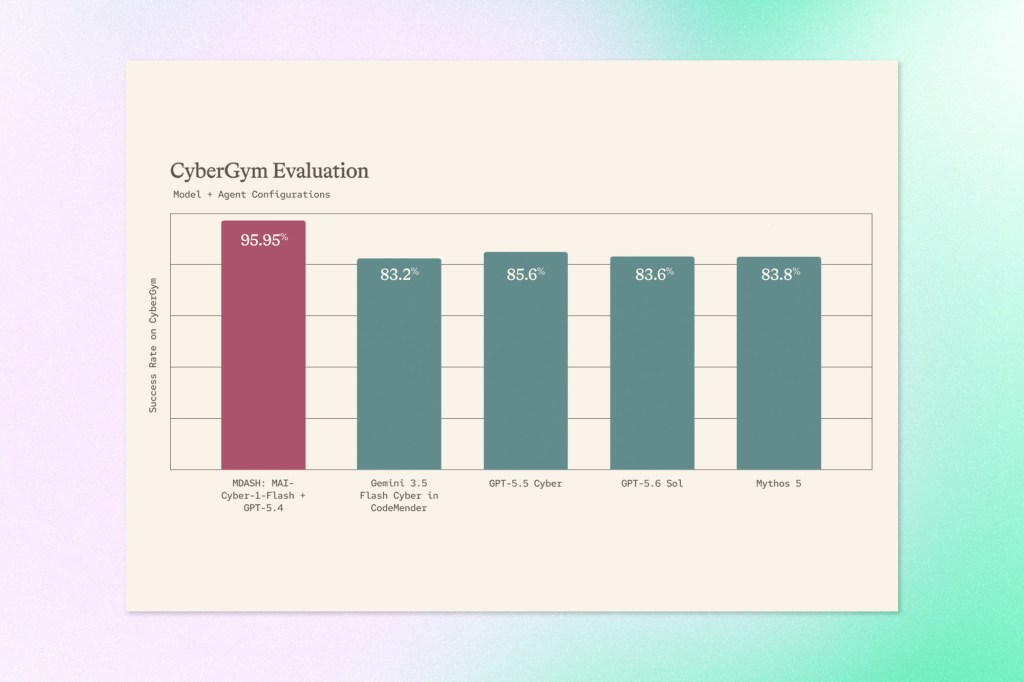
The performance claim rests on CyberGym, a benchmark that tests how well systems reason across big codebases to surface real vulnerabilities. Microsoft reports that MDASH running MAI-Cyber-1-Flash paired with GPT-5.4 scored just under 96%, roughly 12 points ahead of Mythos and above Gemini and GPT as well. The cost story comes from routing: the compact MAI-Cyber-1-Flash is designed to handle up to 90% of tasks on its own, calling in the larger, pricier GPT-5.4 only for the hardest 10%. Microsoft says that arrangement cuts costs in half compared to its current best MDASH configuration.
Alongside the model, Microsoft launched Perception, an agentic security platform that deploys teams of agents across security workflows. The system splits work across red teams that simulate attacks, blue teams that detect and triage bugs, and green teams that apply fixes. Lead engineer Dave Weston framed it as collapsing work that once took specialized humans hours into a process that surfaces, prioritizes, and patches issues in minutes. Microsoft leans hard on its data position as the differentiator, citing more than 100 trillion daily security signals and operational visibility across 1.6 million customers as an asset competitors cannot replicate. Both tools reach preview on November 3, entering a field that already includes Anthropic’s Mythos and OpenAI’s Daybreak.
Why it matters: The interesting move here is architectural, not just competitive. Rather than build one large model to do everything, Microsoft is betting on a routing system where a cheap specialist absorbs the bulk of the volume and an expensive generalist gets reserved for the genuinely hard cases. For defenders drowning in inbound attacks, where token cost scales directly with how much code you can afford to scan, that economic design may matter more than any single benchmark score. The data argument is the part worth scrutinizing: Microsoft is claiming a moat built from decades of real exploits and remediations tied to actual outcomes, which is harder for a pure model lab to match than raw capability is. Whether that translates into durable advantage depends on whether outcome-linked security data actually compounds the way Microsoft says it does, or whether frontier models keep closing the gap on general capability alone, as Anthropic’s own cyber results this week suggest they might.
🤖 Agents & Orchestration
Google Widens Access to Gemini Spark, Its Agentic Workspace Assistant
Google is opening up Gemini Spark, the agentic assistant it introduced at this year’s I/O, to a larger paying audience. In the US, anyone on the $20-per-month Google AI Pro tier now gets access, and it is rolling out globally to Google AI Ultra subscribers who pay between $100 and $200 a month. Several regions are carved out of the Ultra rollout, including the European Economic Area, Switzerland, the UK, and Nigeria, and newly eligible users may want to confirm whether local language support is included. Free users still do not make the cut.
Running on Gemini 3.5, Spark lives inside Google Workspace and takes assigned tasks through a dedicated page reachable from the desktop sidebar or the mobile menu. The use cases Google highlights are the kind of standing routines that eat up a workday: telling Spark to scan email and calendar each morning and flag what to prioritize, auto-drafting replies when messages from a specific person arrive, condensing long email threads, or turning meeting notes and inbox contents into a full report in Google Docs.
Why it matters: An assistant that reads your inbox every morning and drafts replies on your behalf only earns its keep if you trust it enough to stop checking its work, and that trust is exactly what Google is now testing across a much larger paying base. The deeper shift is what agentic tools do to the value of a Workspace subscription: if Spark reliably handles morning triage and turns scattered notes into finished documents, the product people are paying for stops being a set of apps and becomes the assistant that operates them.
Ready to explore what AI can do for your organization?
Cohere Launches North Automations for Orchestrating Agents Across Workflows
Cohere added an orchestration layer to its enterprise platform this week with North Automations, aimed at the gap between what companies expect from AI agents and what they actually get. The company’s framing is that most agent deployments so far have been one-off tools solving narrow tasks, which leaves value on the table, fragments governance, and inflates costs when a single expensive model runs every step. Automations is built to coordinate multiple agents into end-to-end workflows that mirror how employees actually move across systems and teams.
The feature set centers on control. Users describe goals in plain language, connect their existing tools, and set workflows to run on a schedule with branching and looping logic that leaves an auditable trail. Crucially, they can assign a different model to each step to balance cost against performance rather than paying frontier rates for simple tasks. A Plan mode lets people review and edit an approach before building it, versioning tracks changes over time, and approval checkpoints loop in colleagues at defined moments. Administrators get usage analytics and token monitoring to keep spend visible. The whole thing runs inside North, Cohere’s agentic platform, which deploys on-prem or in the cloud and works with Cohere’s own models or external ones.
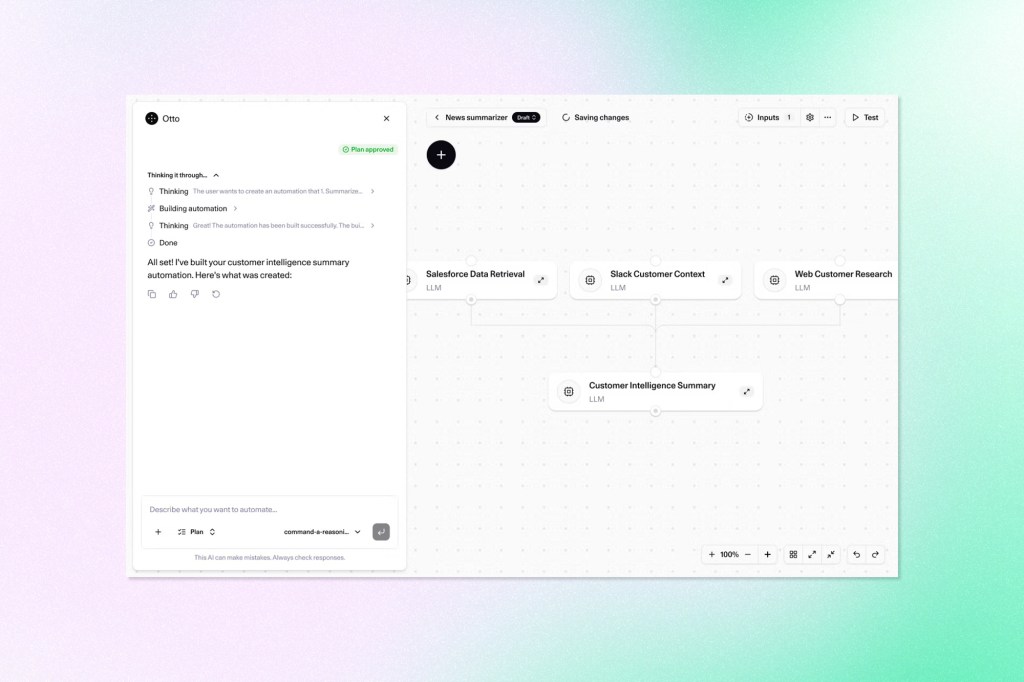
Cohere points to its own internal use as proof. Its marketing operations team wired an automation to BigQuery, so plain-language questions get translated into SQL and answered on the spot, and its customer success group built a daily tracker that pulls from the HR system, Slack, and Salesforce to assemble morning briefings ahead of one-on-ones. Automations is available now to all North customers.
Why it matters: For most enterprises, the problem was never a shortage of agents but the mess that follows once you have dozens of them, each built by a different team, none of them accountable to a common set of rules. Orchestration is a bet that the value was never in the individual agent at all but in the connective layer that sequences them, decides which model handles each step, and keeps a record of what happened. The per-step routing built into the workflow is the quiet tell here, because it treats models as interchangeable parts to be swapped on cost and fit rather than as the product itself, which is a comfortable stance for Cohere to take and an uncomfortable one for anyone selling a single frontier model as the answer.
Runway Brings Model Routing to Generative Media
Runway launched Media Router, which it bills as the first routing system built for generative media rather than language models. The idea borrows from a pattern that is now standard for LLMs but has not existed for video, image, and audio: instead of hand-picking a model for every generation, you configure once what “best” means for a given job, send your request to a single endpoint, and let the router choose. Runway argues media has lacked this until now largely because video, image, and audio models differ so wildly in what they can actually produce, which makes matching a request to the right model harder than it is for text.
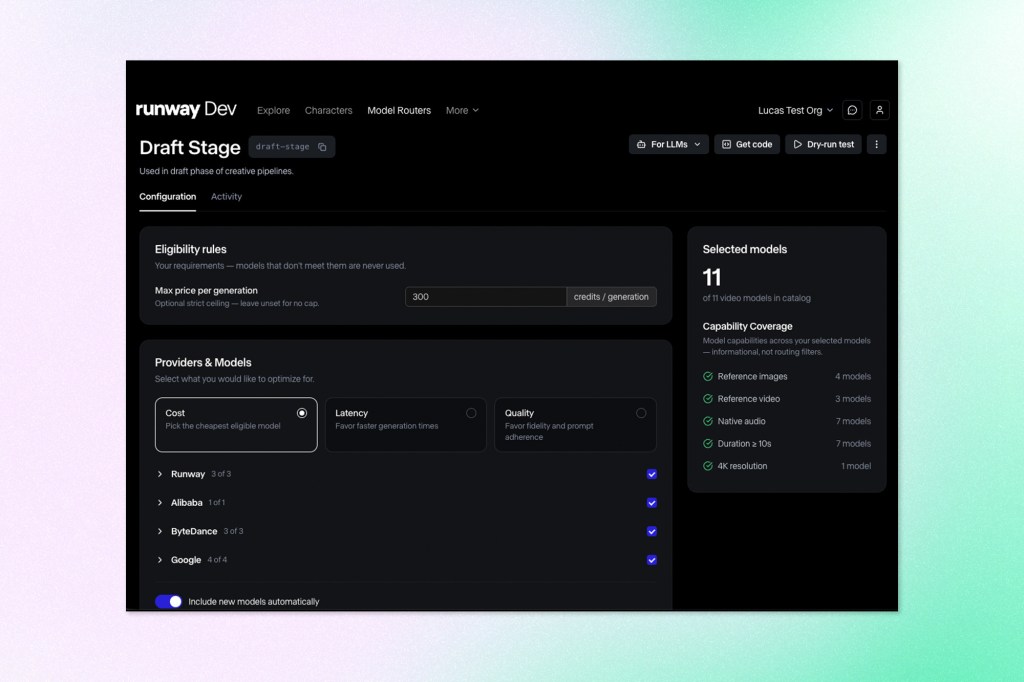
The workflow runs in three steps. You set preferences in the Runway Dev portal, choosing how to weight cost, latency, and quality, then name the config, set a hard price cap, and allow or deny specific models or providers. You call one endpoint with that config ID attached, no model specified. The router then filters out anything that fails your hard constraints, scores what remains against your preferences, generates with the top pick, and returns metadata naming exactly which model ran and why. It draws on both Runway’s own frontier models, including Gen-4.5 and Aleph 2.0, and third-party options like Seedance, GPT Image 2, and ElevenLabs.
Runway leans on a few practical touches. If no model can satisfy your constraints, the router returns an explicit error naming which limit emptied the pool rather than quietly downgrading your settings. A dry-run flag lets you validate which model a config would select before putting it into production, with nothing generated and no cost incurred. The company frames the value around scale, where a fraction of a cent or a few milliseconds per request compounds into real money and latency across millions of generations, and where keeping code current with a churning model catalogue becomes its own integration burden.
Why it matters: For text, “quality” is fuzzy but roughly comparable across models. For generative media, it is a tangle of style, motion, fidelity, and taste, which means a router scoring models on quality is encoding aesthetic judgments that many creative teams will want to make themselves. That tension is the interesting part: the same abstraction that saves an enterprise from tracking a churning catalogue also puts a layer between the creator and the specific model they might have chosen for reasons a scoring function cannot capture.
📊 The Bigger Picture
OpenAI Research Finds AI is Quietly Redrawing the Boundaries of Jobs
OpenAI’s economic research team published the first report in a new series this week, and its central finding is that AI is changing not just how work gets done but who does it. Drawing on more than 800,000 work-related messages from US ChatGPT users, the team found that 16.8% of all work messages, and 43.5% of the ones tied to a specific occupation, involve tasks normally associated with a different job. They call the pattern task crossover: a marketer troubleshooting a website that would once have gone to a developer, a salesperson digging into a dataset that used to require an analyst.
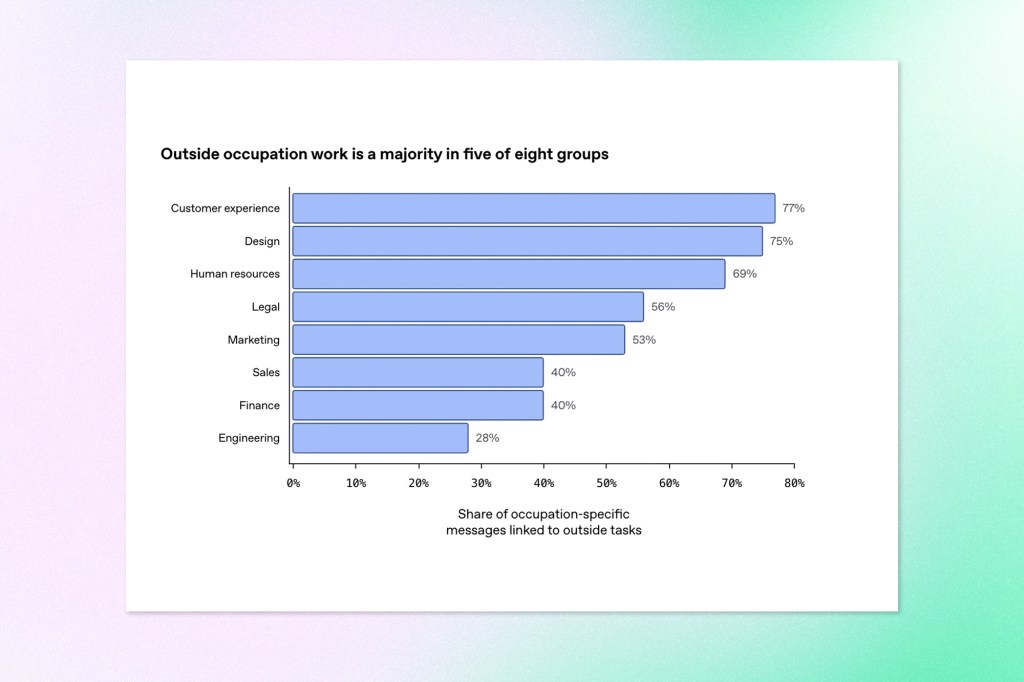
The report first strips out generic activities like writing and scheduling that show up across every job, since those prove nothing about crossover. Among the remaining occupation-specific messages, the share falling outside a person’s own role is striking in several fields: 77% for customer experience workers, 75% for designers, 69% in HR, 56% in legal, and 53% for marketers. Some tasks travel much farther than others. Financial calculation and technology troubleshooting turn up among the top three borrowed tasks in every other occupation studied. Marketing and engineering are the biggest exporters, with their work spreading widely into other roles.
The direction of crossover varies by field. Designers pull in a lot of outside work but rarely see design tasks show up elsewhere. Engineering is the reverse, exporting far more than it imports. Marketing does both. Company size matters too: crossover is more common in smaller organizations, where the person who runs into a problem is more likely to solve it themselves than hand it to a specialist team. OpenAI frames all of this as an early signal, arguing that usage data shows jobs reorganizing in real time, before firms rewrite job descriptions or invent new titles.
Why it matters: If people are already doing work outside their formal roles, the org chart is describing a division of labour that has quietly stopped being true. That has consequences well beyond a research curiosity. Hiring plans built around specialist headcount, training budgets scoped to narrow roles, and compensation bands tied to job titles all assume boundaries that AI is dissolving from the bottom up, one borrowed task at a time. The finding that crossover runs highest in small companies points to where the pressure lands first: firms without deep specialist benches get the most leverage from a tool that lets a generalist cover ground that used to require a hire. The harder question the report raises but cannot answer is whether this expands what workers can accomplish or simply loads more responsibility onto the same people, since a marketer who can now troubleshoot code and run financial analysis is more capable and also, potentially, doing three jobs for one salary.
Keep ahead of the curve – join our community today!
Follow us for the latest discoveries, innovations, and discussions that shape the world of artificial intelligence.