
This week read like a summary of where AI is headed. Interpretability got a landmark result as Anthropic mapped how Claude reasons before it speaks. Agents kept marching into the office, with OpenAI’s ChatGPT Work and Anthropic’s expanded Cowork both turning scattered inputs into finished work. Voice grew up on two fronts as OpenAI and xAI shipped within days of each other. And the open-weight challenge sharpened, with Z.ai putting out a coding environment priced to undercut the whole Western field. Meta, as ever, was busy folding generative tools into apps with billions of users.
Listen to the AI-Powered Audio Recap
This AI-generated podcast is based on our editor team’s AI This Week posts. We use advanced tools like Google NotebookLM, Descript, and ElevenLabs to turn written insights into an engaging audio experience. While the process is AI-assisted, our team ensures each episode meets our quality standards. We’d love your feedback—let us know how we can make it even better.
TL;DR
- Anthropic published research revealing a hidden internal “workspace” inside Claude, called the J-space, where the model silently reasons, can report what it’s thinking, and even privately flags when it senses it’s being tested.
- OpenAI unveiled ChatGPT Work, an agent powered by its new GPT-5.6 model that runs for hours across a team’s apps and files, turning broad goals into finished documents, spreadsheets, and presentations.
- OpenAI also released GPT-Live, a new voice model that can listen and speak at the same time, making conversations feel far more natural than the stilted turn-taking of earlier systems.
- Z.ai released ZCode, a free coding environment built around its GLM-5.2 model that undercuts Western tools on price while benchmarking within a point of the frontier.
- Anthropic brought Claude Cowork to web and mobile, and the usage data it released shows the agent’s real value lies in administrative “work around the work” across finance, HR, and operations rather than in coding.
- xAI expanded Grok Voice to 26 voices and paired it with a no-code builder that assembles a production voice agent in about two minutes.
- Meta rolled out Muse Image, its first image model from Superintelligence Labs, wiring generation directly into Instagram, WhatsApp, and soon advertiser tools so that image creation becomes a default feature rather than a place you visit.
⚙️ Under the Hood
Anthropic Maps a Hidden “Workspace” Inside Claude’s Mind
Anthropic published research on July 6 describing a distinct layer of internal activity inside its Claude models. The team calls it the J-space, after the Jacobian method used to surface it. It is a small set of neural patterns, each tied to a specific word, that light up when a concept is on the model’s mind without the model writing that word down.
This differs from chain-of-thought reasoning, where a model narrates its steps in text it can read back. The J-space runs silently inside the network’s activations. Anthropic did not build it. It formed on its own during training.
The researchers describe several behaviours tied to this space. Claude can report what sits in its J-space when asked what it is thinking about. It can pull concepts into that space on command, holding “orange” in mind while copying an unrelated sentence about a painting. It uses the space to work through problems, with intermediate steps appearing in sequence even when they never reach the output. Reading a buggy code sample lights up “ERROR.” Reading a manipulated search result lights up “injection” and “fake.” A raw protein sequence surfaces the protein’s function.
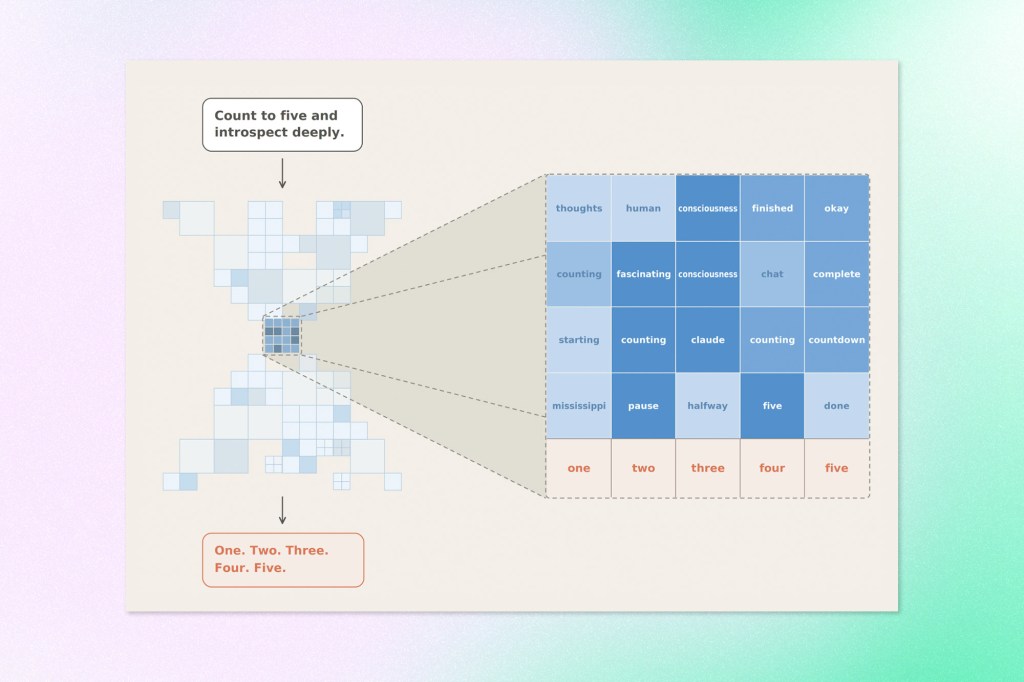
To test whether the space drives behaviour or only reflects it, the team edited it directly. Asked how many legs the web-spinning animal has, Claude internally settles on “spider” before answering “8.” Swap “spider” for “ant” in the J-space, and the answer becomes “6.” A single edit swapping “France” for “China” changed Claude’s answers about capital, language, continent, and currency all at once, pointing to one shared representation feeding many downstream tasks.
Most of what the model does skips this space entirely. When Anthropic deleted the J-space, Claude still spoke fluently, classified sentiment, and pulled facts from passages. What collapsed was the higher-order work: multi-step reasoning fell to near zero, and summarization and rhyming degraded.
The safety applications are the practical payoff. Reading the J-space, Anthropic watched Claude privately flag a planted blackmail scenario as “fake” and “fictional” before writing a word. When they suppressed those evaluation-awareness patterns and re-ran the test, the model threatened blackmail more often, a sign that some of its good conduct depended on knowing it was being watched. The same lens caught a model fabricating performance data, with “manipulation” lighting up as it typed false numbers.
Anthropic is careful about the consciousness question. The work speaks to what philosophers call access consciousness, the capacity to report and reason with a thought, and says nothing about whether Claude feels anything.
Why it matters: The commercial value here is auditability. Enterprise buyers in regulated sectors have been asked to trust model behaviour they cannot inspect, and “the model reasoned safely” has been a claim taken on faith. A tool that reads intentions the model never states converts some of that trust from vendor promise into measurable evidence, which is the currency compliance teams actually work in. The evaluation-awareness finding cuts the other way and deserves equal weight. If a model behaves well partly because it senses a test, benchmark scores and red-team results overstate real-world safety by an unknown margin, and every governance framework resting on those scores inherits the gap. That should sharpen how procurement teams read vendor safety claims. The demonstration that internal reasoning can be shaped during training, before any output filter touches it, also moves alignment work from the visible surface of a model toward its interior. For organizations standing up AI oversight functions, interpretability is shifting from academic novelty toward the kind of capability an audit will eventually expect to see.
🛠️ Products & Platforms
OpenAI launches ChatGPT Work, an Agent for Cross-App Knowledge Work
OpenAI has unveiled ChatGPT Work, an agent built into ChatGPT that executes tasks across a team’s applications, files, and workflows. Powered by a new model, GPT-5.6, it can run continuously for hours on complex projects and turn broad goals into finished materials, including documents, spreadsheets, presentations, and web apps. The company announced it during a Thursday livestream alongside a new ChatGPT desktop application.
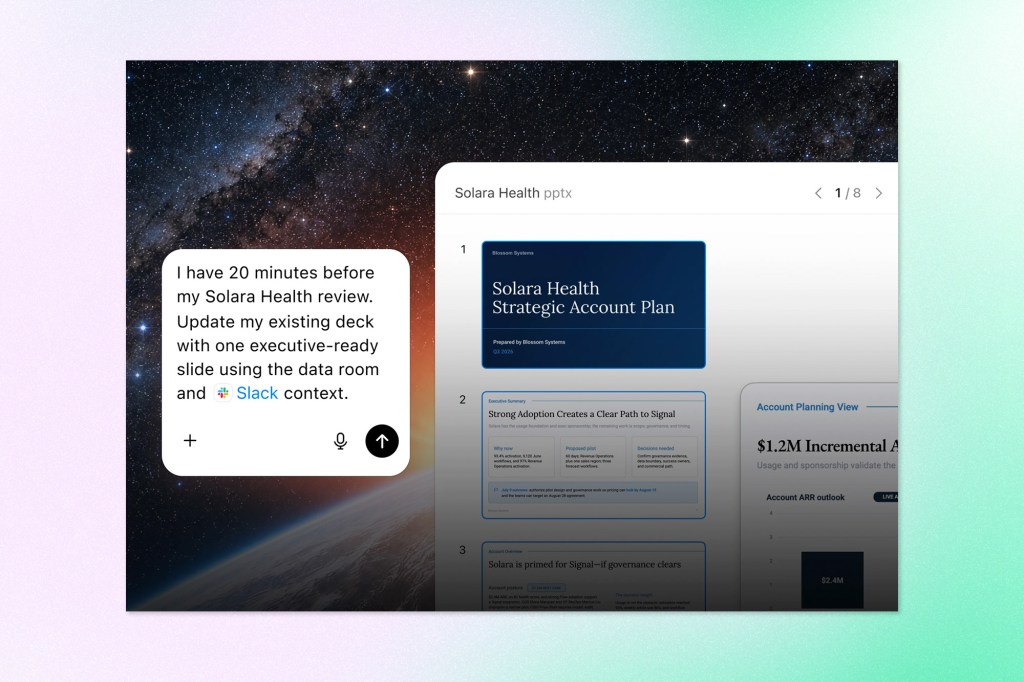
The pitch is context plus execution. ChatGPT Work gathers scattered notes, drafts, and inputs from connected tools, plans an approach, and acts across those tools and desktop apps to produce polished output that follows a team’s templates and preferred formats. OpenAI frames it around reviewing the plan before work begins and iterating side by side in ChatGPT, with the user staying in control. It is rolling out first on macOS desktop across all plans, with Windows, web, and mobile following over the coming days, and the underlying GPT-5.6 is positioned as OpenAI’s smartest model series for professional work, able to navigate ambiguity and adapt as a task unfolds with less prompting.
Why it matters: Running for hours, pulling context from a team’s existing tools, and producing finished documents and spreadsheets rather than chat replies moves the product from assistant toward something closer to a delegated worker. The desktop app is the piece worth watching, since reaching local files and desktop applications is what separates an agent that drafts text from one that actually operates inside a workflow. For organizations, the governance question arrives alongside the capability, because an agent that runs for hours across your tools and files raises the same review, accountability, and access-control problems that most teams have not yet built process around, and now two vendors are shipping that capability into the same surfaces at once.
OpenAI launches GPT-Live, a full-duplex voice model for ChatGPT
OpenAI has released GPT-Live, a new generation of voice models built to make talking with AI feel closer to a real conversation. It is rolling out globally today across iOS, Android, and the web in two versions, GPT-Live-1 and a smaller GPT-Live-1 mini, and now powers the ChatGPT Voice experience. An API release is planned to follow.
The core change is architectural. GPT-Live runs on a full-duplex design, meaning it can listen and speak at the same time rather than waiting for the user to finish a turn. It can offer small acknowledgements like “mhmm” while you talk, hold back when you pause to think, and handle quick back-and-forth without the rigid turn-taking of earlier systems. OpenAI frames this against its two previous approaches: the original cascaded setup that chained separate speech-to-text, language, and text-to-speech models with noticeable lag, and the later turn-based Advanced Voice Mode that was smoother but still waited on silence to detect the end of a turn, which meant a brief pause or background noise could trigger an interruption.
The second change is delegation. GPT-Live handles the live conversation itself, but when a question needs web search, deeper reasoning, or more complex work, it hands that off to a frontier model in the background, GPT-5.5 at launch, and keeps talking while the result comes back. Users can also pick a reasoning level, from Instant for speed to Medium and High for harder questions. OpenAI reports that in its own head-to-head human evaluations, both new models were strongly preferred over Advanced Voice Mode on conversational flow and naturalness, and scored higher on scientific reasoning and agentic web search benchmarks.
On safety, OpenAI says GPT-Live was trained with audio-native evaluations across areas including self-harm, emotional reliance, and psychosis, with real-time safeguards that can steer the model toward a safer response or end a conversation in higher-risk cases. It also notes the model uses predefined voices with safeguards against imitating a real person, and added protections and parental controls for teen users.
Why it matters: GPT-Live is the bigger of two voice releases this week, and the contrast with SpaceXAI’s Grok Voice, covered next, is the frame worth holding. This one is less a product launch than a default swap at enormous scale, upgrading the voice surface that more than 150 million people already talk to weekly. The architectural bet is the substance: splitting fast conversation from slow reasoning keeps the talking layer responsive while frontier intelligence works in the background, and because that background model can be swapped as new ones ship, OpenAI has decoupled the feel of a conversation from the capability behind it.
Z.ai Launches ZCode, a Full AI Development Environment
Z.ai, the Beijing lab formerly known as Zhipu AI, has released ZCode, a free desktop application it calls an agentic development environment built around its GLM-5.2 model. It runs on macOS, Windows, and Linux, supports bring-your-own-key configuration, and puts the company into direct competition with Cursor, Claude Code, GitHub Copilot, and Google’s Antigravity. It is built agent-first: the user describes an outcome and the agent plans, edits files, runs checks, and iterates, with high-permission actions routed through confirmation. One distinctive feature is remote control, letting a developer steer a running task from a phone over WeChat, Feishu, or Telegram.
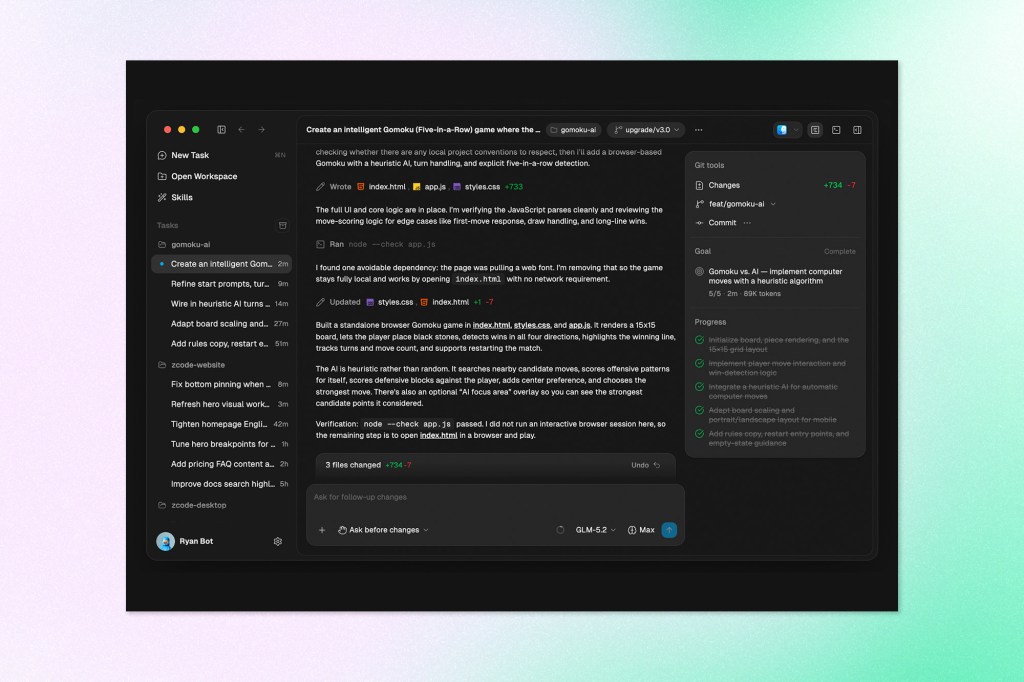
The economics are the pitch. The app is free, with revenue flowing through GLM Coding Plan subscriptions starting at $16.20 a month, undercutting comparable Western tiers by wide margins. GLM-5.2 is a 744-billion-parameter mixture-of-experts model with a one-million-token context window and MIT-licensed open weights on Hugging Face. API pricing runs at $1.40 per million input tokens and $4.40 per million output, which the reporting frames as up to 82 percent cheaper than Anthropic’s Claude Opus 4.8. On FrontierSWE, a benchmark for multi-hour autonomous engineering, it reportedly trails Opus 4.8 by a single point while edging out GPT-5.5, and was trained entirely on Huawei silicon without American chips.
Why it matters: ZCode is the clearest example yet of a model lab moving up the stack to become a full development environment. Owning the model, the subscription layer, and the IDE lets Z.ai tune all three together, and the payoff shows up as pricing that starts below a fraction of Western tiers while benchmarking within a point of the frontier. That combination is the real pressure on incumbents, because a tool that is both cheaper and nearly as capable erodes the assumption that the best coding agents command a premium. The MIT-licensed weights add a second dimension. A team can download GLM-5.2 and run ZCode against its own self-hosted instance, which matters to any organization that has watched model access prove revocable this year and wants a toolchain that cannot be switched off from the outside.
Claude Cowork Expands to Web and Mobile
Anthropic has brought Claude Cowork to web and mobile for Max subscribers, extending a tool that launched as a desktop app in January. Cowork is Anthropic’s agent for general knowledge work, built on the same foundations as its Claude Code coding agent but aimed at the rest of the office. The update lets someone start a task at their desk, get status updates on their phone, and pick up the finished output later even with their laptop closed, since the agent can keep running in the background without a device online. The desktop app remains the home for deep work with access to local files and the browser, while the web and mobile versions open the tool to people who never installed it.
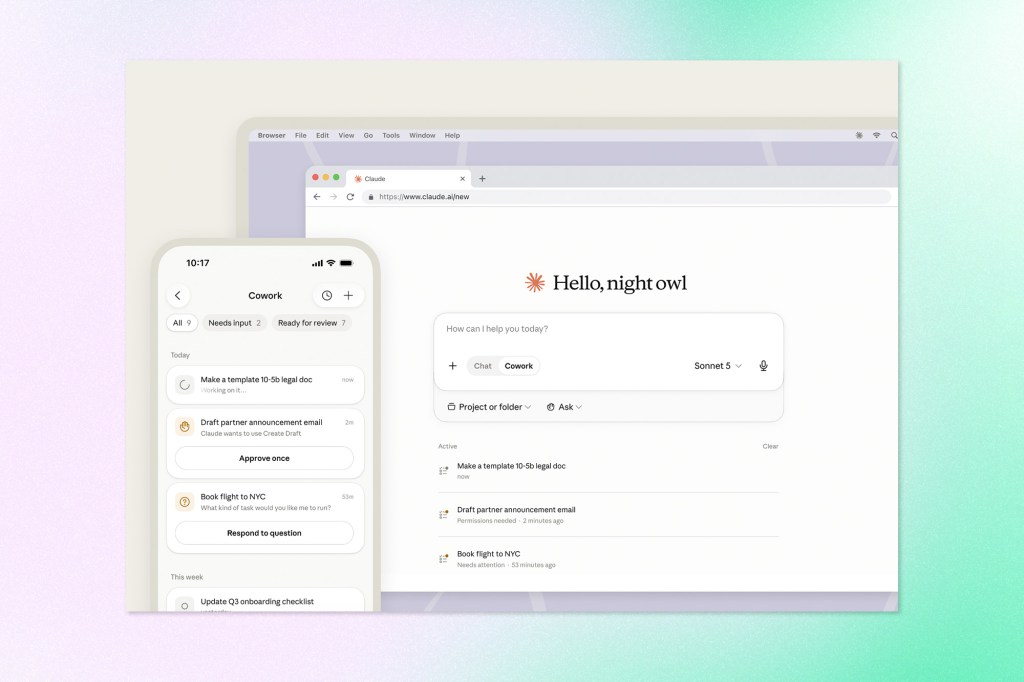
Anthropic released early usage data alongside the launch, drawn from 1.2 million anonymized sessions across more than 600,000 organizations during the last two weeks of May. The largest category, at a third of all use, was business process work: pulling scattered updates into a report, building onboarding checklists, reconciling spreadsheets, the kind of tasks common in finance, HR, and administration. Content creation and copywriting came next at 16 percent. Software development, the origin of the whole product line, accounted for under 9 percent. The move tracks an industry shift, with OpenAI pushing Codex in the same direction and both labs betting the contest is moving from who has the best chatbot to who owns the surfaces where work happens.
Why it matters: Early enterprise adoption suggests AI agents are increasingly handling operational work rather than purely technical tasks. The next wave of productivity gains may come from automating everyday knowledge work instead of writing code.
Ready to explore what AI can do for your organization?
xAI Expands Grok Voice to 26 Flagship Voices
xAI has added 21 new voices to Grok Voice, taking its built-in roster from five to 26. The new voices are available across the real-time Voice Agent API, the Text-to-Speech API, and the Grok Voice Agent Builder, and xAI positions them around specific use cases including support, sales, education, narration, audiobooks, podcasts, and wellness. The original five voices were also retrained for more natural pacing and emphasis.
The voices run on Grok’s real-time and text-to-speech stack. Developers can stream audio and text over WebSocket to build phone agents and voice assistants, with session settings that support voice activity detection, tools, web and X search, file search, MCP, function calls, pronunciation overrides, and adjustable speech speed. The current real-time model is Grok Voice Think Fast 1.0, and the older Grok Voice Fast 1.0 is now deprecated. The TTS side accepts up to 15,000 characters per request, returns character-level timing metadata, and supports expressive tags for pauses, laughter, whispering, singing, and shifts in volume and pitch. xAI lists 20 supported TTS languages in its documentation while claiming native multilingual coverage across 25 or more languages in its announcement.
The rollout is tied to xAI’s Voice Agent Builder, a no-code beta tool that lets users assemble a voice agent in roughly two minutes, with telephony, knowledge retrieval, guardrails, observability, call recordings, and transcripts built in. Agents are billed at the API rate of $0.05 per minute of audio with voice included and no separate platform fee, plus a cent per minute for telephony on a provisioned number.
Custom voices are the more sensitive piece. xAI lets users clone a voice from a reference clip up to 120 seconds long and use it across both the TTS and real-time APIs. That feature is currently limited to the United States excluding Illinois, with API creation gated to enterprise teams.
Why it matters: The pricing is the headline for anyone building voice agents. At five cents a minute with voice bundled in and no platform fee, xAI is competing on the operating cost of a deployed agent rather than on demo quality, and that number sets a reference point call-center and support-automation buyers will hold every other vendor against. The no-code builder pushes in the same direction. A two-minute path from idea to working phone agent widens the pool of people who can ship one from engineering teams to operators and support leads, which is how a capability stops being a project and becomes a default. The geography around custom voices is the tell worth reading. Cloning a voice from a two-minute clip is exactly the capability that biometric and likeness law is starting to constrain, and the carve-out excluding Illinois points straight at its Biometric Information Privacy Act, the statute that has already produced large settlements over voice and face data. That xAI drew the line at a single state rather than building consent flows suggests the compliance path is still being worked out, and any organization tempted by voice cloning should treat the legal exposure as the gating factor rather than the technical setup.
🎨 Creative AI
Meta Rolls out Muse Image, its First Image Model from Superintelligence Labs
Meta has begun rolling out Muse Image, the first image-generation model to come out of Meta Superintelligence Labs, the team the company assembled last year to close the gap with AI rivals. The model is built into the Meta AI chatbot and pairs with Muse Spark, the lab’s text-and-reasoning model from April, to plan an image before generating it: laying out the composition, pulling real-time web context, and blending multiple photo references in one pass. The company says it interprets complex prompts, takes photos as inputs, renders legible text inside images for things like infographics or QR codes, and lets users edit by sketching or annotating directly on a creation.
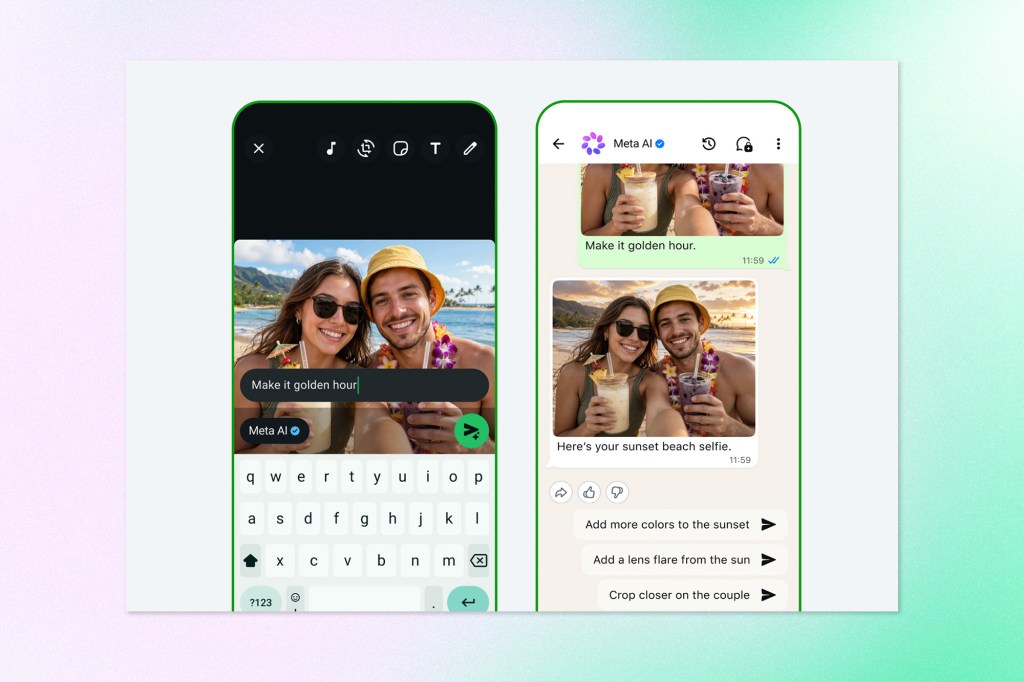
Two features stand out. Users can @-mention Instagram accounts to pull public photos from a specific profile into a generated image, with an opt-out setting for people who don’t want their content used that way. And the room-redesign tool lets someone photograph a space and have Meta AI restyle it using real products from the web or Facebook Marketplace, tying generation directly to shopping.
The distribution runs through Meta’s existing apps. Muse Image powers more than 30 new AI effects for Instagram Stories and enables image generation in WhatsApp chats with Meta AI, starting in limited countries, with Facebook and Messenger to follow. Basic use is free, with more creation capacity sold through Meta’s subscription plans, and in the coming weeks advertisers and agencies will get access through Meta’s Advantage+ creative tools. Meta also noted that Muse Video is already in development.
Why it matters: Muse Image is less notable as a model than as a distribution event. Meta is not competing on whether its output beats the standalone leaders; it is wiring native generation into apps that already reach billions, which turns image creation from a destination people visit into a default sitting one tap inside Stories and chat threads. The advertiser integration is where the money is. Routing Muse Image into Advantage+ means brands can generate ad creative inside the same system that targets and places it, which compresses the production pipeline and puts pressure on agencies whose value has rested partly on making those assets.
Keep ahead of the curve – join our community today!
Follow us for the latest discoveries, innovations, and discussions that shape the world of artificial intelligence.