
Who does your AI work for? This week, that question had several different answers. Bluesky built one that works for the user. Runway built one that works for the platform it’s trying to become. OpenAI shut down one that wasn’t working for anyone. The week in AI was less about capability than about alignment in the original sense: not safety, but whose interests the technology actually serves.
Listen to the AI-Powered Audio Recap
This AI-generated podcast is based on our editor team’s AI This Week posts. We use advanced tools like Google NotebookLM, Descript, and Elevenlabs to turn written insights into an engaging audio experience. While the process is AI-assisted, our team ensures each episode meets our quality standards. We’d love your feedback—let us know how we can make it even better.
TL;DR
- Anthropic had two accidental leaks in one week. The first surfaced a powerful, unreleased model called Mythos. The second exposed 512,000 lines of Claude Code source, revealing an unreleased autonomous agent mode, anti-distillation mechanisms, and a mode that hides AI involvement in external code commits.
- 15% of Americans say they’d work for an AI supervisor. 70% think AI will shrink the overall job market. The second number is the one worth watching.
- Mila and Mozilla are partnering on open-source AI tools, starting with a portable memory layer that would let users move conversation data between LLM providers.
- Bluesky launched Attie, an AI app that builds custom social feeds from natural language commands, built on Claude and the open AT Protocol.
- OpenAI shut down Sora six months after launch. It was burning $1 million a day while losing users. Disney found out less than an hour before the public.
- Runway launched a $10 million venture fund and a Builders program around its real-time video agent API, Characters, positioning itself as infrastructure for synthetic environments.
⚒️ Models, Tools & Platforms
The Most Careful Lab in AI Has a Bad Week
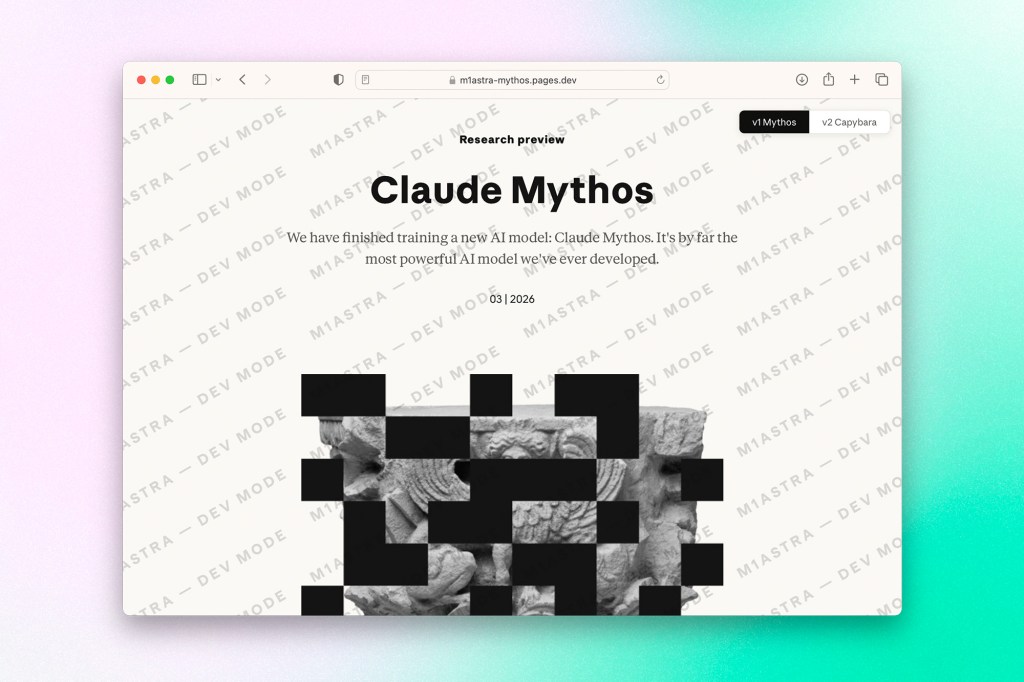
A model called Claude Mythos has been circulating in developer communities after surfacing through API exploration and leaked benchmark data, not through any announcement from Anthropic, which has not confirmed the model exists.
If the leaked benchmarks are accurate, Mythos would sit above Claude Opus in Anthropic’s model hierarchy. The current lineup runs Haiku, Sonnet, and Opus. Mythos doesn’t slot into that system; it’s a standalone name, which suggests Anthropic may be building a new tier rather than just incrementing the existing one.
The reported benchmark gains are in three areas: coding, multi-step reasoning, and cybersecurity. The cybersecurity numbers drew the most attention, given that strong performance on security-related tasks cuts both ways, useful for threat analysis and red teaming, sensitive for a lab that leads with safety messaging.
That leak was just the start. The following week, Anthropic accidentally shipped a source map in its Claude Code npm package, exposing nearly 2,000 source files and more than 512,000 lines of code before it was pulled and widely mirrored. A security researcher named Chaofan Shou spotted it almost immediately. Anthropic called it a packaging error caused by human error, not a security breach.
What the source exposed was instructive. It contained an anti-distillation mechanism that injects fake tool definitions into API requests to poison competitor training data, a mode that strips all traces of Anthropic internals when Claude Code operates in external repositories with no way to force it off, and references throughout to an unreleased autonomous agent mode called KAIROS, which includes background daemon workers, nightly memory distillation, and GitHub webhook subscriptions. A comment in the compaction code also documents 250,000 wasted API calls per day from a runaway failure loop, fixed with three lines of code.
The likely culprit is a known bug in Bun, the runtime Anthropic acquired late last year, which serves source maps in production mode despite documentation saying otherwise. The bug was filed on March 11th and was still open when the leak happened.
Why it matters: Anthropic has built its public identity around being a careful AI company. Two accidental disclosures in a week don’t erase that reputation, but they complicate it. The Mythos leak revealed a capability roadmap nobody announced. The Claude Code leak revealed a strategic one. Competitors now know KAIROS exists, know the anti-distillation architecture, and have 512,000 lines of scaffolding to study. The code can be refactored. The strategic surprise can’t be un-leaked. The undercover mode is a separate issue worth sitting with: a tool that actively conceals its own involvement in external code commits is a transparency question, not just a branding one, and it took an accidental source map to make it visible.
A Canadian Open-Source Bet
Montréal’s Mila and Mozilla are partnering to build open-source AI tools, with Mozilla contributing an initial $1 million CAD and engineering resources toward the first project. The work will be led by Mila’s research team, with Mozilla contributing its open-source infrastructure and developer community.
The first project targets memory portability for AI agents, specifically the problem of users losing all their accumulated context when they switch between LLM providers. The goal is a portable, open-source layer that lets people move their conversation data across models without starting from scratch.
The partnership also has a Canadian dimension. Both organizations have flagged AI sovereignty as a priority: building a Canadian-made open-source stack across compute, models, and data. That framing aligns with the federal government’s ongoing push to reduce dependence on US technology platforms.
Mila was founded by Yoshua Bengio in 1993 and has grown into one of the world’s leading AI research institutions, with more than 1,500 affiliated researchers across Université de Montréal and McGill. It’s funded through the Pan-Canadian AI Strategy alongside Vector Institute in Toronto and Amii in Edmonton.
Why it matters: The memory portability problem is underappreciated. Right now, every LLM conversation is effectively siloed. Your context, your history, your preferences live inside a single provider’s walls. That’s not just inconvenient, it’s a lock-in mechanism. If Mila and Mozilla can build a workable open standard for portable AI memory, it would meaningfully shift the leverage between users and platforms. The sovereignty angle adds a second layer: Canada is one of the few countries with the research infrastructure to actually build an independent AI stack, and this is a concrete step toward that rather than just a policy position.
Bluesky Builds an AI That Works for You
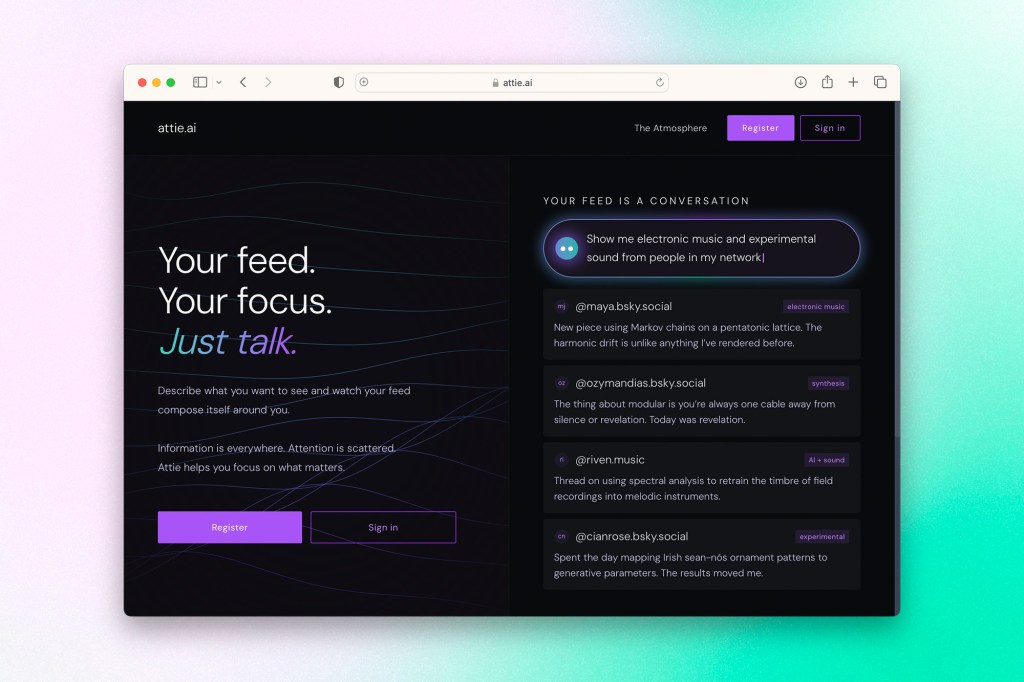
Bluesky has launched Attie, a standalone AI app that lets users build custom social feeds through natural language commands, no code required. Built on Claude and running on the AT Protocol, Attie debuted at the Atmosphere conference last weekend as a private beta for attendees.
The pitch is straightforward: tell Attie what you want to see, and it builds the feed. Because ATProto is an open system, Attie can pull context from your activity across any app in the ecosystem from the start. Future versions are expected to let users build and share tools with others, effectively vibe-coding their own social apps on top of the protocol.
Attie is the first product from a new internal team led by Jay Graber, who stepped back from the CEO role to return to building. Toni Schneider, former CEO of Automattic, is now interim CEO and is framing the broader ATProto ecosystem in terms he knows well: a decentralized open platform with the potential to generate the kind of ecosystem WordPress built around itself.
Bluesky also confirmed $100 million in additional funding from a round that closed last year, giving the company over three years of runway.
Why it matters: Every major platform uses AI to optimize for time-on-site. Attie is a direct counter-argument: an AI that optimizes for what the user actually wants, made possible because the underlying protocol is open and the data isn’t locked to one app. That’s not just a product decision, it’s a structural one. If Attie works, it demonstrates that open protocols can support AI-driven personalization without the surveillance architecture that makes closed platforms so hard to leave. Whether it scales is a separate question, but the model it’s testing is worth watching.
🎨 Creative AI
Runway Bets on Its Own Ecosystem
Runway, the AI video generation company valued at around $5.3 billion, has launched a $10 million venture fund and a companion Builders program offering free API credits to early-stage startups. The fund will write checks of up to $500,000 for pre-seed and seed companies working across AI, media, and what Runway is calling “world simulation.” The Builders program gives eligible startups 500,000 API credits and access to Characters, Runway’s real-time video agent API.
The move follows Runway’s December launch of its general world models, a shift from creative tooling toward something more foundational. The fund is seeded by existing investors and close partners, and Runway has already quietly backed a handful of companies over the past 18 months, including LanceDB, which builds databases for AI applications, and Tamarind Bio, which applies AI to molecular design tools.
Characters, the API at the center of the Builders program, lets developers create generative agents with faces and voices that operate in real time, ranging from cartoonish to photorealistic. The founding cohort is already using it for customer support agents, sales assistants, personalized onboarding, and synthetic media. Runway sees gaming, telemedicine, and education as the bigger opportunities ahead.
Runway joins a growing list of AI companies turning investors. OpenAI has its Startup Fund, Perplexity launched a $50 million fund last year, and CoreWeave stood up its own ventures arm in September.
Why it matters: Runway is doing what platform companies do when they hit the limits of what a 150-person team can pursue: they fund the use cases they can’t staff. The $10 million is small by venture standards, but the API credits and early access to Characters are the real currency here. Runway is trying to seed an ecosystem around its models before competitors do. The more interesting signal is the world simulation framing. Runway is positioning itself not as a video tool but as infrastructure for interactive, real-time synthetic environments. If that thesis holds, the Builders program is less about finding good startups and more about stress-testing whether that vision has legs.
Get AI This Week, along with industry news, delivered straight to your inbox
Sora’s Short Run
OpenAI shut down Sora, its AI video generation app, six months after launch. The official framing was a strategic focus. The actual story, according to Wall Street Journal reporting, was simpler: the app was burning roughly $1 million a day in compute costs while its user base had collapsed from a peak of around one million to fewer than 500,000. Video generation is expensive to run, and not enough people cared enough to justify it.
The timing made it worse. While internal resources were tied up keeping Sora alive, Anthropic was pulling ahead with enterprise and developer customers. Claude Code, in particular, was gaining ground on the software engineering segment that drives real revenue for these companies. Killing Sora freed up compute and attention for the products actually winning.
The Disney fallout illustrated how abrupt the decision was. The entertainment company had committed $1 billion to the Sora partnership and reportedly found out the app was shutting down less than an hour before the public announcement. The deal ended with it.
Some observers called the shutdown a sign of maturity, pointing to OpenAI’s willingness to kill a product that wasn’t working rather than defend it. New operations lead Fidji Simo is widely seen as the hand behind the call.
Why it matters: Sora launched with genuine fanfare and talk of AI replacing Hollywood production pipelines. Its shutdown is a useful correction to that narrative. The gap between what AI video can generate in a demo and what it can sustain as a product turns out to be substantial, technically and legally. ByteDance reportedly delayed its own Seedance 2.0 global rollout over unresolved IP protection questions, which compounds the point. The technology is real, but the path from impressive capability to viable consumer product is not automatic, and the costs of figuring that out in public are high.
📊 AI in the Workplace
The AI Boss Is Already Here
A new Quinnipiac University poll of nearly 1,400 American adults finds that 15% say they’d be willing to report directly to an AI supervisor that assigns work, sets schedules, and manages their day. That’s still a minority, but it’s a notable one given how recently the concept would have seemed absurd.
The more telling story is what’s already happening without anyone being asked. Amazon has restructured layers of middle management out of existence, replacing those functions with AI workflows. Workday now offers agents that handle expense approvals autonomously. Engineers at Uber reportedly built an AI model of their CEO to screen pitches before they reach him. These aren’t pilots anymore. They’re live deployments, and they’re moving faster than the public’s comfort level with them.
Seventy percent of poll respondents believe AI will shrink the overall job market. Among people currently employed, nearly a third are worried their specific role could be made obsolete.
Why it matters: The 15% willing-to-work-for-an-AI number gets the headline, but the more consequential figure is the 70% who expect fewer jobs overall. That’s not technophobia, it’s pattern recognition. The management layer is being automated, not because AI is better at managing people, but because it’s cheaper and doesn’t push back. What’s being tested right now isn’t whether AI can lead. It’s whether organizations can strip out human judgment at scale and still function. The answer will shape how work is structured for the next decade.
Keep ahead of the curve – join our community today!
Follow us for the latest discoveries, innovations, and discussions that shape the world of artificial intelligence.