For marketing teams that need to move quickly, the tools behind the website often make a bigger difference than expected. A CMS influences more than just how content gets published. It affects how often campaigns can launch, how quickly experiments can run, and how efficiently a team can adapt.
WordPress has become a natural fit for high-speed teams. Despite outdated perceptions, it offers a balance of flexibility, usability, and performance that supports marketing without creating unnecessary friction.
Why Time to Market Shapes CMS Decisions
Marketing teams work inside increasingly compressed timelines. Campaigns roll out in smaller waves. Adjustments happen continuously. New content is often published in stages, then refined once the early signals appear. In environments shaped by constant movement, the CMS beneath a site becomes a quiet force that determines how fast a team can respond.
Time has become the central currency in digital publishing. A CMS that shortens this cycle opens the door to more experimentation, quicker responses, and smoother alignment between planning and execution. A platform that slows this window introduces delays that compound over weeks and quarters, often without anyone noticing how much momentum is lost along the way.
Different CMS platforms influence this metric in different ways. WordPress, HubSpot CMS Hub, Contentful, and Webflow approach content creation from distinct angles, each shaped by their architecture, workflows, and integration ecosystems. Some give teams immediate control. Others create stability through predefined systems. Understanding how each one shapes speed offers clarity on why certain platforms support marketing momentum better than others.
The Speed Factor: Experimentation Without the Wait
The MVP and Microsite Mindset
When timelines tighten and feedback cycles shorten, launching new campaign assets should feel quick and uncomplicated. WordPress fits this environment well. A marketing team can set up a microsite, test a landing page, or publish a new content type with minimal technical overhead.
This ability to move from idea to execution in a short window is essential for organizations that rely on marketing to respond to market changes or test positioning in real time.
Avoiding the Delay Cycle
Many proprietary CMS platforms include approval workflows and role restrictions that turn small edits into multi-step processes. Even adjusting a headline or adding a new block often involves logging tickets or waiting on developers.
WordPress removes that barrier. Content teams can make updates directly. Visual editors and reusable components give them structure while keeping the process agile. This way, publishing stays aligned with the pace of planning.
No-Code Functionality Built for Actual Use
Design Tools That Put Teams in Control
WordPress has matured into a truly visual platform. The Gutenberg editor gives marketers full access to layout and content management without writing code. Teams can manage everything from typography to mobile responsiveness inside a single interface.
Instead of asking for development help to launch new variations or layouts, content creators can make decisions in the moment and see immediate results.
When teams no longer need to wait for technical resources, the creative process becomes more fluid. Building a campaign hub, updating a product section, or running a layout test becomes part of everyday work, not a separate project.
This model not only saves time but also helps teams take more ownership of the digital experience.
AI That Fits Into the Everyday Publishing Flow
Tools Already in Use
WordPress already includes tools that support smarter content creation. Jetpack AI helps with writing and translation. Elementor AI assists with layout and content suggestions. Rank Math and Yoast use AI to improve keyword targeting and on-page SEO.
These tools sit within the editor, providing real-time feedback and updates as the content is being developed.
Smarter Workflows Without Adding Steps
Because AI tools are part of the workflow rather than external systems, content teams can move faster and with more confidence. Text is more refined. Headlines are clearer. Optimization is built into the process.
The result is higher-quality output without extra time spent toggling between apps or copying content into external tools.
Scalability That Keeps Up Without Locking Teams In
Ready for High-Traffic Events
WordPress can support both small campaigns and large-scale launches. Sites that see sudden traffic surges, such as news events or product reveals, remain stable when backed by optimized hosting and caching. Major brands rely on WordPress to handle these moments without interruption.
Teams that build on WordPress gain the flexibility to test small ideas and also launch major campaigns without shifting platforms.
No Forced Upgrades or User Limits
Proprietary systems often tie growth to spending. As traffic increases or new features are unlocked, costs rise through additional licensing. WordPress does not follow that pattern. Growth is handled at the hosting level rather than through restrictions built into the CMS.
This allows teams to expand usage without worrying about crossing pricing thresholds or entering contract renegotiations.
Integrations Without Roadblocks
Compatibility With Tools That Matter
Modern marketing depends on a network of systems. WordPress integrates with nearly all of them. Salesforce, HubSpot, Marketo, GA4, and hundreds of others connect seamlessly through plugins or APIs.
No Waiting for Vendor Approvals
Because WordPress is open, teams are not limited to official partnerships or approved integrations. They can adopt the tools that fit their strategy and evolve their stack at any time.
Strategic Control Without the Overhead
Flexibility at Every Level
WordPress gives organizations control over hosting, theming, integrations, and workflow design. There is no dependency on a vendor roadmap or contract cycle. This stability supports long-term planning.
More Autonomy Across the Team
When marketing teams can publish independently, momentum improves. Launches happen faster. Iteration becomes easier. Ideas can be tested without waiting through lengthy processes.
But How Much Flexibility Does a Marketing Team Actually Need?
Flexibility isn’t about bells and whistles. For marketing teams, it is about whether the CMS can support real-world needs without friction. When campaign timelines shift, new channels get added, or priorities change mid-quarter, the ability to adjust quickly becomes essential.
Each platform approaches flexibility differently. Some prioritize consistency. Others emphasize design control or technical breadth. But not all forms of flexibility support marketing operations equally. Here’s how WordPress, HubSpot CMS Hub, Webflow, and Contentful compare when adaptability is put to the test.
WordPress: Practical Freedom That Scales with Strategy
WordPress supports structured content, complex workflows, and unique marketing models without requiring platform changes or tool swaps. Teams can shape the system around their goals, whether that involves launching a content library, connecting a CRM, embedding conversion tracking, or integrating with several internal systems.
This freedom comes from both the open-source foundation and the maturity of the plugin ecosystem. Plugins, themes, and custom development options allow teams to move quickly while maintaining full control over design and performance. As marketing needs shift, WordPress keeps pace without friction or costly upgrades.
Webflow: Strong Visual Control, Limited Extensibility
Webflow offers a polished visual building environment that suits teams running smaller websites or design-led campaigns. Pages can be created without developer intervention, which supports quick production cycles. But once projects require deeper integration, multi-role workflows, or structured content, Webflow’s boundaries become clear. It excels within its intended scope but often needs workarounds when marketing needs expand.
HubSpot CMS Hub: Predictable and Contained
HubSpot’s CMS supports efficiency through predefined patterns and tight integration with the HubSpot CRM. This creates a smooth path for standard marketing workflows. But when strategies move beyond the defaults, such as introducing new content types or custom workflows, the structure becomes restrictive. Teams often adapt their plans to the limits of the tool rather than shaping the tool to match their plans.
Contentful: Maximum Technical Flexibility, Minimal Marketing Access
Contentful offers deep architectural control and works well for omnichannel environments. Developers can build flexible content models and distribute updates across multiple experiences. But its strength depends on engineering capacity. For most marketing teams, Contentful lacks the visual tools and intuitive workflows needed to publish independently. The flexibility exists, but access to it often requires development support.
Real-World Scale: When WordPress Powers Enterprise Marketing
TIME and Metallica Handle the Pressure
TIME.com moved to WordPress to modernize its publishing workflow. With structured templates and clear editorial workflows, their content and marketing teams gained the ability to move faster and publish with confidence. During a major audience spike, the site handled more than 100,000 requests per second without downtime.
Metallica’s global site uses WordPress to power announcements, events, and fan engagement. The platform continues to perform under intense demand while supporting ongoing evolution.
StackAdapt Moves from Limits to Flexibility
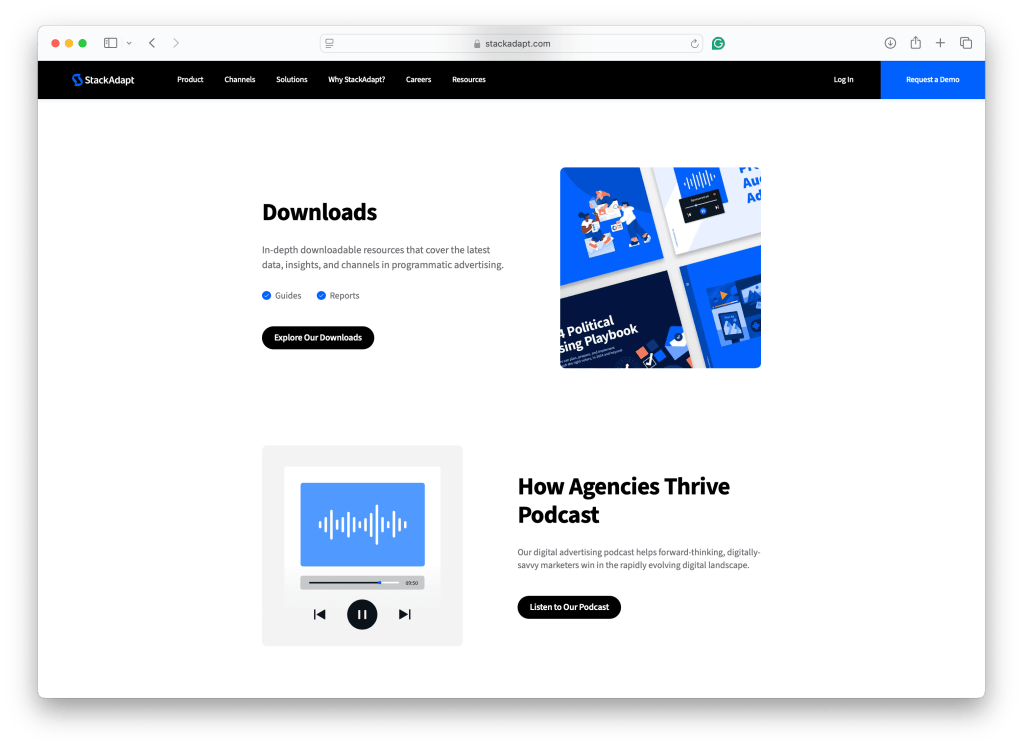
StackAdapt needed a resource hub that could support rapid publishing and a varied content strategy. After testing a proprietary CMS, the team found it too limiting for the pace they needed. WordPress offered a more adaptable foundation.
Their new hub, built with custom blocks and full site editing, supports blogs, downloads, webinars, and podcasts. Special components handle everything from event schedules to author metadata. Direct Salesforce integration helps connect content performance with campaign activity.
Most importantly, StackAdapt’s content team now owns the process. Templates and structured components empower them to publish confidently and consistently without relying on developers.
WordPress as a Platform for Momentum
Marketing today moves quickly. Deadlines shift. Strategies pivot. Campaigns often launch in stages, then scale up. In environments like these, a CMS has to support movement, not hold it back.
WordPress offers that support through accessibility, scalability, and customization. It encourages experimentation, simplifies collaboration, and allows marketing teams to work without unnecessary barriers.
Trew Knowledge collaborates with organizations that expect more from their digital platforms. From design systems to custom component libraries, we build WordPress solutions that support momentum rather than slow it down. Ready to improve time to market? Let’s build the system that makes it possible.