
Governments made major moves on AI transparency this week, though in opposite directions. Canada launched a public registry documenting 400+ federal AI systems, while the EU proposed loosening GDPR and cookie rules to boost competitiveness. The battle for AI-powered discovery intensified as Yoast partnered with Microsoft to keep the open web visible to AI agents, just as OpenAI quietly tested ad infrastructure inside ChatGPT’s Android app. Runway claimed the top spot in video generation benchmarks with Gen-4.5, promising cinematic quality without the price increase. And Amazon CTO Werner Vogels dropped his annual predictions, forecasting companion robots addressing loneliness, quantum-safe encryption becoming urgent, and defence tech reaching civilian use within two years. Here’s what happened in AI this week.
Listen to the AI-Powered Audio Recap
This AI-generated podcast is based on our editor team’s AI This Week posts. We use advanced tools like Google NotebookLM, Descript, and Elevenlabs to turn written insights into an engaging audio experience. While the process is AI-assisted, our team ensures each episode meets our quality standards. We’d love your feedback—let us know how we can make it even better.
🏛️ Policy & Regulation
Canada Unveils Public Registry of 400+ Federal AI Systems
Ottawa made a significant transparency move last Friday by launching a public registry documenting how artificial intelligence is being deployed across the federal government. The new database reveals more than 400 AI systems operating or under test across 42 departments, ranging from agricultural insect classification to border security screening to the calculation of medical protocols for astronauts.
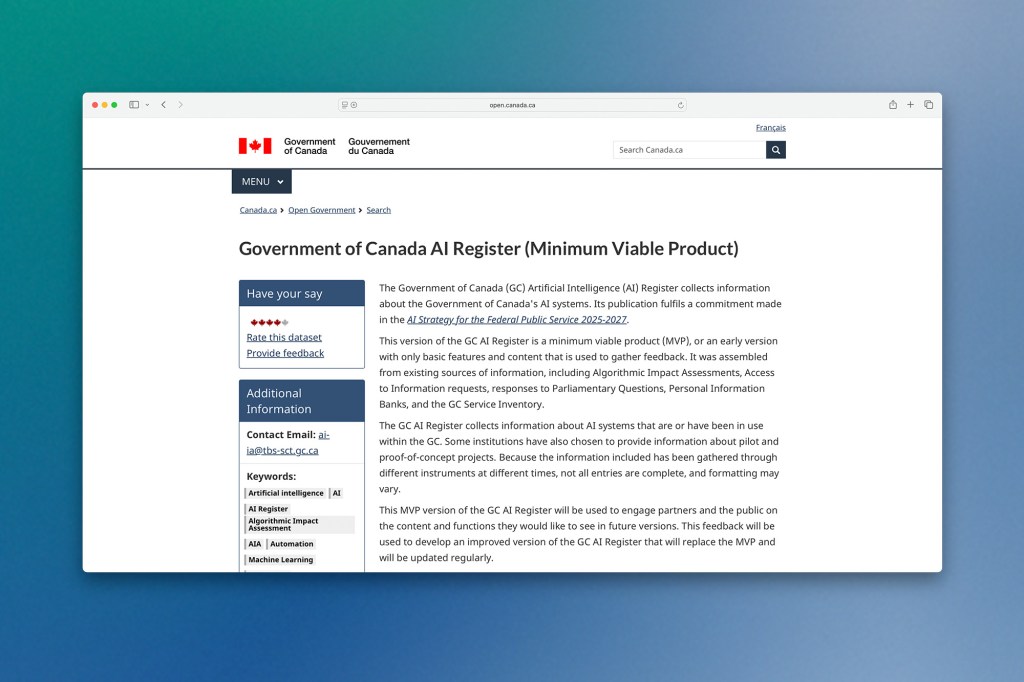
Available through Canada’s Open Government portal, the searchable registry provides details on which departments are using specific AI tools, their intended purposes, and the vendors behind them. Notably, the registry excludes what officials consider “low-risk” applications, such as spell-checkers and basic virtual assistants, focusing instead on more substantial implementations.
The applications themselves span a remarkable breadth. The Canada Border Services Agency is testing package-scanning technology from Israeli firm SeeTrue to detect concealed weapons. Other systems tackle everything from analyzing farm pest patterns to optimizing space-based healthcare delivery. Treasury Board President Shafqat Ali framed the registry as essential for building public confidence, stating it represents “an important step in building public trust and ensuring the responsible use of AI across the federal public service.”
But the registry also exposes a concerning trend for Canada’s domestic tech sector: American companies dominate federal AI procurement. Microsoft appears 75 times in the documentation, while OpenAI is mentioned 15 times. Canadian small and medium-sized businesses remain largely absent from the list.
Arvind Gupta, a University of Toronto computer science professor serving on Ottawa’s AI Strategy Task Force, sees both promise and problems in the release. While many entries appear to be internally developed tools for straightforward applications, he notes the registry lacks crucial technical details about system architecture, training datasets, and testing protocols, which are the information needed to verify whether best practices are actually being followed.
Gupta hopes the registry signals the beginning of a procurement transformation, advocating for a Canadian version of the US Small Business Innovation Research model, which requires departments to allocate 2% of discretionary budgets toward solutions from smaller enterprises. “Given how much [Canada] spends on [Scientific Research and Experimental Development]… we could redirect some of those funds towards a major and impactful SBIR-inspired program,” he suggested.
The registry documents AI use dating back to 1994, when CBSA first deployed “fuzzy search” software to flag potentially high-risk travellers by cross-referencing names across multiple systems. In a meta twist, the registry notes it was itself created using machine translation, though human experts reviewed the outputs.
The government characterizes this release as an early-stage version with basic functionality, promising enhanced features and expanded detail in future iterations based on public feedback throughout 2026.
European Commission Proposes Sweeping Relaxation of GDPR and AI Rules
The European Commission introduced a “Digital Omnibus” package this week that would substantially ease restrictions across GDPR data protection laws, the AI Act, and cookie consent requirements. While nothing has changed legally yet, the proposal signals Europe’s attempt to recalibrate its digital rulebook as concerns grow about the continent falling behind in AI development.
The omnibus approach bundles multiple regulatory modifications into a single legislative package. For AI governance, the proposal delays stricter compliance requirements for high-risk AI systems by 16 months, pushing implementation from August 2026 to December 2027. It would simultaneously reduce documentation burdens for certain systems and consolidate more oversight authority within the EU AI Office, streamlining what many companies have described as fragmented enforcement across member states.
The data protection changes target a persistent point of friction: determining when information stops being “personal data” subject to GDPR restrictions. The Commission aims to clarify rules around anonymized and pseudonymized datasets, explicitly making them easier to share and utilize for AI model training. Privacy advocacy group noyb warns this language shift introduces dangerous subjectivity, allowing data controllers to essentially self-determine what qualifies as personal data based on their stated intentions rather than objective standards. The organization argues this could effectively exempt significant portions of the advertising technology and data broker industries from GDPR protections.
The cookie consent provisions would produce the most immediately visible changes for both website operators and users. The Commission wants to address “banner fatigue” by exempting certain low-risk cookies from requiring explicit consent pop-ups, instead shifting privacy controls to browser-level settings that apply across websites. Functional cookies and some analytics uses would no longer trigger consent banners once risk categories are formally defined. Additionally, websites would become legally required to respect standardized, machine-readable privacy signals transmitted by browsers, effectively mandating technical compliance with tools like Global Privacy Control when such standards exist.
The most contentious element involves AI training data. The Digital Omnibus would establish expanded legal grounds allowing major AI developers, explicitly including Google, Meta, and OpenAI, to train models on Europeans’ personal data without obtaining explicit opt-in consent. Privacy advocates argue this fundamentally misapplies GDPR’s legal bases, contending that using individuals’ behavioural data for AI training should require affirmative consent rather than relying on opt-out mechanisms that remain difficult to exercise in practice. Noyb specifically highlights concerns about social media history and long-term behavioural profiles being incorporated into training datasets through opt-out frameworks that few users will successfully navigate.
While the EU established itself as the global leader in digital regulation through GDPR and the AI Act, critics increasingly argue these frameworks handicap European companies relative to American and Chinese competitors operating under lighter restrictions. The Digital Omnibus attempts to thread a needle: maintaining Europe’s reputation for privacy protection while reducing compliance friction that some business leaders claim stifles innovation.
🌐 The Open Web vs. Closed Platforms
WordPress SEO Leader Yoast Partners with Microsoft to Bridge Open Web and AI Systems
Yoast, the SEO plugin powering over 13 million websites, is teaming up with Microsoft to ensure the open web remains discoverable in an AI-driven future. The collaboration centers on NLWeb, Microsoft’s open framework designed to make web content interpretable by AI agents and language models.
The partnership represents a natural evolution for Yoast, which has spent more than a decade helping websites optimize for traditional search engines through structured data and metadata. Now, as discovery shifts from search boxes to conversational AI interfaces, the company is applying that same structured approach to help AI systems accurately understand and represent web content.
Microsoft’s NLWeb project provides a standardized layer connecting websites with AI systems, essentially creating a common language for machines to comprehend online content. By integrating the structured data already generated by Yoast’s millions of WordPress users, the companies are building an infrastructure that makes human-created web content accessible to AI without requiring publishers to learn entirely new formats or tools.
The initiative addresses a growing concern among content creators and small businesses: as AI systems increasingly mediate how people discover information, will the open web remain visible, or will only major platforms with resources to optimize for AI maintain their reach? Yoast SVP Chaya Oosterbroek positioned the collaboration as a continuation of the company’s mission to keep the web accessible, while Microsoft’s Ramanathan Guha emphasized democratization, stating the goal is ensuring every website, not just tech giants, can participate in AI-mediated discovery.
For Yoast’s WordPress users, the integration will roll out gradually, beginning with features that automatically format their content for AI comprehension without requiring additional configuration or new tools. The company is framing this as extending existing SEO capabilities rather than replacing them, which means the same structured data that helps search engines will now help AI agents.
The collaboration signals a broader industry recognition that AI discovery requires open standards rather than proprietary solutions. By building on existing web infrastructure such as schema markup and structured data, the partnership aims to create an interoperable system where content remains platform-independent and publisher-controlled.
Yoast users interested in early access to NLWeb features can sign up for updates at the company’s dedicated notification page.
OpenAI Quietly Tests Advertising Infrastructure Inside ChatGPT
OpenAI appears ready to monetize ChatGPT‘s massive user base through advertising, according to code discovered in the Android app’s latest beta release. Developer Tibor Blaho uncovered references to ad functionality in version 1.2025.329, including strings for “ads feature,” “bazaar content,” “search ad,” and “search ads carousel”, suggesting the company is building the technical foundation for sponsored content.
The timing makes strategic sense. ChatGPT now serves roughly 800 million weekly users, a dramatic acceleration from 100 million in November 2023 and 300 million by late 2024. The platform processes approximately 2.5 billion prompts daily across an estimated 5-6 billion monthly visits. India has emerged as the largest national user base, surpassing the United States.

What makes this development particularly significant is the nature of the data OpenAI possesses. Unlike traditional search engines, where users submit isolated queries, ChatGPT engages in extended conversations that reveal user intentions, problems, preferences, and decision-making processes in granular detail. This conversational context could enable advertising personalization that exceeds what’s possible through search history alone.
The code references suggest ads will initially appear within ChatGPT’s search features rather than its core conversational interface. That’s a more conservative approach that mirrors how Google introduced sponsored results. However, the infrastructure being built could eventually support ads throughout the platform.
This shift would mark ChatGPT’s transition from a pure product experience to an ad-supported business model, fundamentally changing its economic relationship with users. Until now, OpenAI has monetized through premium subscriptions and enterprise licensing while keeping the core experience ad-free. Introducing sponsored content creates a new revenue stream but also introduces potential conflicts between user experience and advertiser interests.
The implications extend beyond OpenAI itself. If conversational AI platforms become the primary discovery channels, the advertising dollars currently flowing to search engines could be redirected to AI chat interfaces. Publishers and businesses already grappling with AI-generated answers would face additional pressure if AI platforms become direct advertising competitors rather than just traffic intermediaries.
OpenAI has not publicly confirmed advertising plans or provided timeline details for any potential rollout.
🎨 Creative AI
Runway Releases Gen-4.5, Claims Top Position in Video Generation Benchmarks
Runway launched Gen-4.5 this week, positioning the model as the current leader in AI video generation quality. The release marks two years since the company introduced Gen-1, the first publicly available video generation model, and represents what Runway characterizes as significant advances in both training efficiency and output control.
Gen-4.5 currently holds the top ranking on the Artificial Analysis Text to Video benchmark with 1,247 Elo points, surpassing competing models from other providers. The company emphasizes improvements in three core areas: motion quality, prompt adherence, and visual fidelity—the perennial challenges in AI video generation where models often struggle with physics, temporal consistency, and translating text descriptions into accurate visuals.
According to Runway’s technical description, Gen-4.5 handles realistic physics more convincingly than previous versions, rendering objects with appropriate weight and momentum, liquids with proper fluid dynamics, and maintaining fine details like individual hair strands across movement. The model also reportedly manages complex multi-element scenes while keeping visual elements coherent throughout the generated sequence.

The release supports diverse aesthetic styles, from photorealistic footage to stylized animation, while maintaining visual consistency. Runway plans to extend all existing control modes to Gen-4.5, including image-to-video conversion, keyframe-based generation, and video-to-video transformation, giving users multiple entry points for guiding output.
Critically, Runway maintains that Gen-4.5 delivers enhanced quality without sacrificing generation speed or increasing costs. The model remains available at existing subscription pricing across all tiers, making the performance gains accessible without requiring plan upgrades, and that’s a notable decision given the computing resources typically required for quality improvements in generative AI.
The technical infrastructure relies entirely on NVIDIA hardware, with Gen-4.5 developed and deployed on NVIDIA GPUs throughout research, training, and inference stages. Generation runs on NVIDIA’s Hopper and Blackwell GPU series, representing a deep integration between the companies. NVIDIA CEO Jensen Huang publicly endorsed the collaboration, positioning it within the broader development of video and world models.
The release intensifies competition in video generation, where multiple providers are racing to achieve outputs that meet professional production standards. As these models approach usability for commercial video work, questions around training data sources, intellectual property, and industry disruption continue to intensify alongside technical capabilities.
🔮 Looking Ahead
Amazon CTO Werner Vogels Forecasts Five Major Technology Shifts for 2026
Werner Vogels, Amazon’s Chief Technology Officer, released his annual technology predictions this week, outlining five transformative developments he expects to accelerate dramatically in the coming year. Rather than focusing on incremental improvements, Vogels’ forecast emphasizes fundamental shifts in how humans interact with technology across healthcare, education, security, and software development.
The most unexpected prediction centers on companion robots addressing what Vogels identifies as a global loneliness crisis. Citing World Health Organization data showing one in six people worldwide experiencing loneliness, he argues we’re approaching a breakthrough in human-robot emotional relationships. Clinical studies he references show that companion robots like Paro produce measurable mental health improvements in dementia patients, with 95% experiencing beneficial interactions, including reduced agitation and improved sleep. Vogels draws on Amazon’s own Astro robot data, noting families develop genuine attachments to mobile robots in ways they don’t with stationary smart devices. His key caveat: companies must implement safeguards preventing these trusted companions from exploiting emotional bonds to manipulate user decisions.
Vogels dedicates significant attention to debunking the “AI will replace developers” narrative. He frames generative AI as the latest in a historical pattern, noting that compilers didn’t eliminate assembly programmers, cloud computing didn’t obsolete operations engineers, and AI coding assistants won’t end software development. Instead, he argues AI amplifies the need for what he terms “renaissance developers”—professionals who combine technical skill with business context, systems thinking, and domain expertise that AI cannot replicate. The core argument: AI generates code quickly, but understanding why specific technical decisions matter, navigating organizational constraints, and translating stakeholder needs into functional systems still requires human judgment.
On quantum computing, Vogels’ tone shifts to urgency. He notes error correction breakthroughs from AWS, Google, and IBM have dramatically compressed timelines for cryptographically relevant quantum computers. Recent research shows 2048-bit RSA encryption could potentially be broken with 95% fewer qubits than estimated just six years ago, suggesting viable quantum attacks on current encryption within five years. His prescription involves three simultaneous actions: deploying post-quantum cryptography standards now available from major tech providers, planning physical infrastructure transitions for devices that cannot be software-updated, and developing quantum-literate engineering talent to manage this transformation.
Vogels identifies defence technology as undergoing a fundamental transition model change. Unlike historical military-to-civilian technology transfers that took 10-20 years, he observes companies like Anduril and Shield AI designing dual-use technologies from inception, collapsing adaptation timelines. Technologies refined in conflict zones through rapid iteration cycles, such as autonomous systems, tactical edge computing, and advanced sensing, are reaching civilian applications in emergency response, healthcare, and infrastructure within years rather than decades. His timeline prediction: capabilities emerging from current defence investments will reach commercial deployment within two years.
The final prediction addresses education transformation through AI tutoring. Vogels frames traditional schooling as designed for conformity rather than individual learning styles, contributing to widespread student disengagement. AI tutoring systems from Khan Academy and others have achieved unexpected scale. Khanmigo reached 1.4 million students in its first year, 1,400% beyond projections. He emphasizes that AI doesn’t replace teachers but rather handles scalable tasks like grading and routine questions, freeing educators for individualized instruction. Studies he cites show teachers using AI tools save approximately six weeks annually, while students demonstrate 65% increased willingness to tackle difficult problems with AI assistance.
Vogels’ overarching theme positions 2026 as a transition point in which AI shifts from a tool to a collaborator, with humans remaining central to decision-making across domains from caregiving to software architecture. His predictions reflect Amazon’s strategic interests while offering a blueprint for how organizations might prepare for converging technology shifts across multiple sectors simultaneously.
Keep ahead of the curve – join our community today!
Follow us for the latest discoveries, innovations, and discussions that shape the world of artificial intelligence.