
AI keeps finding new ways to embed itself into how we work, build, and buy. This week brought milestones from OpenAI, strategic partnerships from Anthropic, a new security program from Google, and signals from Adobe and WooCommerce that shopping is entering its AI-powered era.
Listen to the AI-Powered Audio Recap
This AI-generated podcast is based on our editor team’s AI This Week posts. We use advanced tools like Google Notebook LM, Descript, and Elevenlabs to turn written insights into an engaging audio experience. While the process is AI-assisted, our team ensures each episode meets our quality standards. We’d love your feedback—let us know how we can make it even better.
🚀 New Models and Milestones
ChatGPT Reaches 800 Million Weekly Active Users
OpenAI’s latest milestone is staggering by any measure: 800 million people now use ChatGPT every week. Sam Altman shared the number during his Dev Day keynote, noting that the platform now processes over 6 billion tokens per minute and has 4 million developers building with OpenAI tools.
The announcement underscores just how quickly AI has shifted from a novelty to infrastructure. What began as an experimental chatbot in 2022 has become an ecosystem where individuals, enterprises, and even governments are building daily. ChatGPT is no longer just a place to ask questions; it’s where workflows, products, and digital agents are taking shape.
Altman framed this next phase around interactivity and personalization, pointing to a wave of apps built directly inside ChatGPT and the rise of agentic systems — software that doesn’t just respond but reasons, adapts, and acts. It’s a clear signal that OpenAI wants ChatGPT to be less of a destination and more of a platform layer across industries.
The company’s momentum extends beyond software. OpenAI recently became the most valuable private company in the world, hitting a $500 billion valuation after a $6.6 billion secondary share sale. With chip acquisition races, new video-generation tools like Sora 2, and experimental features like OpenAI Pulse delivering personalized AI briefings, OpenAI is moving fast, and sometimes faster than the world can process.
But that pace has its trade-offs. Alongside the hype are reminders that alignment remains an unsolved challenge, with cases like Allan Brooks’ AI-induced “discovery” showing how easily confidence can turn into confusion. The milestone proves one thing, though: generative AI isn’t slowing down. It’s multiplying, embedding, and shaping the next stage of how we build and think online.
💼 AI in the Enterprise
Anthropic Gains Ground in the Enterprise with Deloitte and IBM
Anthropic’s enterprise momentum is accelerating. This week, the company announced two landmark partnerships — one with Deloitte and another with IBM — marking a major expansion of its presence inside global organizations.
For Deloitte, the collaboration brings Claude to nearly 500,000 employees worldwide, making it Anthropic’s largest deployment to date. The partnership focuses on creating AI-powered compliance and productivity tools for regulated sectors such as finance, healthcare, and public services. Deloitte will also experiment with AI agent personas to enhance internal workflows, reflecting its commitment to integrating AI responsibly and at scale.

Meanwhile, IBM plans to embed Claude models directly into its software suite, starting with its integrated development environment for enterprise clients. The two companies have also published a joint guide on building and maintaining enterprise-grade AI agents, signalling a shared focus on governance, security, and long-term sustainability in AI adoption.
Together, these alliances show how Anthropic is positioning itself as a trusted partner for large-scale, compliance-driven organizations. The company’s emphasis on safety and interpretability, built around its “Constitutional AI” framework, is finding strong resonance across the enterprise sector.
A recent study by Menlo Ventures reinforces this trend, reporting that Claude models now lead in enterprise preference, surpassing OpenAI’s for the first time. As the race to operationalize AI continues, Anthropic’s strategy appears to be less about speed and more about credibility, and that may prove to be its biggest advantage.
🧩 AI Safety and Security
Google Offers Up to $30,000 for Finding AI “Rogue Actions”
Google is putting a price tag on AI safety. The company has launched a new AI bug bounty program that pays researchers up to $30,000 for uncovering vulnerabilities in its AI products, especially those that could trigger what it calls “rogue actions.”
These are not your average software bugs. Google’s examples include scenarios like tricking a Google Home device into unlocking a door or injecting a poisoned calendar event that could shut off lights and open smart shutters. The company defines an AI bug as any exploit that uses a large language model or generative AI system to cause harm or compromise user security.
The highest rewards are reserved for Google’s flagship products — Search, Gemini apps, and core Workspace tools like Gmail and Drive. Lower payouts apply to secondary products such as NotebookLM or Jules, and to less severe cases like stolen model parameters. To date, AI researchers have already earned more than $430,000 for similar findings under Google’s existing vulnerability program.
Not all problems qualify, though. Simply making Gemini hallucinate will not earn a reward. Google separates those incidents from genuine security flaws, directing users to submit them through product feedback channels instead. The company says that the approach allows its AI safety teams to improve model training rather than treat them as isolated bugs.
Alongside the bounty launch, Google also introduced CodeMender, an AI agent that helps patch vulnerabilities in open source projects. The system has reportedly assisted with 72 verified fixes, each vetted by human researchers.
This latest move shows how AI safety is shifting from a research concept to an operational discipline. The same companies racing to expand AI capability are now formalizing the hunt for its weakest points, and paying handsomely for anyone who can find them.
🛍️ AI and Commerce
Adobe Forecasts 520% Surge in AI-Assisted Shopping This Holiday Season
If last year marked the arrival of AI in e-commerce, this year could mark its tipping point. Adobe Analytics projects that AI-assisted shopping will rise 520% during the 2025 U.S. holiday season, peaking in the ten days before Thanksgiving.
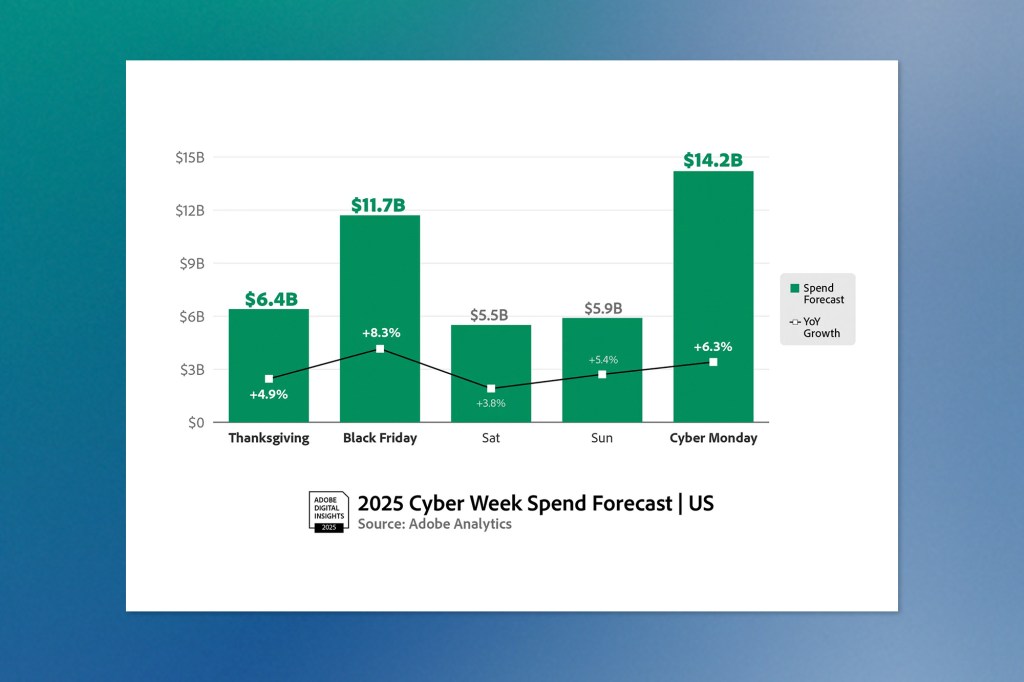
According to Adobe’s forecast, U.S. consumers are expected to spend $253.4 billion online, a 5.3% year-over-year increase. The data draws from more than 1 trillion visits to retail sites and over 100 million SKUs across 18 categories, giving the report a uniquely comprehensive view of digital commerce trends.
AI will play a growing role in how consumers research, discover, and decide. Adobe’s survey of 5,000 U.S. shoppers found that 53% plan to use AI services for pre-purchase research, while 40% will use them for recommendations, 36% for deal finding, and 30% for gift inspiration. The biggest categories for AI-assisted shopping are expected to be toys, electronics, jewelry, and personal care.
Cyber Monday remains the biggest event of the season, projected to reach $14.2 billion in sales, followed by $11.7 billion on Black Friday and $6.4 billion on Thanksgiving Day. Mobile will continue its steady rise, driving 56.1% of total online spend, while buy now, pay later services are forecast to hit $20.2 billion, up 11% from last year.
Adobe’s report also highlights a dramatic rise in social-commerce influence, with social media advertising expected to generate 51% more online revenue year over year, compared to just 5% growth in 2024.
The takeaway: consumers are not just shopping online; they are shopping through AI. From chat-based discovery to personalized deal alerts, AI is quickly becoming the invisible layer guiding billions in seasonal spending. And with ecosystems like WooCommerce, Stripe, and Shopify already adapting for agentic commerce, Adobe’s numbers suggest this year’s holiday rush could be the first true AI-powered shopping season.
WooCommerce Prepares for the Age of Agentic Commerce
Speaking of AI’s growing influence on ecommerce, WooCommerce is setting the stage for one of the most significant shifts since the checkout button: agentic commerce, where AI agents browse, recommend, and even complete purchases on behalf of users.
In a recent roadmap update, Beau Lebens revealed that Woo is collaborating with Stripe on its new Agentic Commerce Protocol, a framework that allows AI systems to interact directly with online stores. The goal is to make WooCommerce stores discoverable and operable by AI assistants across the web.
Imagine a customer asking, “Find me a birthday gift for someone who loves gardening,” and an AI instantly browsing Woo merchants’ catalogues, comparing prices, and finalizing the order without the shopper ever opening a browser. That is the direction WooCommerce is building toward, powered by new technologies like the WooCommerce MCP (Model Context Protocol) and the WordPress Abilities API.
The first version of WooCommerce MCP, launching with WooCommerce 10.3, allows AI assistants such as Claude, Cursor, or VS Code to interact with stores for tasks like searching, adding, and managing products or orders. When combined with Woo’s existing REST and Store APIs, the technology moves beyond store management toward enabling secure, AI-driven shopping experiences.
The initiative also highlights WooCommerce’s commitment to open-source extensibility. Rather than building a walled ecosystem, the Woo team is aligning its AI tools with the same APIs and frameworks that power the broader WordPress community. This approach ensures that developers and merchants alike can experiment and innovate as the AI landscape evolves.
As Lebens explains, WooCommerce’s long-term advantage lies in its flexibility. Its open foundation makes it a natural fit for emerging standards like OpenAI’s Product Feed Spec, which helps make products visible to AI-driven search and shopping assistants. When paired with protocols like Stripe’s, it positions WooCommerce merchants to thrive in an AI-powered marketplace that values interoperability as much as discovery.
Agentic commerce is still in its early days, but WooCommerce’s direction is clear. The platform that helped democratize online selling is now preparing for the next leap: a world where storefronts talk to systems, and customers shop through conversations, not clicks.
Keep ahead of the curve – join our community today!
Follow us for the latest discoveries, innovations, and discussions that shape the world of artificial intelligence.