This week’s AI developments are split between adoption wins and workforce concerns. Enterprise organizations are seeing measurable returns from AI tools, with Salesforce reporting double-digit productivity gains and Cloudflare research showing modernized infrastructure triples the odds of success. Meanwhile, the UK faces the steepest AI-related job losses among major economies, prompting government action on both employment support and service modernization. On the product side, Anthropic expanded Claude’s enterprise capabilities, WordPress shipped practical editorial AI tools, and Google Photos added text-driven video generation for consumers.
Listen to the AI-Powered Audio Recap
This AI-generated podcast is based on our editor team’s AI This Week posts. We use advanced tools like Google NotebookLM, Descript, and Elevenlabs to turn written insights into an engaging audio experience. While the process is AI-assisted, our team ensures each episode meets our quality standards. We’d love your feedback—let us know how we can make it even better.
🏢 Enterprise AI Integration & Productivity
Anthropic Launches Interactive Claude Apps for Enterprise Users
Anthropic rolled out interactive app integrations for Claude on Monday, bringing workplace tools directly into the chatbot interface. The launch focuses on enterprise productivity with apps such as Slack, Canva, Figma, Box, and Clay, with Salesforce integration expected soon.
The feature allows logged-in users to access these services through Claude, enabling actions like sending Slack messages, creating charts, or pulling files from cloud storage. Anthropic says dedicated visual interfaces combined with Claude’s capabilities let users work faster than either tool could alone.
Access is limited to Pro, Max, Team, and Enterprise subscribers. Eligible users can enable apps at claude.ai/directory.

The implementation mirrors OpenAI’s Apps system from October, with both built on the Model Context Protocol, an open standard Anthropic introduced in 2024. MCP added app support in November through work from both companies.
The apps show particular promise when paired with Claude Cowork, Anthropic’s multi-stage agent tool launched last week. Cowork handles complex tasks across large datasets without requiring terminal commands. Once apps integrate with Cowork—currently planned but not available at launch—the agent could update Figma designs or access Box files during automated workflows.
Anthropic’s safety documentation for Cowork stresses careful monitoring and limited permissions. The company specifically warns against granting access to financial documents, credentials, or personal records, recommending users create dedicated working folders rather than allowing broad access.
Salesforce Reports Major Productivity Gains from Cursor Adoption
Salesforce achieved 90% adoption of Cursor across its 20,000-engineer workforce within months, recording double-digit improvements in development velocity and code quality.
The enterprise software company already maintained internal AI coding tools, including an open-source model called Code Genie, but made Cursor available as an additional option. Adoption split along experience lines: junior engineers, many hired during pandemic remote work periods, used Cursor to understand unfamiliar codebases faster. Senior engineers started with repetitive tasks, then expanded usage once they verified the tool’s reliability.
Shan Appajodu, Salesforce’s SVP of Engineering, said Cursor transformed how developers approach product quality. The company tracks three core metrics—cycle time, bug count, and throughput—and saw double-digit gains across all three. Legacy code coverage time dropped 85%.
Engineers now generate significantly more unit tests with Cursor assistance, improving the reliability of shipped code. The tooling helped accelerate products like Agentforce, Salesforce’s AI platform.
Challenges remain around code review processes as AI-assisted code becomes standard. Salesforce continues refining how to maintain trust and quality standards for contributions created with Cursor’s help. Appajodu believes the shift represents an early stage of broader transformation across software planning, development, and maintenance workflows.
Cloudflare Study Links App Modernization to AI Investment Returns
Organizations that modernize their applications are nearly three times more likely to see clear returns from AI investments, according to Cloudflare’s 2026 App Innovation Report.
The study surveyed over 2,300 senior leaders across APAC, EMEA, and the Americas, finding that application infrastructure determines AI success more than the AI tools themselves. In the Asia-Pacific, 92% of leaders identified software updates as the most critical factor in improving AI capabilities.
The report frames AI performance as an infrastructure problem. AI systems need fast data access, flexible architectures, and reliable integration points. Those are capabilities that legacy applications and fragmented systems cannot provide. Modernized applications create space for experimentation and scaling without constant rework.
Leading organizations report significantly higher confidence that their infrastructure can support AI development. In APAC, 90% of advanced organizations have already embedded AI into existing applications, compared to much lower rates among lagging companies. About 80% plan to deepen that integration over the next year.
The shift marks a move from isolated AI pilots to integrated deployment. Leading organizations use AI for internal processes, content-driven applications, and revenue-generating work, while lagging companies remain cautious and fragmented.
Organizations behind on modernization typically act reactively, often following security incidents or operational failures. These companies report lower confidence in both infrastructure and team capabilities, which slows decision-making and limits AI project scope. Poor alignment between security and application teams compounds the problem, with security issues consuming time that could otherwise be spent on AI work.
Tool sprawl creates additional friction. While nearly all organizations struggle with complex technology stacks, 86% of APAC leaders are actively eliminating redundant tools and addressing shadow IT. Simplifying platforms makes modernization, security implementation, and AI integration smoother.
Developer productivity differs sharply between modernized and lagging organizations. Teams working with modernized foundations spend time maintaining and improving functional systems, while those in lagging organizations rebuild from scratch or handle configuration and remediation work.
The report concludes that AI investment without modernization produces shallow results, while modernization without integration plans risks becoming an endless rebuild. Organizations seeing the strongest returns treat application updates, security alignment, and AI integration as connected work rather than separate projects.
🛠️ Development Tools
WordPress AI Experiments Plugin Reaches Version 0.2.0
The WordPress AI Team released version 0.2.0 of AI Experiments, shifting focus from a foundational framework to practical editorial tools that content creators can actually use in production workflows.
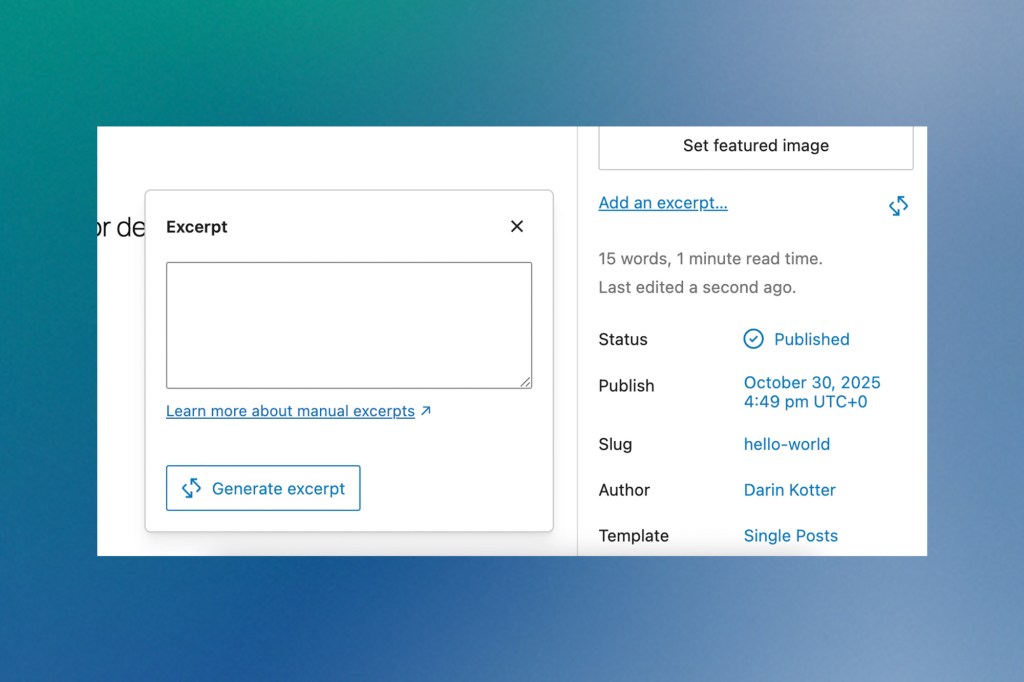
The headline addition is AI-powered excerpt generation, which creates draft excerpts directly from post and page content. The feature targets a common editorial gap: excerpts are widely used in archives and feeds, but frequently skipped or rushed. Authors can now generate initial excerpts from their content, then review and edit as needed.
Version 0.2.0 also introduces the Abilities Explorer, an admin interface that displays all registered AI capabilities within the plugin. The tool shows what AI-powered actions are available and how they’re configured, giving developers visibility into the system’s capabilities as the framework expands.
The release includes backend work on the Abilities system, the core abstraction layer that defines how AI features integrate with WordPress. While not user-facing, this groundwork supports upcoming experiments, including content summarization and image-related features.
Version 0.3.0 is already in development with several features planned: content summarization for longer posts, featured image generation, alt text generation for accessibility workflows, and a TypeScript refactor of the Abilities Explorer using WordPress’s DataViews and DataForms components. The Settings interface will receive similar modernization to align with current WordPress admin patterns.
📱 Consumer AI
Google Photos Adds Text Prompts for AI Video Generation
Google Photos expanded its photo-to-video feature with text prompt capabilities, giving users more control over how still images transform into short video clips.
The update builds on existing options (Subtle Movement and I’m Feeling Lucky) by adding custom text input for video generation. Users can describe desired movement, style, or effects in written prompts, then watch the AI interpret those instructions. The feature is restricted to users 18 and older.
Google included prompt suggestions for users unsure how to describe their vision, and allows editing and refinement of prompts to adjust video output. All videos created through the feature, whether from custom prompts or templates, can now include audio by default.
Videos are generated within moments and saved directly to user libraries for sharing.
💼 AI’s Impact on the Workforce
UK Reports Highest AI-Related Job Losses Among Major Economies
The UK is experiencing net job losses from artificial intelligence adoption, losing positions at a faster rate than other large economies, according to Morgan Stanley research.
British companies using AI for at least a year reported an 8% net decline in headcount over the past 12 months. That’s the steepest drop among major economies, including the United States, Japan, Germany, and Australia. The investment bank surveyed businesses across five sectors: consumer staples and retail, real estate, transportation, healthcare equipment, and automotive.
UK firms recorded an average 11.5% productivity boost from AI, matching gains reported by US companies. The critical difference: American businesses created more positions than they eliminated, while British firms cut staff.
The trend compounds pressure on the UK labour market, where unemployment has reached a four-year high as minimum wage increases and higher employer national insurance contributions limit hiring capacity.
A separate Randstad survey found over a quarter of UK workers now fear their jobs could vanish within five years due to AI. Concern splits across age groups, with Gen Z workers expressing the most anxiety about adapting, while baby boomers approaching retirement show greater confidence. Morgan Stanley’s research indicates companies are most likely to eliminate early-career roles requiring two to five years of experience.
London Mayor Sadiq Khan warned in his Mansion House speech this month that AI could trigger mass unemployment in the capital. He argued London faces heightened risk due to its concentration of white-collar positions in finance, creative industries, and professional services like law, accounting, and consulting. Khan said entry-level and junior positions would disappear first, calling for proactive job creation measures.
At the World Economic Forum in Davos last week, JPMorgan CEO Jamie Dimon said governments and businesses must support workers displaced by AI or face potential civil unrest.
UK Taps Anthropic for AI Assistant Pilot in Employment Services
The UK Department for Science, Innovation, and Technology selected Anthropic to build an AI assistant pilot aimed at modernizing citizen access to government services.
The project, announced Monday, builds on a February 2025 memorandum of understanding between DSIT and Anthropic. Rather than deploying a standard chatbot, the initiative focuses on agentic AI that actively guides users through government processes instead of simply retrieving information.
The pilot targets employment services, where the system will help citizens find jobs, locate training programs, and navigate available support. The domain choice serves dual purposes: employment represents high-volume government interaction where efficiency improvements directly affect economic outcomes, and job-seeking workflows test the system’s ability to maintain context across ongoing interactions rather than one-off transactions.

The deployment follows a “Scan, Pilot, Scale” framework designed to validate safety protocols and effectiveness before broader rollout. Users will control their data, including opting out and managing what information the system retains. All personal data handling aligns with UK data protection requirements. The UK AI Safety Institute is participating in model testing and evaluation.
Knowledge transfer drives the partnership structure. Anthropic engineers will work directly with civil servants and Government Digital Service developers, aiming to build internal government AI expertise rather than creating vendor dependency. DSIT is treating AI capability as an operational asset that should remain in-house once the initial engagement ends.
Pip White, Anthropic’s head of UK, Ireland, and Northern Europe, said the partnership demonstrates how frontier AI can deploy safely for public benefit and set standards for government AI integration.
The UK project fits Anthropic’s expanding public sector work, which includes education pilots in Iceland and Rwanda. The company is growing its London office policy and applied AI teams.
Keep ahead of the curve – join our community today!
Follow us for the latest discoveries, innovations, and discussions that shape the world of artificial intelligence.