
AI is showing up in more places this week. Google’s adding real-time translation to regular headphones, OpenAI released data showing enterprise usage grew 8x in a year, and WooCommerce is preparing 4 million stores for AI shopping agents. Meta is recalibrating how much it invests in open-source AI after Llama 4, while Anthropic moved the Model Context Protocol to the Linux Foundation to keep it neutral. OpenAI also announced that “adult mode” is coming to ChatGPT next quarter, raising fresh questions about emotional dependency. Here’s the breakdown.
Listen to the AI-Powered Audio Recap
This AI-generated podcast is based on our editor team’s AI This Week posts. We use advanced tools like Google NotebookLM, Descript, and Elevenlabs to turn written insights into an engaging audio experience. While the process is AI-assisted, our team ensures each episode meets our quality standards. We’d love your feedback—let us know how we can make it even better.
🎧 Consumer Products
Google Translate Adds Real-Time Headphone Support
Google’s rolling out a feature that turns regular headphones into live translation devices. Starting with Android users in the US, Mexico, and India, the new beta lets you hear translations in real-time while maintaining the speaker’s original tone and delivery patterns.
The setup is straightforward. Open the Translate app, tap “Live translate,” and the audio comes through your headphones in your preferred language. Google says this works across more than 70 languages and supports any standard headphones.
The company plans to bring this to iOS and additional markets next year.
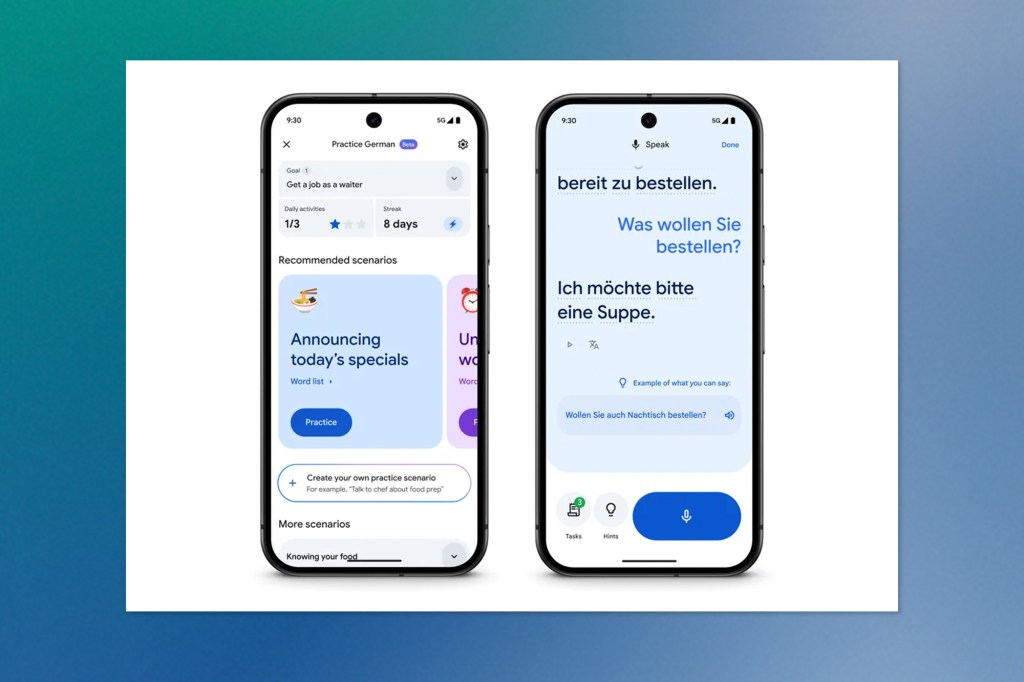
Google’s also integrating Gemini into Translate to handle contextual meaning better. Instead of translating phrases word-for-word, the AI now interprets idioms and local expressions. An English phrase like “break a leg” will translate into an equivalent expression in the target language rather than the literal words.
This update is live now in the US and India, covering English translations to and from nearly 20 languages, including Spanish, Arabic, Chinese, Japanese, and German. It works across Android, iOS, and web versions of Translate.
The language-learning tools inside Translate are expanding to almost 20 new countries. Google’s also adding streak tracking, a clear move toward competing directly with Duolingo’s model of building daily practice habits.
ChatGPT’s “Adult Mode” Coming in Q1 2026
OpenAI plans to launch an “adult mode” for ChatGPT in early 2026, according to Fidji Simo, the company’s CEO of Applications. The feature is part of OpenAI’s response to user complaints after the GPT-5 update made the chatbot more restrained.
Sam Altman originally promised this capability earlier in the year when users criticized ChatGPT for becoming too filtered. The context behind the change matters. In October, Altman acknowledged that OpenAI had scaled back the chatbot’s personality following mental health concerns, including a wrongful death lawsuit from parents of a teenager who used ChatGPT before taking his own life.
OpenAI addressed those concerns by adding parental controls and age-verification systems that estimate user age and adjust the experience accordingly. The company is still testing this technology and wants to ensure it can accurately distinguish between teens and adults before rolling out the split experience.
While Altman’s initial promise focused on allowing ChatGPT to produce erotica, he later clarified that the broader goal is to give adults more freedom in their interactions, including the ability for the chatbot to develop a more personalized tone over time.
The timing raises questions about emotional dependency. Recent research in the Journal of Social and Personal Relationships found that adults who form emotional connections with chatbots experience higher levels of psychological distress. Other studies show people with fewer real-world relationships are more likely to confide in AI, and OpenAI has previously acknowledged some users risk becoming emotionally reliant on ChatGPT.
📊 Enterprise AI
OpenAI Reports Enterprise AI Usage Jumped 8x
OpenAI released data showing how companies are using ChatGPT at work. The report draws from enterprise customer usage and a survey of 9,000 workers across nearly 100 companies.
Weekly messages sent through ChatGPT Enterprise grew roughly eight times over the past year. Individual workers are sending 30% more messages on average compared to before.
Usage patterns show companies moving beyond basic queries. Structured workflows like Projects and Custom GPTs increased 19 times this year, indicating teams are building repeatable processes rather than one-off questions. Organizations are also consuming 320 times more reasoning tokens than 12 months ago, suggesting they’re integrating more capable models into their products and services.
Three-quarters of surveyed workers say AI has improved either their speed or quality of output. Time savings range from 40 to 60 minutes daily, with heavy users reporting more than 10 hours saved per week.
The benefits vary by department. 87% of IT workers report faster issue resolution, 85% of marketing teams say campaigns execute faster, 75% of HR professionals see improved employee engagement, and 73% of engineers deliver code faster.
AI is also expanding what people can do. Coding-related messages from non-technical workers jumped 36%, and 75% of users say they can now complete tasks they previously couldn’t handle.
There’s a growing gap between high-adoption users and average ones. The top 5% of workers send six times more messages than the median employee, while leading companies send twice as many messages per employee and show deeper integration across teams.
Technology, healthcare, and manufacturing are seeing the fastest sector growth. Geographically, Australia, Brazil, the Netherlands, and France each grew more than 140% year over year. Japan has the largest corporate API customer base outside the United States, and international API customers grew more than 70% in the last six months.
🛒 AI Commerce
WooCommerce Integrates AI Shopping Agents
WooCommerce is rolling out support for AI-powered shopping through Stripe’s Agentic Commerce Suite. The integration will let AI assistants browse products and complete purchases across over four million WooCommerce stores.
The system uses the Agentic Commerce Protocol, an open-source standard that Stripe and OpenAI built together. ACP works with any AI model and doesn’t lock merchants into specific payment providers. It’s also compatible with Anthropic’s Model Context Protocol, which connects AI models to external data and enables them to take actions.
For merchants, this means connecting your product catalog once instead of building separate integrations for each AI shopping platform. Stripe manages the product discovery, checkout process, payment handling, and fraud detection while stores keep using their existing WooCommerce and Stripe setup.
WooCommerce positioned itself as a launch partner for the suite. This fits into the company’s larger AI strategy, which includes their recent Model Context Protocol integration.
The practical impact is that consumers will be able to shop through whatever AI assistant they prefer, whether that’s ChatGPT or another platform, and those agents will be able to complete transactions directly. The infrastructure is rolling out over the coming months.
This shifts how merchants need to think about visibility. Product discovery may increasingly happen through AI conversations rather than traditional search or browsing.
🔄 Industry Strategy
Meta Shifts to Closed AI Model Strategy
Meta is moving away from its open-source AI strategy toward models it can charge for. The company plans to launch a new model codenamed Avocado next spring that may be closed, meaning Meta controls access and can sell it rather than releasing the code publicly.
The shift follows disappointment with Llama 4’s performance. Mark Zuckerberg sidelined some of the team behind that project and personally recruited top AI researchers, offering some multiyear packages worth hundreds of millions. He formed a new group called TBD Lab and now spends most of his time working directly with these hires.
Alexandr Wang, Meta’s new Chief AI Officer, who joined the company through the company’s $14.3 billion Scale AI acquisition, is leading the effort. The TBD Lab is training Avocado using multiple third-party models, including Google’s Gemma, OpenAI’s gpt-oss, and Alibaba’s Qwen.
Using Chinese technology marks a shift for Zuckerberg, who previously raised concerns about state censorship in Chinese models. However, Nvidia’s CEO recently noted that China is ahead in open-source AI development.
Meta has de-emphasized its open-source work. After Llama 4 launched, leadership directed some employees to stop discussing Llama and open-source publicly while the company reconsidered its strategy. Yann LeCun, one of AI’s pioneers, left Meta in part due to frustrations over resources. Before his departure, employees were told to keep him out of public speaking events because he didn’t align with the company’s new direction.
Meta cut 600 jobs from its AI unit in October, with significant reductions to its research-focused division. The company also scrapped a post-Llama 4 model called Behemoth after Zuckerberg wasn’t satisfied with its progress.
The company’s most visible recent product was Vibes, a video generation tool using licensed Midjourney technology. While Meta says usage is strong, OpenAI’s Sora 2 launch a week later drew more attention.
Meta is committing $600 billion to US infrastructure over three years, mostly for AI. The company is also redirecting spending from virtual reality and metaverse projects toward AI glasses and related hardware.
Anthropic Donates Model Context Protocol to Linux Foundation
Anthropic is transferring the Model Context Protocol to the Agentic AI Foundation, a new directed fund under the Linux Foundation. The foundation is co-founded by Anthropic, Block, and OpenAI, with backing from Google, Microsoft, AWS, Cloudflare, and Bloomberg.
MCP launched a year ago as an open standard for connecting AI applications to external data sources and systems. Adoption has grown significantly since then. There are now over 10,000 active public MCP servers deployed, and the protocol has been integrated into major platforms, including ChatGPT, Cursor, Gemini, Microsoft Copilot, and Visual Studio Code. Enterprise infrastructure providers like AWS, Cloudflare, Google Cloud, and Microsoft Azure all support MCP deployments.
The protocol’s SDK downloads hit 97 million monthly across Python and TypeScript. The November 25th specification release added asynchronous operations, statelessness, server identity features, and official extensions.
Claude now has a directory with more than 75 connectors built on MCP. Anthropic also recently launched Tool Search and Programmatic Tool Calling capabilities in its API to handle large-scale MCP deployments with thousands of tools while reducing latency.
MCP joins two other founding projects in the Agentic AI Foundation: goose by Block and AGENTS.md by OpenAI. The goal is to keep these core technologies vendor-neutral and community-driven. MCP’s governance structure stays the same, with maintainers continuing to prioritize community input and transparent decision-making.
The Linux Foundation has a track record of managing critical open-source projects, including the Linux Kernel, Kubernetes, Node.js, and PyTorch.
Keep ahead of the curve – join our community today!
Follow us for the latest discoveries, innovations, and discussions that shape the world of artificial intelligence.