Personalization has become the defining measure of meaningful digital experiences. In education, it’s what turns information into insight, helping teachers find exactly what supports their practice and growth.
For Edutopia, a trusted resource founded by the George Lucas Educational Foundation, personalization is more than a feature. It reflects the way educators learn and connect, with curiosity, context, and community guiding every interaction.
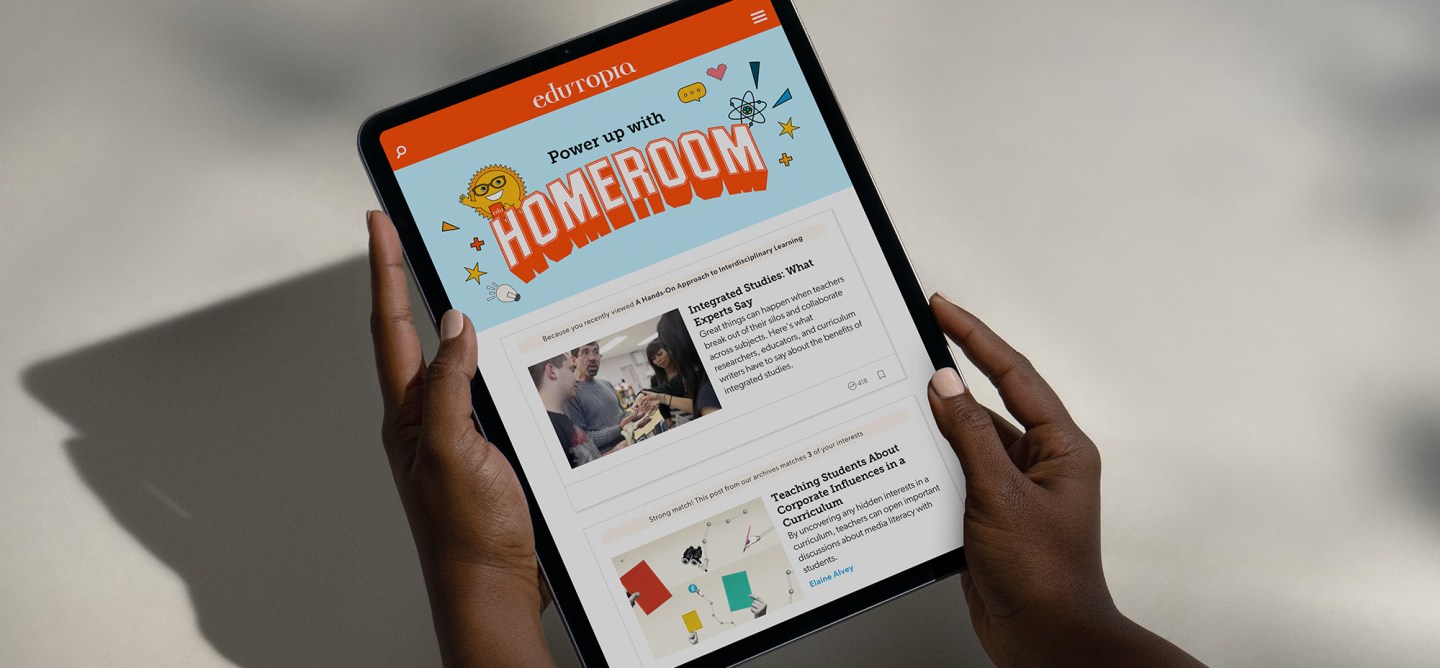
That vision comes to life in Homeroom, Edutopia’s new AI-powered feed system developed in partnership with Trew Knowledge. More than a dashboard or a collection of articles, it functions as a living ecosystem that evolves with each user. As teachers explore, share, and discuss, Homeroom learns alongside them, shaping a feed that becomes more relevant and insightful over time.
About Edutopia
Since its inception, Edutopia has been dedicated to improving K–12 education through evidence- and practitioner-based learning strategies. Its content empowers teachers, administrators, and policymakers to bring innovation into classrooms around the world.
Our Ongoing Partnership with Edutopia
When Trew Knowledge first partnered with Edutopia, the team was publishing multiple articles each day on an older Drupal platform that made content management slow and complex. As their audience and ambitions grew, so did the need for a system that could handle scale, flexibility, and experimentation.
The migration to WordPress marked the beginning of that transformation. Working closely with Edutopia’s editorial and technical teams, we built a decoupled publishing ecosystem capable of supporting more than 10,000 content pieces while dramatically improving speed and stability. Editors gained an intuitive WYSIWYG interface that reduced content layout time by more than 80 percent and allowed them to focus on storytelling rather than formatting.
The new infrastructure also opened the door to innovation. With development bottlenecks removed, Edutopia could finally move forward with features that had been on the back burner, bringing personalization, interactivity, and AI-driven engagement to life.

One of the first of these was Ask Edutopia AI, a custom AI integration developed by Trew Knowledge. Built as a WordPress block, it allows editors to add interactive AI prompts to any article, inviting readers to explore ideas further and discover practical ways to apply them in their classrooms. The result is a more conversational and participatory learning experience.
The foundation laid by this modernization set the stage for Homeroom. Leveraging a microservice architecture and AI-enhanced content modelling, Homeroom expands on the same principles that drove the original migration: flexibility, scalability, and a deep focus on user experience.
Today, Edutopia continues to lead by example, combining trusted educational content with cutting-edge technology to create meaningful, adaptive experiences for its community.
Why Relational Models Fall Short for Dynamic Content
Traditional content systems run on relational databases. Those are great for structured, predictable data, but limited when relationships evolve.
In education, context is everything. A teacher might explore project-based learning, follow discussions about new teachers, and engage with articles on assessment rubrics. Each of these interactions provides a clue about their interests. But in a relational database, those clues are scattered across tables, requiring rigid joins and manual logic to connect.
Personalization doesn’t fit in a spreadsheet. It needs fluidity and a model that understands both meaning and relationships. Homeroom replaces rigid data structures with a hybrid of vector embeddings and graph databases, creating a living system that learns and adapts as educators interact with content.
Understanding Vector Embeddings: Giving Meaning a Shape
Before Homeroom can connect relationships, it needs to understand meaning.
Vector embeddings make this possible. They convert words, phrases, and even entire articles into long lists of numbers that represent meaning in multi-dimensional space and serve as numerical coordinates.
In that invisible space:
- “Inquiry-based learning” and “student curiosity” live close together.
- “Standardized testing” sits in another constellation.
- As new content is added, these galaxies expand and reshape themselves.
By representing meaning mathematically, Homeroom can:
- Group related content semantically, even when phrasing differs.
- Recommend resources by concept, not just keyword.
- Identify emerging themes as new educational conversations take shape.
This approach eliminates the need for rigid taxonomies. Instead of being told what’s similar, Homeroom learns what’s similar based on how educators write, search, and share ideas. The embedding layer works in tandem with Homeroom’s graph database. Together, they form the semantic core of Homeroom’s intelligence, which is a system that doesn’t just store content but understands it.
How Graph Databases Work
If embeddings define what content means, graph databases define how it all connects.
Homeroom’s graph layer, powered by Neo4j, maps every interaction between users, topics, and content. Each entity becomes a node, and every interaction becomes an edge connecting those nodes.
For example:
- A user READS an article.
- An article BELONGS_TO a topic.
- A user COMMENTS_ON a discussion.
- Two topics RELATE_TO each other.
These connections form a dynamic network of relationships that can be queried in milliseconds.
It’s how Homeroom can:
- Surface articles that other educators in your subject area found useful.
- Highlight discussions related to topics you’ve explored.
- Identify trending themes across the teaching community.
Unlike traditional databases, Neo4j doesn’t need fixed schemas. The graph can expand organically, accommodating new topics, user types, or relationships without reengineering the entire system.
In essence, the graph gives structure to the living, breathing relationships that power personalization.
AI-Enhanced Filtering and Clustering
Once Homeroom understands meaning (via embeddings) and relationships (via graphs), AI brings everything together through filtering and clustering.
Machine learning models analyze the embedded vectors and relational data to create clusters — groups of content that share conceptual or behavioural proximity.
The AI layer also factors in:
- Engagement signals: what educators interact with most.
- Recency weighting: which topics are gaining traction now.
- Community patterns: what peers and similar users are exploring.
These clusters evolve over time, adjusting as educators’ interests shift and as new content enters the ecosystem.
The outcome is a feed that feels intuitive, and it’s not just algorithmically personalized, but contextually aware. Homeroom doesn’t just know what you read. It understands why you might want to read the next thing.
The Flow Behind Every Feed
Every piece of content follows a lifecycle within Homeroom:
- Creation — WordPress content is published and processed into Neo4j as graph nodes.
- Generation — Personalized and trending activity items are created.
- Display — The frontend renders an educator’s Homeroom with smooth, app-like performance.
Each layer communicates through AWS Lambda functions for near-instant responsiveness and scalability.
Results and Key Takeaways
Showing users what they care about drives engagement and retention. When experiences are built around personal relevance, users stay longer, interact more deeply, and return more often. Homeroom quickly demonstrated the value of personalized learning experiences. Within the first five weeks of launch, Edutopia saw a clear lift in engagement, participation, and user growth.
- 18% increase in direct traffic site-wide
More educators are returning directly to Edutopia, reflecting a stronger brand connection and repeat engagement. - 73K Homeroom page views in 5 weeks
The new feed became one of the most visited sections of the platform, reinforcing user interest in personalized content discovery. - 2,9K new accounts created
Sign-ups surged as educators sought to access customized feeds and community-driven content. - 14% click-through rate across personalized cards
AI-curated recommendations are resonating with users, translating relevance into measurable interaction.
The Bigger Picture: Personalization that Builds Community
Homeroom’s architecture was built to last. It’s designed around modular, scalable principles that meet the demands of modern enterprises. But, more importantly, Homeroom is about people. By combining semantic understanding with relational mapping, Homeroom turns content discovery into shared learning. It reflects the idea that personalization isn’t about isolation. Instead, it’s about amplifying connection.
AI may guide what appears next, but it’s human curiosity that shapes the journey.
As education and technology continue to evolve, Edutopia’s Homeroom offers a glimpse into the future of personalized digital learning:
- Adaptive graph-based models that learn continuously.
- AI systems that understand meaning, not just metadata.
- Seamless integrations between publishing, analytics, and personalization layers.
It’s a model that any forward-thinking organization can learn from, and one where personalization serves purpose, not just performance.
With deep experience in enterprise WordPress development in Canada, Trew Knowledge helps organizations build ecosystems like Homeroom, where personalization, scalability, and purpose align. From architecture to AI-driven experience design, our team builds platforms that evolve with your audience. Let’s talk about building your next intelligent platform.